
The New24 virus falls within the Phobos ransomware family. Malware of such sort encrypts all user’s data on the PC (photos, documents, excel sheets, music, videos, etc) and appends its extra extension to every file, leaving the info.txt files in each folder which contains the encrypted files.
What is New24 virus?
☝️ New24 is a Phobos family ransomware virus.
The renaming will be done according to the following pattern: id[xxxxxx].[contact-email].new24. As a part of encryption, a file named, for example, “report.docx” will be changed to “report.docx.id[9ECFA84E-3449].[[email protected]].new24”.
In every folder with the encrypted files, a info.txt file will be found. It is a ransom money note. It contains information on the ways of contacting the racketeers and some other information. The ransom note usually contains instructions on how to buy the decryption tool from the New24 developers. You can obtain this tool after contacting [email protected] by email. That is how they do it.
New24 Summary:
| Name | New24 Virus |
| Ransomware family1 | Phobos ransomware |
| Extension | .new24 |
| Ransomware note | info.txt |
| Contact | [email protected] |
| Detection | Win32/Remtasu.O Virus Removal, Trojan:Win32/BazarLoader!MSR Virus Removal, Trojan:MSIL/AgentTesla Virus Removal |
| Symptoms | Your files (photos, videos, documents) have a .new24 extension and you can’t open them. |
| Fix Tool | See If Your System Has Been Affected by New24 virus |
The info.txt document coming in package with the New24 malware states the following:
!!!All of your files are encrypted!!!
To decrypt them send e-mail to this address: [email protected].
If we don\'t answer in 24h., send e-mail to this address: [email protected]
In the image below, you can see what a folder with files encrypted by the New24 looks like. Each filename has the “.new24” extension added to it.
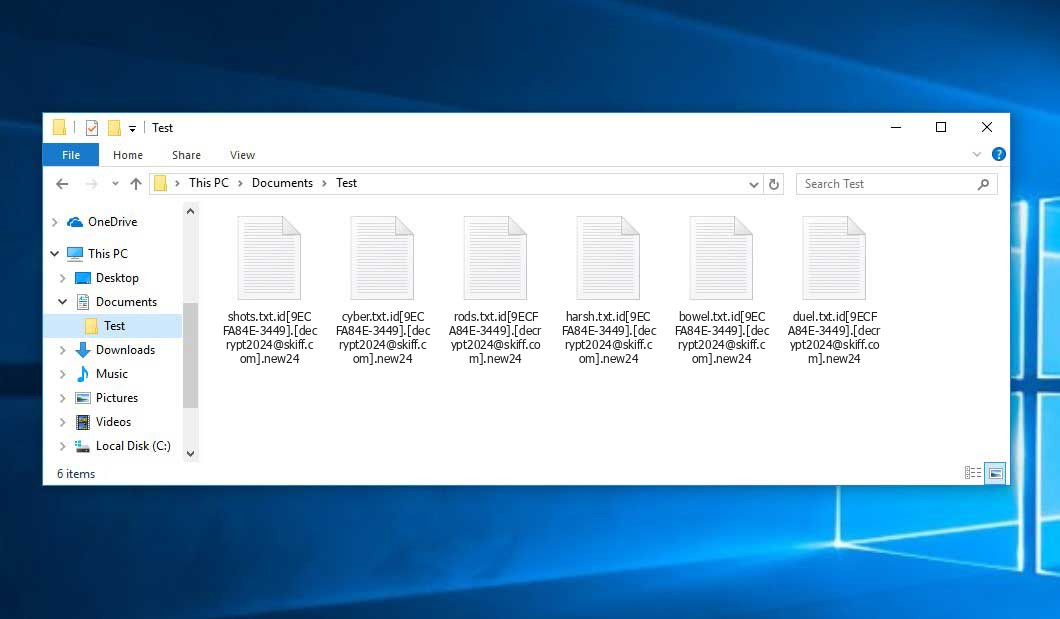
An example of encrypted .new24 files.
How did my machine catch New24 ransomware?
There are plenty of possible ways of ransomware infiltration.
Nowadays, there are three most exploited methods for hackers to have ransomware planted in your digital environment. These are email spam, Trojan injection and peer-to-peer networks.
- If you access your inbox and see emails that look like familiar notifications from utility services companies, postal agencies like FedEx, Internet providers, and whatnot, but whose mailer is unknown to you, be wary of opening those emails. They are very likely to have a ransomware item enclosed in them. Thus it is even riskier to download any attachments that come with letters like these.
- Another option for ransom hunters is a Trojan virus scheme. A Trojan is a program that infiltrates into your machine pretending to be something different. For instance, you download an installer of some program you need or an update for some program. But what is unboxed turns out to be a harmful program that encodes your data. As the update package can have any title and any icon, you have to make sure that you can trust the source of the things you’re downloading. The optimal thing is to trust the software companies’ official websites.
- As for the peer-to-peer file transfer protocols like BitTorrent or eMule, the threat is that they are even more trust-based than the rest of the Internet. You can never know what you download until you get it. So you’d better be using trustworthy websites. Also, it is a good idea to scan the folder containing the downloaded items with the antivirus as soon as the downloading is complete.
How to remove ransomware?
It is crucial to inform you that besides encrypting your data, the New24 virus will most likely deploy Vidar Stealer on your machine to seize your credentials to various accounts (including cryptocurrency wallets). That program can derive your credentials from your browser’s auto-filling data.
How сan I avoid ransomware infection?
New24 ransomware doesn’t have a superpower, so as any similar malware.
You can protect your computer from ransomware attack taking three easy steps:
- Never open any emails from unknown mailboxes with strange addresses, or with content that has nothing to do with something you are expecting (can you win in a lottery without even taking part in it?). If the email subject is more or less something you are waiting for, check all elements of the suspicious letter carefully. A fake email will always have a mistake.
- Never use cracked or unknown software. Trojan viruses are often distributed as an element of cracked products, most likely as a “patch” which prevents the license check. But untrusted programs are very hard to distinguish from trustworthy ones, as trojans may also have the functionality you seek. You can try to find information on this program on the anti-malware message boards, but the best solution is not to use such programs at all.
Frequently Asked Questions
🤔 Can I somehow access “.new24” files?
Negative. That is why ransomware is so frustrating. Until you decode the “.new24” files you will not be able to access them.
🤔 The encrypted files are very important to me. How can I decrypt them quickly?
Hopefully, you have made a copy of those important files. In case you haven’t, there is still a chance that you do have a Restore Point from some time ago to roll back the whole system to the moment when it had no virus yet, but already had your files. There are other ways to beat ransomware, but they take time.
🤔 What to do if the New24 virus has blocked my PC and I can’t get the activation key.
🤔 And what should I do now?
Many of the encrypted files might still be within your reach
- If you exchanged your important files by email, you could still download them from your online mailbox.
- You might have shared photographs or videos with your friends or relatives. Just ask them to give those pictures back to you.
- If you have initially downloaded any of your files from the Internet, you can try downloading them again.
- Your messengers, social media pages, and cloud drives might have all those files as well.
- It might be that you still have the needed files on your old PC, a laptop, cellphone, external storage, etc.
HINT: You can use file recovery utilities2 to get your lost data back since ransomware encodes the copies of your files, removing the original ones. In the tutorial below, you can see how to recover your files with PhotoRec, but remember: you can do it only after you remove the ransomware itself with an antivirus program.


Leave a Comment