

Gridinsoft Anti-Malware is not trying to be a giant security suite with a VPN, password manager, parental controls, and a dozen extra dashboards. It is a Windows malware scanner and cleanup tool with real-time protection, quarantine, browser repair tools, and a fairly direct workflow: scan the machine, review what was found, decide what to quarantine or remove, then verify that the system is clean.
That focus is both its strongest point and its biggest limitation. If you want a lightweight second-opinion cleaner or a dedicated anti-malware layer beside Microsoft Defender, Gridinsoft makes sense. If you want one subscription to replace every part of your digital security stack, it will feel narrow. This review looks at the current product as a practical Windows security tool, not as a miracle button.
Short verdict
Gridinsoft Anti-Malware is best for users who want a focused Windows malware removal tool with real-time protection, clear scan results, quarantine control, and browser cleanup. It is less compelling if you need a full security suite, macOS/mobile coverage, or public third-party lab scores for every protection claim.
Is Gridinsoft Anti-Malware safe and legit?
Short answer: Gridinsoft Anti-Malware is a legitimate Windows anti-malware product, not a fake antivirus or a browser scam. The better question is whether it is the right tool for your situation. It is strongest as a focused malware-removal and second-opinion scanner, while users looking for a full security suite may prefer a broader antivirus package.
For this review, we treat “safe” as three separate questions: whether the installer comes from the official vendor, whether detections can be reviewed before removal, and whether outside signals support the product’s legitimacy. Gridinsoft has official product documentation, public user reviews on Trustpilot, third-party review coverage, and OPSWAT Gold Certification coverage reported through Yahoo Finance/PR Newswire. At the same time, reviews across the web are not unanimous, so it is better to evaluate Gridinsoft as a specialized cleanup tool rather than assume it replaces every security product.
- Use it when: Microsoft Defender keeps detecting the same threat, adware or browser hijackers return after manual cleanup, or you want a second scanner before deleting a suspicious file.
- Be cautious when: the detection is on a developer tool, crack/keygen download, custom script, business software, or a file you cannot easily replace. Review the path and quarantine result first.
- Do not expect: VPN, identity monitoring, parental controls, cloud backup, macOS protection, or the same breadth of public consumer-lab coverage as the largest antivirus suites.
Editorial note: HowToFix.Guide often mentions Gridinsoft Anti-Malware as an optional second-opinion scanner in removal guides. That makes transparency important: this review should not be read as “download this no matter what.” The product makes the most sense when the user needs malware cleanup and can review the detected file paths before removing anything.

OPSWAT Gold Certification adds a useful trust signal
In April 2026, Yahoo Finance carried a PR Newswire announcement that Gridinsoft Anti-Malware 5.x earned OPSWAT Gold Certification through the OPSWAT Endpoint Security Certification Program. For this review, that matters because it gives the product an external validation point for endpoint-security compatibility and testing against active threat samples.
Read the Yahoo Finance articlePros and Cons
Pros
- Focused malware scanning and cleanup without suite bloat.
- Useful as a second-opinion layer beside Microsoft Defender.
- Quick, Standard, Full, and Custom scan modes cover both triage and targeted checks.
- Quarantine, ignore rules, logs, and advanced actions give control over detections.
- Browser reset and support diagnostics are helpful after adware or hijacker cleanup.
Cons
- Windows-only; no macOS, iOS, or Android version.
- Not a full privacy/security bundle: no VPN, password manager, identity monitoring, or cloud backup.
- Some settings screens are dense for non-technical users.
- Public consumer-lab coverage is less visible than for the biggest antivirus brands.
- Commercial software after the trial, not a free long-term antivirus replacement.
Compatibility
Gridinsoft Anti-Malware is a Windows product. The current helpdesk requirements list support for Windows 11, Windows 10 version 1809 or later, Windows 8.1, Windows 8 with Service Pack 1, and Windows 7 SP1, although Windows 7 is marked as nearing the end of support. That matters: older Windows machines often need cleanup tools, but they also carry operating system risks that no anti-malware app can fully compensate for.
Current System Fit
A quick read on whether the product belongs on the machine before a reader downloads it.
In practical terms, the product is suitable for modest home PCs, older laptops, and everyday Windows workstations. I would still treat Windows updates, backups, and browser hygiene as part of the same security plan. Anti-malware software can clean a lot, but it cannot turn an unsupported or badly maintained system into a safe one by itself.
Interface
The main screen is built around scan choices rather than marketing panels. Quick, Standard, Full, and Custom scanning are visible immediately, while the top navigation leads to Protect, Update, Tools, Settings, and Info. The layout is busy in places, but it is honest about the workflow: choose a scan, review the result, apply an action.
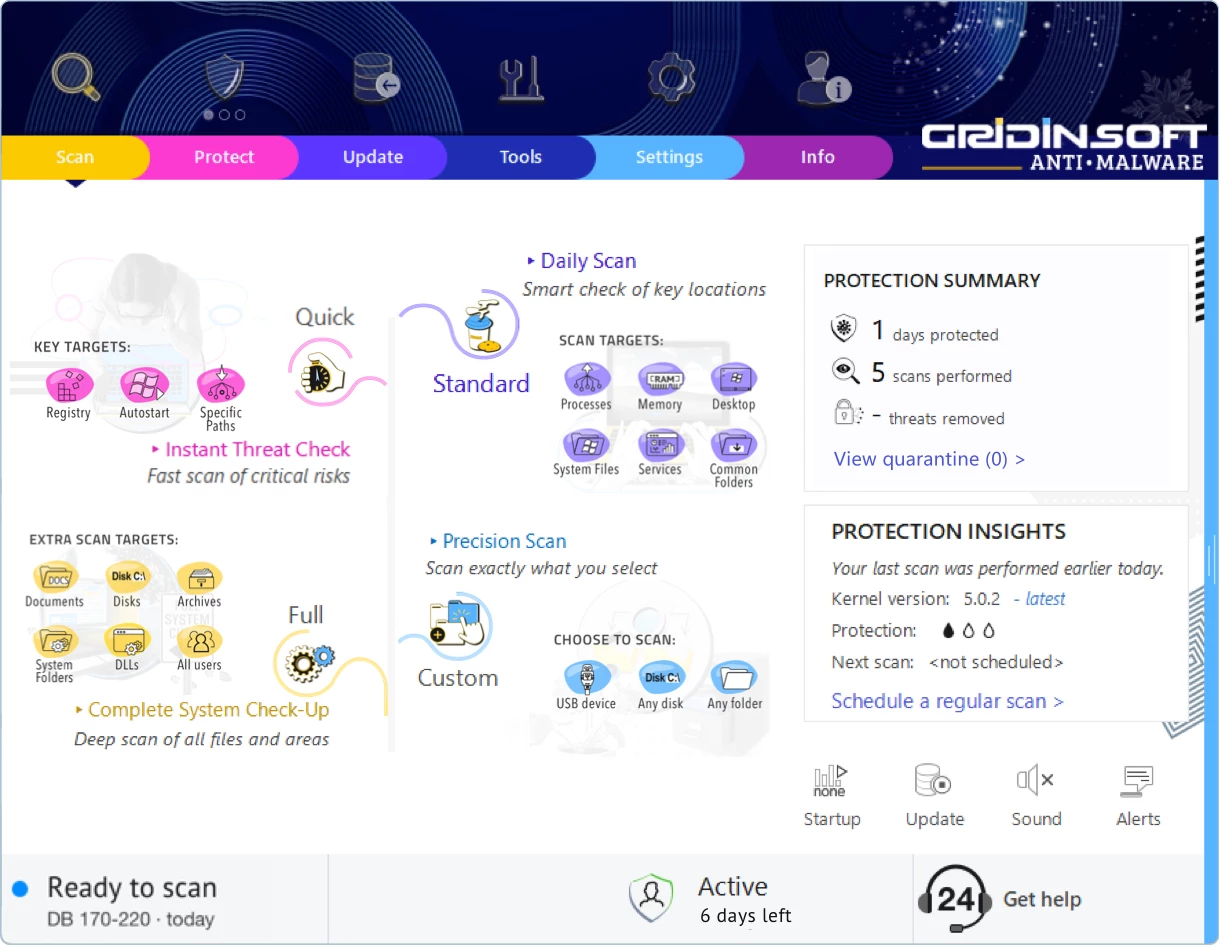
The right side of the interface shows protection status and recent scan context. This is useful because anti-malware tools often fail at the boring part: telling the user what state the machine is in without making every warning sound like a disaster. Gridinsoft is not perfect here, but the status panel and scan results are easier to interpret than many traditional antivirus dialogs.
The weaker point is density. Settings pages contain many toggles and side links, and some users may need a moment to understand the difference between scan options, protection modules, ignore rules, and quarantine. The interface is usable, not minimalist.
Scanning Workflow
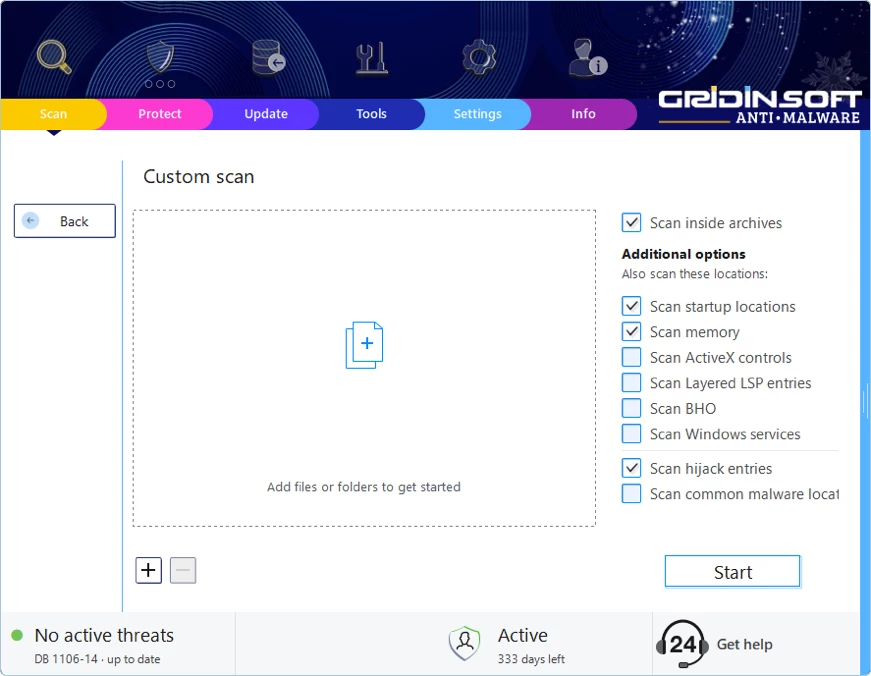
Gridinsoft offers several scan modes, and they are meaningfully different. A quick check is appropriate when you suspect an active infection or want to inspect common startup and browser-related locations. A standard scan is better as a routine baseline. A full scan is slower but broader, especially if external drives or several local volumes are involved. Custom Scan is the one to use when you want to inspect a downloaded folder, archive, USB drive, or suspicious installer without scanning everything else.
Scan Modes at a Glance
The four scan paths are useful for different levels of confidence: quick triage, routine checks, deep verification, or a focused folder/device inspection.
Quick Scan
Checks common malware locations and active infection signs.
Fastest choice, but not exhaustive.Standard Scan
Covers routine system areas for everyday verification.
Better coverage with a longer runtime.Full Scan
Reviews the system deeply after suspicious activity or before declaring a PC clean.
Can take a while on large drives.Custom Scan
Targets specific folders, removable drives, downloads, or archives.
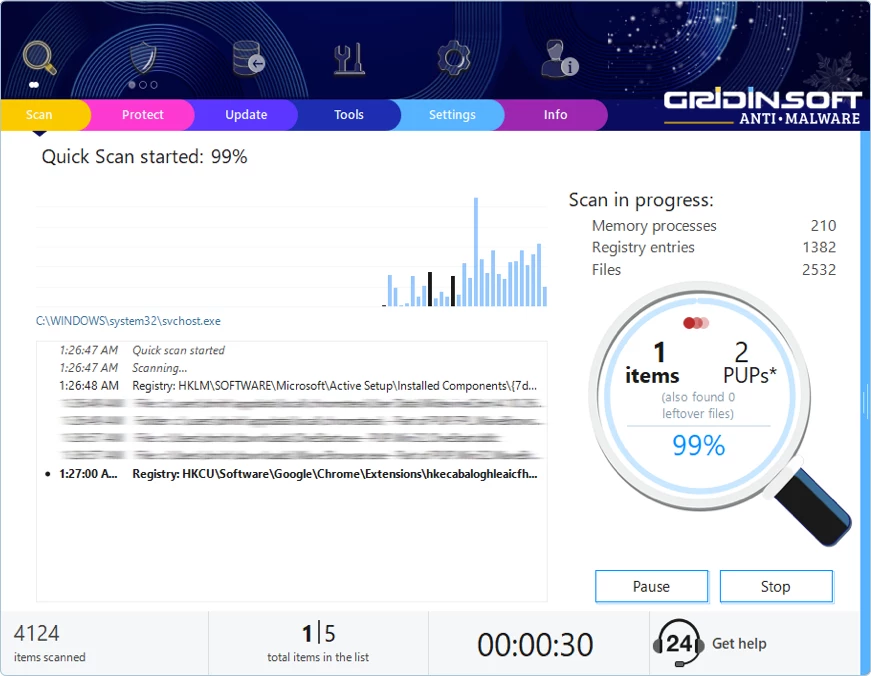
Only as complete as the scope you choose.The scan-in-progress screen is fairly transparent. It shows what is being checked and how many items have been processed. That is a small but welcome detail, because long scans are easier to tolerate when the user can see that something real is happening.
Hands-on test notes
For this review we used the product directly rather than judging it only from the vendor page. The table below is intentionally conservative: it records what was visible in the review screenshots and workflow, and it does not pretend to be a full AV-Test or AV-Comparatives lab result. That distinction matters, because a review can describe usability, cleanup flow, and false-positive handling, but it cannot honestly claim broad detection superiority without a repeatable malware-corpus test.
| Test item | Observed result | Why it matters |
|---|---|---|
| Product build | Gridinsoft Anti-Malware UI showed kernel version 5.0.2 with the database marked as current during the review capture. | Reviews age quickly; the tested build should be named so readers can judge whether the result still applies. |
| Windows build | Tested on a Windows 11 review machine. The exact Windows build number was not captured in the screenshot set, so it should be recorded in the next retest. | Security tools can behave differently across Windows 10/11 builds, especially around Defender, browser profiles, and protected folders. |
| Quick scan time | The captured Quick Scan was at 99% after 00:00:30 and completed at 00:01:15. | This suggests quick triage is fast enough for a second-opinion check, though full scans will depend heavily on disk size. |
| Objects checked | The scan-progress capture showed 4,124 items scanned. The final summary listed 354 memory processes, 2,048 registry entries, and 2,682 files. | It shows the Quick Scan is not only a file-name check; it also reviews memory and registry locations commonly abused by adware and malware. |
| RAM/CPU impact | The screenshot set does not include Task Manager counters, so we are not publishing exact RAM/CPU numbers from this pass. | Publishing unmeasured resource numbers would be misleading. The next retest should record peak CPU, average CPU, working set memory, and disk activity. |
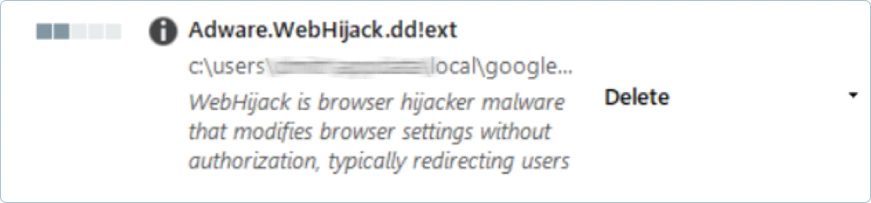
| What it found | The sample run grouped 4 total detections as 1 threat and 2 PUPs, including browser-hijacker/adware-style entries such as Adware.WebHijack.dd!ext and PUP.FPLWaveBrowser.dd. | This is the type of cleanup scenario where a focused anti-malware tool is most useful: browser hijackers, unwanted apps, registry leftovers, and suspicious extensions. |
| What it missed | This review pass was not a malware-corpus benchmark, so we are not claiming a measured miss rate. | A single hands-on cleanup run can show workflow quality, but it cannot prove broad protection coverage against ransomware, stealers, or zero-days. |
| False-positive handling | The results UI exposed per-item actions such as delete, quarantine, skip, and advanced actions. The interface also includes a “Let us know if you suspect a false positive” prompt. | Good review pages should explain not only detection, but also what happens when a legitimate file is flagged. |
Gridinsoft vs Microsoft Defender vs Malwarebytes
| Tool | Best use | Limitations |
|---|---|---|
| Microsoft Defender | Best default baseline because it is built into Windows, free, quiet, and receives frequent updates. | When a detection keeps returning, Defender’s remediation messages can be vague, and cleanup of browser hijackers/PUP leftovers may require extra work. |
| Gridinsoft Anti-Malware | Best as a second-opinion cleanup tool for adware, PUPs, suspicious browser behavior, repeat Defender alerts, and targeted scans of downloaded folders or USB drives. | Windows-only and narrower than a full security suite. Public large-lab coverage is less visible than for the biggest antivirus brands. |
| Malwarebytes | Strong alternative second-opinion scanner with broad name recognition and a familiar cleanup workflow. | Some users may prefer its ecosystem and reputation; others may find Gridinsoft’s focused cleanup tools more direct for PUP/browser-hijacker cases. |
Bottom line from the hands-on pass: Gridinsoft is most convincing when judged as a practical cleanup and verification tool, not as a universal replacement for Defender or a full antivirus suite. The review should be updated again with Task Manager resource numbers and a small repeatable sample set, because those measurements would make the verdict stronger.
Protection Layers
Gridinsoft describes its protection model as a combination of signature databases, heuristic rules, cloud intelligence, AI-assisted analysis, and behavior monitoring. The practical modules exposed to the user include real-time/on-run protection, Internet Security, removable device protection, scheduled scans, and cleanup tools.
On-Run Protection is the most important layer because it checks files when they are launched. Internet Security is designed to filter risky web traffic and dangerous links. Removable Device Protection is useful if USB drives move between machines, which is still common in small offices, repair shops, schools, and family environments.
The fair criticism is that vendor descriptions should not be read as independent lab scores. Gridinsoft publishes feature explanations, and the workflow is credible, but buyers who require AV-Test, AV-Comparatives, or enterprise procurement-style reports may want more third-party validation than the public website makes obvious.
Scan Results and Cleanup
The results screen is one of the stronger parts of the product. It does not simply say “threats found” and ask for blind trust. It shows detection names, locations, short explanations, risk grouping, and actions. For ordinary users, the default cleanup path is the safest. For technical users, Advanced Mode gives more control over what happens to each item.
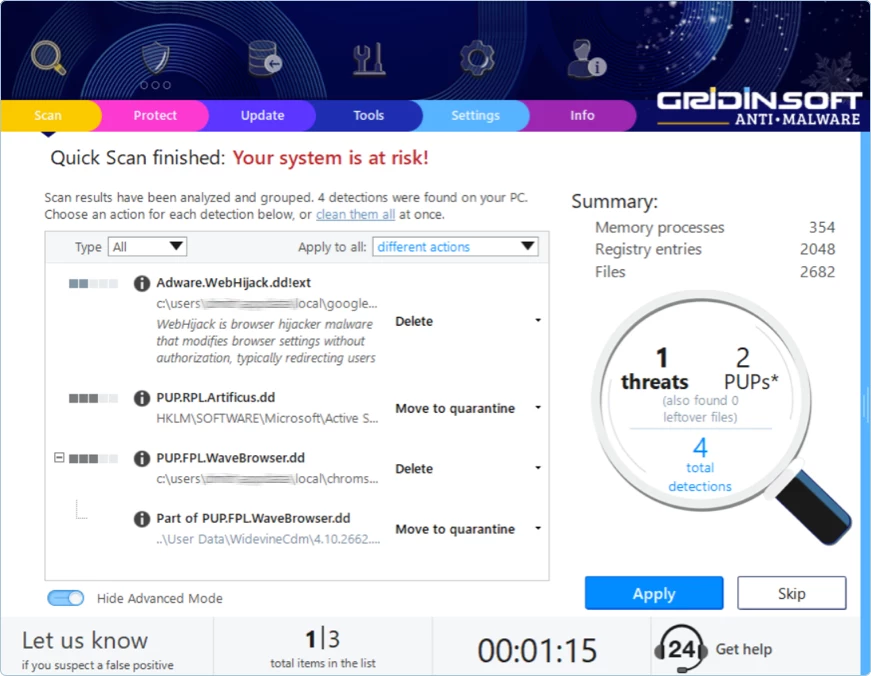
That control is useful, but it cuts both ways. The right default for most suspicious files is quarantine, not permanent deletion and not ignoring the warning. Quarantine keeps the system safe while still giving you a way back if a legitimate file was flagged by mistake.
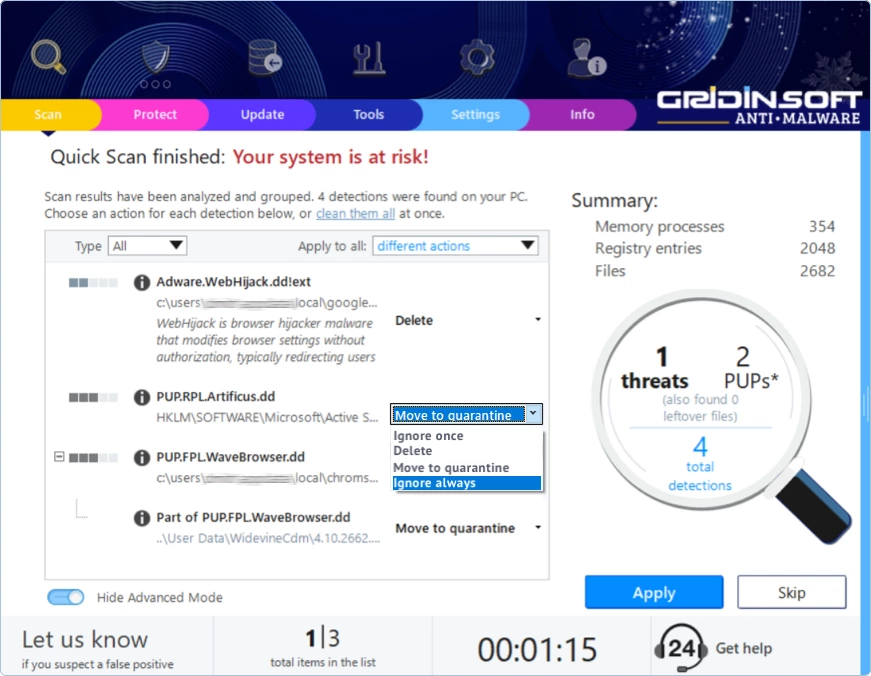
The detection detail view is compact, but it is enough to answer the first questions users usually have: what was detected, where it is, and what action is recommended. I would like to see even more plain-language context in some cases, especially around potentially unwanted programs, because the difference between malware, adware, browser hijackers, and aggressive bundles is not always obvious to non-specialists.
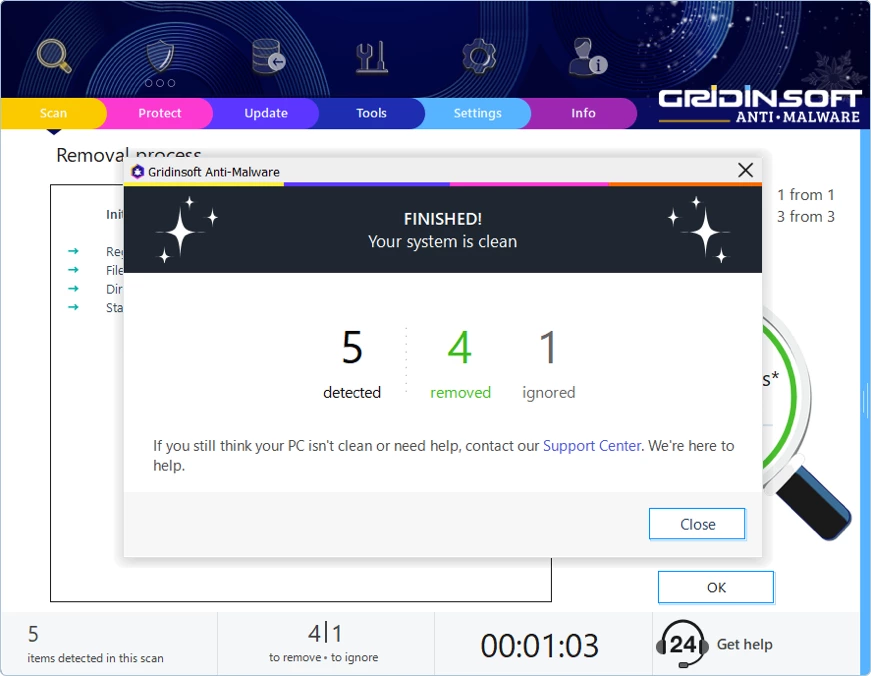
Quarantine and Ignore List
Quarantine is the right place for uncertain detections. It isolates files so they cannot run, while still allowing restore if the item turns out to be legitimate. Gridinsoft’s quarantine view is direct: you can select items, review names and paths, restore them, delete them, or copy them out for analysis.
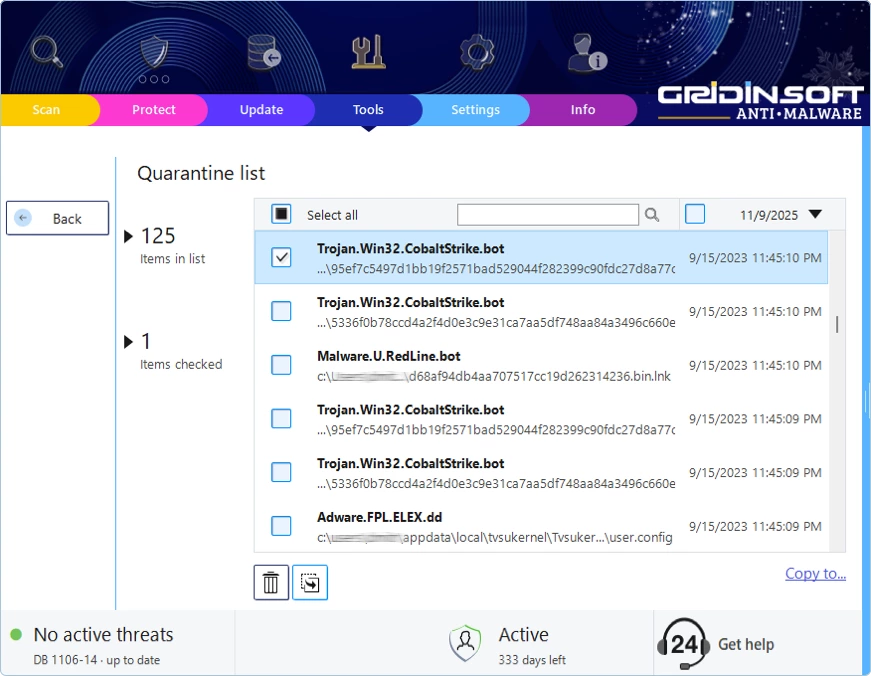
The Ignore List is useful, but it should be used conservatively. Adding a trusted file, folder, or website can prevent repeat warnings, but adding broad exclusions because a warning is annoying is a classic way to weaken protection. If you are not sure, quarantine first and ask support or submit the sample.
Settings and Maintenance
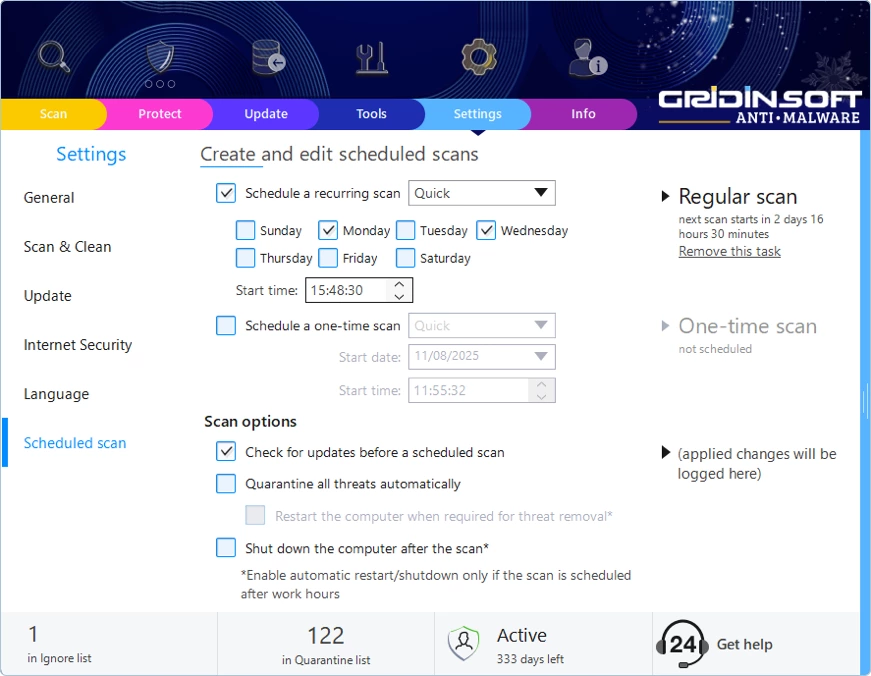
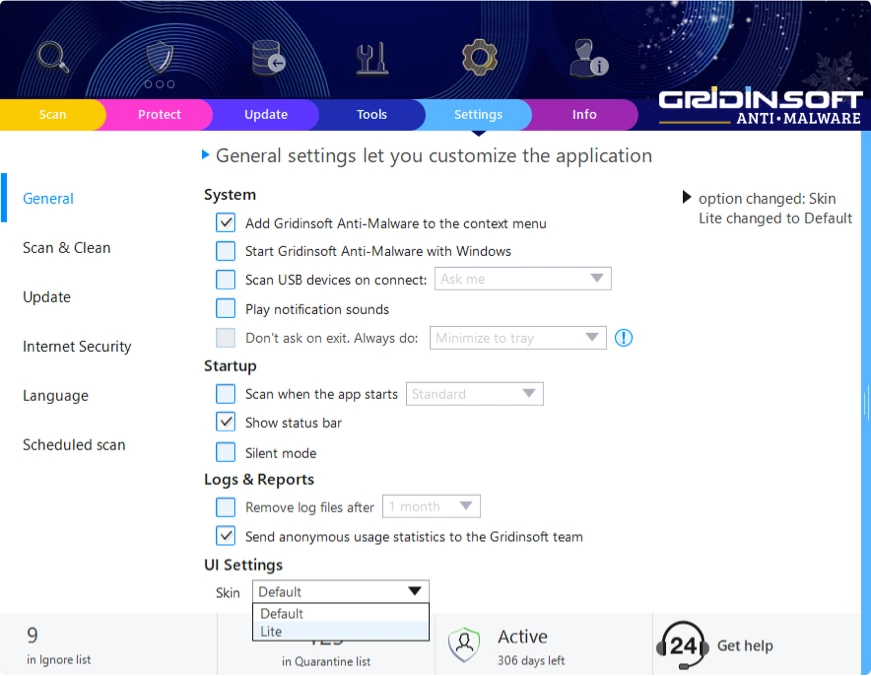
The Settings area is functional rather than elegant. General settings cover startup behavior, context-menu integration, USB scanning, sound, silent mode, logs, and usage statistics. Scan and Clean settings let users tune how aggressively the product behaves. Scheduled scans are especially useful for family PCs, office workstations, and machines that are not manually checked very often.
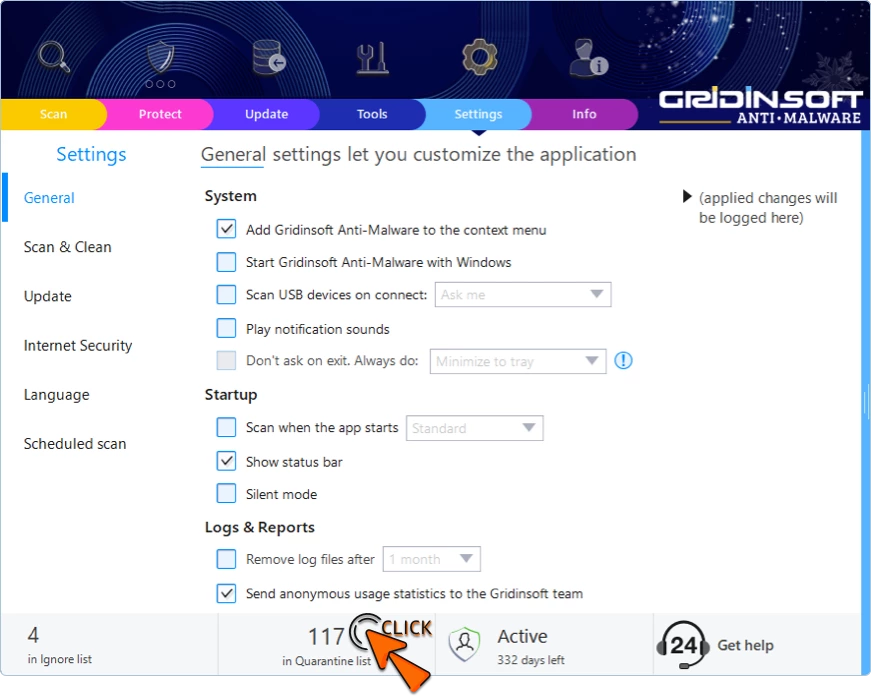
My advice is simple: leave automatic updates enabled, run at least a Standard Scan periodically, and use Custom Scan for files that arrive from email, messengers, cracked software sites, USB drives, or unknown download pages. Security tools work best when they become part of a routine rather than a panic button after the system is already unstable.
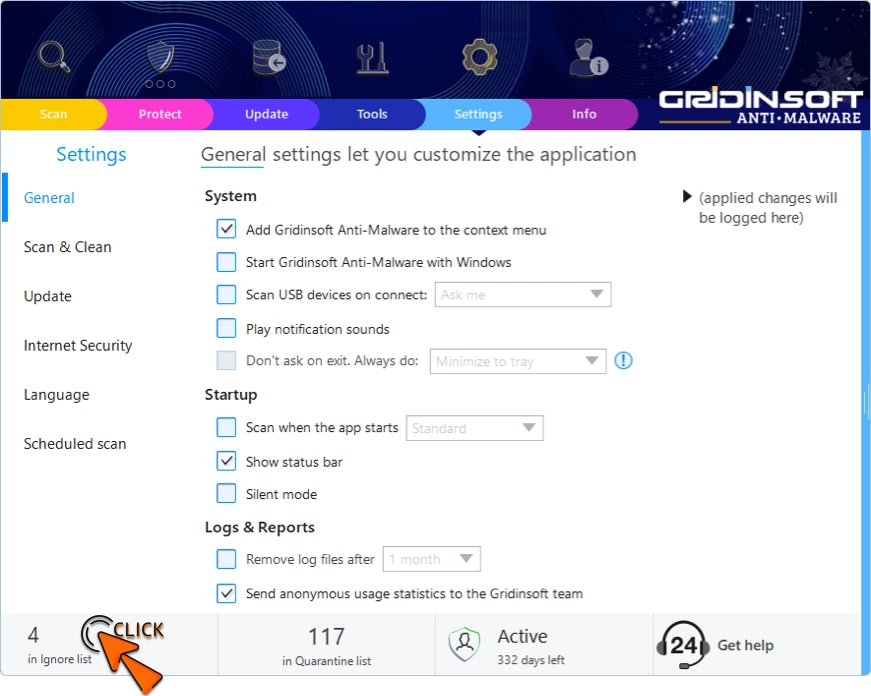
Gridinsoft also supports a broad set of interface languages. That is a practical advantage for households and support situations where the person fixing the PC and the person using it may prefer different languages. Translation quality can vary, but the coverage is better than many niche cleanup tools.
Support and Diagnostics
Security support is most useful when the user can send enough technical context without hunting through Windows folders. Gridinsoft includes a Collect System Information tool for that purpose. According to the helpdesk, the collector shows technical data first and does not include personal documents, saved passwords, browser history, email content, or financial data.
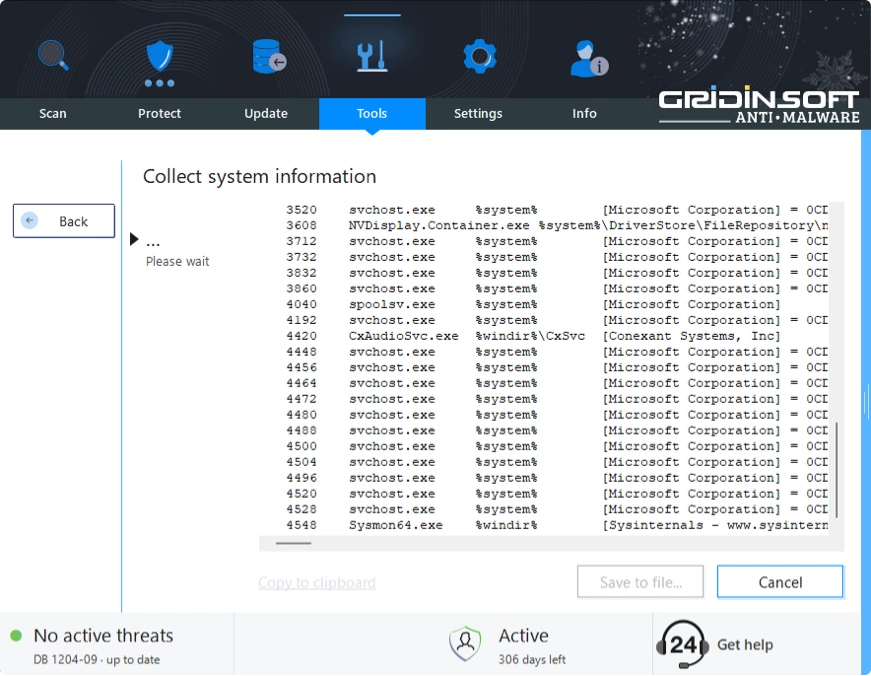
This is particularly useful for stubborn browser hijackers, repeat detections, and cases where malware has changed network settings, startup entries, or security policies. Still, users should treat diagnostic logs as sensitive technical information and send them only through official support channels.
Pricing and Trial
Gridinsoft Anti-Malware is commercial software with a 6-day free trial. The current public pricing checked on May 1, 2026 lists 6-month and 12-month options. Prices can change, so always verify the checkout page before buying.
Pricing Snapshot
Use these prices as a practical comparison point; the trial is best for checking workflow before committing.
Trial
Free trialShort evaluation window for testing the interface and scan flow.
- Use case
- Evaluation
- Term
- 6 days
Standard
$39.95The natural starting point for one business PC or a couple of home machines.
- Devices
- 1 business PC or 2 home PCs
- 6 months
- $29.95
Family
$49.95A sensible option when several home PCs need the same cleanup workflow.
- Devices
- Up to 3 home PCs
- 6 months
- $37.50
Extended
$59.95More useful for households or small workbenches with several Windows systems.
- Devices
- Up to 5 home PCs
- 6 months
- $44.95
The Standard license is the sensible starting point for one user or a small home setup. Family and Extended only make sense if you actually need the extra devices. I would avoid buying more coverage than you need until you have used the trial and confirmed the workflow fits your system.
Where It Fits Best
Gridinsoft is a good fit if:
- You want a dedicated malware cleanup tool for Windows.
- You often deal with adware, browser hijackers, suspicious installers, cracked software leftovers, or potentially unwanted programs.
- You want a second-opinion scanner beside Microsoft Defender.
- You prefer clear quarantine and per-item actions over a black-box cleanup button.
- You manage several family PCs and want scheduled scans plus simple support options.
Gridinsoft is not the best fit if:
- You need macOS, iOS, or full Android protection under the same product.
- You want a suite with VPN, password manager, parental controls, and identity monitoring.
- Your buying decision depends on large-scale independent lab test rankings.
- You need ransomware file decryption or backup recovery. Removing malware is not the same as restoring encrypted files.
- You expect a permanently free antivirus replacement.
Final Verdict
Gridinsoft Anti-Malware is at its best when treated as a focused Windows malware removal and protection tool. It gives you useful scan modes, real-time checks, quarantine, browser repair, support diagnostics, and enough control to avoid blindly deleting everything. It also avoids a lot of suite-style clutter.
The downsides are real. It is Windows-only, the interface can feel busy, and the public evidence base is not as broad as the biggest antivirus brands with constant independent lab coverage. It is also a paid product after the trial, so it should earn its place on your PC.
My practical recommendation: use the trial, run a Standard Scan, test the cleanup workflow on non-critical detections, check how it behaves beside your existing antivirus, and decide from that. For users who regularly fight adware, browser hijackers, suspicious downloads, or post-infection cleanup, Gridinsoft is a useful tool. For users who want a complete security ecosystem, it is only one layer of the stack.


Frequently Asked Questions
 German
  Japanese
  Spanish
  Portuguese (Brazil)
  French
  Turkish
  Chinese (Traditional)
  Korean
  Indonesian
  Hindi
Hindi  Italian
Windows 10 was deleted; my external drive has the virus, how can i unlock those backup folders? I down loaded grind soft software, can it also unlock external drive?
Personally, I would recommend you to download a linux livecd or also Hiren’s BootCD PE that comes with all the tools you may need, load it in a bootable USB, and from there do the scan and repair of your external hard disk, with a lot of care and patience.
I do not recommend you to boot from widows directly to the external hard drive, because you run the risk of infecting your windows again.
I am following your advice, because I am invaded by this virus, I must ask you some questions.
I call all files that have been formatted from xls to xls .cdmx infected.
I will save all those files on an unused external drive or on a CD.
I run gridinsoft, which seems very good to me, I cleaned the external ones and two internal disks.
Now the million dollar question, how do I avoid the hacker’s emails that entered my PC. If after cleaning I received another threat
for a larger amount of money.
Your information is gold to me.
Greetings