
The Wwpl virus, also known as a ransomware infection, is part of the STOP family. This malware family is known for malicious file ciphering. When the Wwpl virus infects a system, it targets various types of files, like documents, videos, photos, and more. It changes the file structure and adds the “.wwpl” extension to each file, making them inaccessible and unusable without the decryption key.
Wwpl Virus Overview
Wwpl
🤔 Wwpl virus belongs to ransomware that belongs to the DJVU/STOP family. Its primary purpose is to cipher files that are important to you. After that this ransomware asks for a ransom payment – ($490 – $980) in Bitcoin.
The Wwpl virus is a malicious program that encrypts your files and forces you to pay for their restoration. This ransomware encrypts various file types. Encrypted files can be identified by a distinct “.wwpl” extension. The files touched by ransomware become inaccessible and unusable.
Then, the ransomware asks for a ransom payment in Bitcoin from the victims, ranging from $490 to $980. Usually, a text file with ransom payment guidances is named “_readme.txt“.
Wwpl Ransomware operates by Salsa20 encryption algorithms to cipher the files. Since the Wwpl virus utilizes such a robust ciphering method, it becomes particularly difficult, if even possible, to pick the decryption key without the assistance of the attackers.
Once Wwpl malware finishes the encryption, it shows a ransom note to the user, demanding a ransom payment for the decryption key. The ransom note contains instructions on how to pay off the bill and often includes threats of system wipeout or increased ransom amounts if the ransom is not paid within a specified timeframe.
I have created a comprehensive list of the solutions, advice, and practices to disable the Wwpl virus and decrypt and recover your files. There are cases where it may be possible to restore your files, while sometimes, it may be impossible.
📌 Important Reminder!
It is crucial to say that paying off the bill is not a guarantee of the successful files recovery. The scoundrels who stand behind the Wwpl virus are not trustworthy. There have been instances where victims have paid the ransom, only to be denied by the cyber criminals with the decryption key provision.
Wwpl employs a unique key for each victim, with one exception:
The Wwpl virus bears resemblance to other DJVU ransomware samples such as MZRE, MZHI, MZQT, and MZOP. This virus encrypts a wide range of common file types and appends its distinct “.wwpl” extension to all files. For instance, a file named “1.jpg” would be altered to “1.jpg.wwpl” and “2.png” to “2.png.wwpl“.
Upon successful encryption, the virus creates a special text file named “_readme.txt” and places it in every folder containing the encrypted files. It as well adds this file to the desktop, so the user will not miss its appearance even without opening folders.
The image below provides a visual representation of files with the “wwpl” extension:
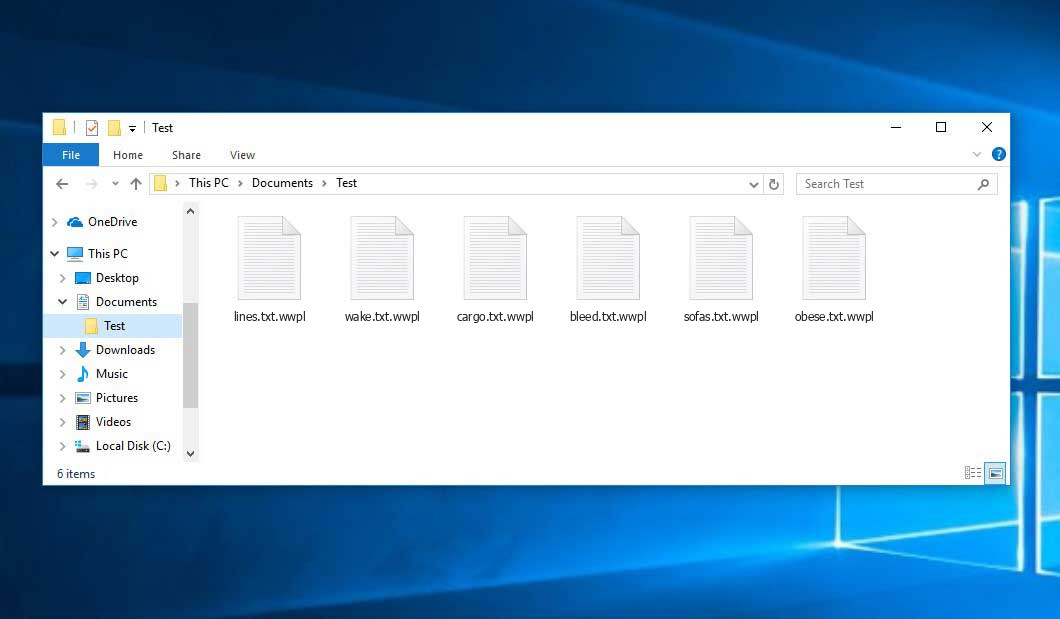
Encrypted Files by STOP/DJVU Ransomware
| Name | Wwpl Virus |
| Ransomware family1 | DJVU/STOP2 ransomware |
| Extension | .wwpl |
| Ransomware note | _readme.txt |
| Ransom | From $490 to $980 (in Bitcoins) |
| Contact | [email protected], [email protected] |
| Detection | Win32/TrojanDownloader.Tovkater.IB, P2P-Worm.Win32.Convagent, Ransom:Win32/StopCrypt.LAT!MTB |
| Symptoms |
|
| Fix Tool |
To remove possible malware infections, scan your PC:
6-day free trial available. |
This message is asking for payment to restore files via a decryption key:
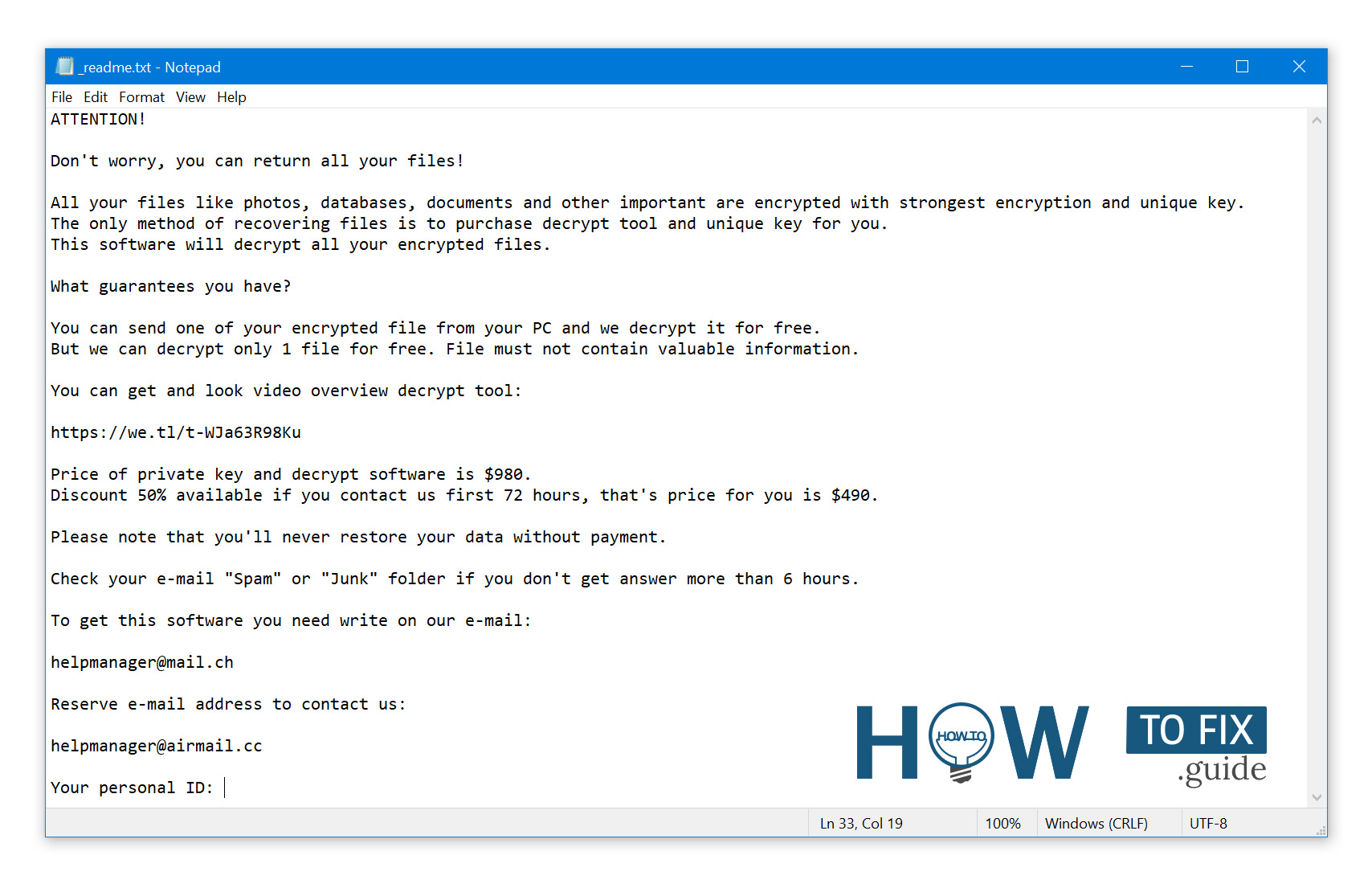
_readme.txt (STOP/DJVU Ransomware) – The terrifying alert demands users to pay the ransom to unlock the encrypted data and contains these exasperating cautions.
Wwpl ransomware executes a set of actions that intend to perform various tasks on a victim’s computer. One of the first processes it launches is winupdate.exe, a deceptive process that displays a fake Windows update alert during the attack. This trick helps to convince the victim that their PC has become slow because of a Windows update.
Simultaneously, the ransomware initiates another process (usually named by four random characters) that starts scanning the system for target files and encrypting them. Then, the ransomware deletes Volume Shadow Copies from the system using the following CMD command:
vssadmin.exe Delete Shadows /All /Quiet
Once removed, it becomes impossible to recover the previous computer state using System Restore Points. The issue is that ransomware operators are eliminating any built-in Windows techniques that could assist the victim in recovering files for free. In addition, the crooks modify the Windows HOSTS file by appending a list of domains to it and redirecting them to the localhost IP. As a result, the victim will witness a DNS_PROBE_FINISHED_NXDOMAIN error when trying to access one of the listed websites.
We have noticed that the ransomware attempts to block websites that publish various how-to guides for computer users. It is obvious that by limiting specific domains, the perpetrators are trying to stop the victim from reaching relevant and helpful ransomware-attack-related information online. This malware also stores two .txt files on the victim’s computer that provide details related to the attack – the victim’s public encryption key and personal ID. These two files are named bowsakkdestx.txt and PersonalID.txt.
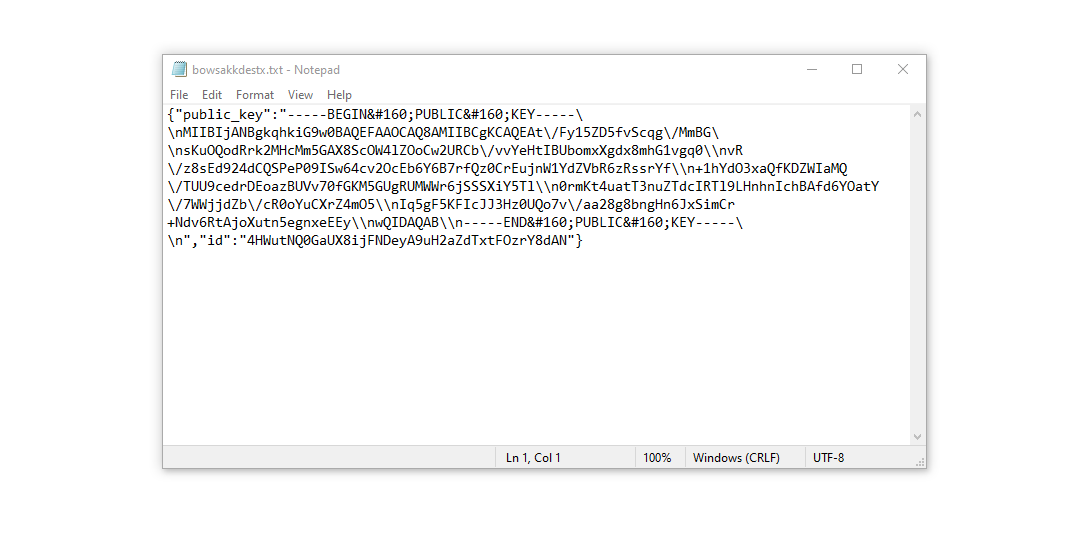
After all these modifications, the malware doesn’t stop. Variants of STOP/DJVU tend to install Vidar password-stealing Trojan on compromised systems. This threat has an extensive list of capabilities, including:
- Manipulating and viewing files on the victim’s computer without their knowledge.
- Extracting sensitive information such as browser cookies, saved passwords, and browsing history.
- Obtaining unauthorized access to login credentials of Steam, Telegram, and Skype.
- Granting the hackers remote control over the victim’s computer for various malicious activities.
- Stealing cryptocurrency wallets from the victim’s system.
- Gathering sensitive data by running malicious software on the victim’s computer.
The cryptography algorithm in STOP/Djvu ransomware is AES-256. So, once your data is encrypted with an online decryption key, the chances to get your files back are quite low. Thing is, online key is unique for each victim, and finding a suitable one will take exceptionally big amount of time.
Obtaining the online decryption key in any other way is also merely impossible. It is stored on a command server controlled by the crooks who promote the Wwpl infection. For receiving unlocking key the payment should be $980. To obtain the payment details, the victims should contact the hackers by email ([email protected]).
The message by the ransomware states the following information:
ATTENTION!

Don't worry, you can return all your files!

All your files like photos, databases, documents and other important are encrypted with strongest encryption and unique key.
The only method of recovering files is to purchase decrypt tool and unique key for you.
This software will decrypt all your encrypted files.

What guarantees you have?

You can send one of your encrypted file from your PC and we decrypt it for free.
But we can decrypt only 1 file for free. File must not contain valuable information.

You can get and look video overview decrypt tool:

https://we.tl/t-WJa63R98Ku

Price of private key and decrypt software is $980.
Discount 50% available if you contact us first 72 hours, that's price for you is $490.

Please note that you'll never restore your data without payment.

Check your e-mail "Spam" or "Junk" folder if you don't get answer more than 6 hours.

To get this software you need write on our e-mail:

[email protected]

Reserve e-mail address to contact us:

[email protected]

Your personal ID:
XXXXXXXXXXXXXXXXXXXXXXXXXXXXXXX
Do not pay the ransom!
Please, try to use the available backups, or Decrypter tool
_readme.txt file also indicates that the computer owners should contact the hackers within 72 hours starting from the moment of files were encrypted. If user contacts hackers within 72 hours, hackers grant a 50% off. This decreases the ransom sum down to $490.
Yet, stay away from paying off the ransom! I highly recommend that you do not contact these swindlers and do not pay. A highly effective solution to recover the lost data is just using the available backups, or using Decrypter tool from Emsisoft.
The distinctiveness of all such viruses is the employment a similar set of actions for decryption key generation. Thus, unless the ransomware is still in development or has some hard-to-track encryption, manually recovering the ciphered data is a thing you can’t perform. The only solution to prevent the data loss is to regularly make backups of your important files.
Note that even if you do preserve such backups regularly, they must be located into a specific location without loitering, not being connected to your main workstation. For instance, the backup may be kept on the USB flash drive or some alternative external hard drive storage. Optionally, you may turn to the help of online (cloud) information storage.
Unnecessary to mention, when you keep your backup data on your common device, it may be ciphered together with other data. For this reason, placing the backup on your disk is surely not a wise idea.
How I was infected?
Ransomware has a various methods to built into your system. But it doesn’t really matter what way had place in your case.
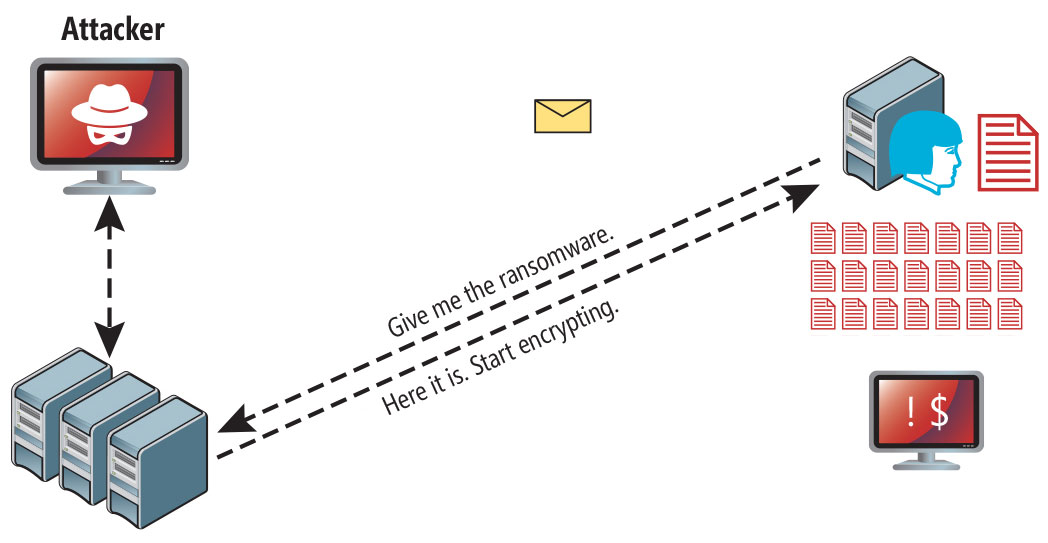
Ransomware attack following a successful phishing attempt.
However, cybercriminals commonly inject it into your PC through these means:
- They use online free hosting resources to distribute the virus undetected.
- They disguise the virus installer alongside various apps, especially those offered as freeware or shareware.
- They spread the virus through spam emails containing deceptive links that lead to its installation.
- They distribute pirated software through illegal peer-to-peer (P2P) resources, exposing users to potential malware threats.
Instances have been reported where the Wwpl virus masquerades as legitimate tools, such as messages requesting the installation of a browser update or a critical codec for online media playback. This is how some online fraudsters attempt to trick you into manually deploying the ransomware.
Indeed, the fake update alert won’t explicitly mention that you’re about to install the virus. Instead, it conceals this installation under an alert claiming the need for an urgent security update or some suspicious program.
Of course, using software cracks also poses risks. Engaging in illegal P2P sharing can introduce severe malware, including the Wwpl ransomware.
In summary, what can you do to prevent the ransomware from infiltrating your computer? While there’s no 100% guarantee, here are some tips to shield against Wwpl penetration:
1. Be cautious when installing free software.
2. Always read what the installation window offers, in addition to the main free program.
3. Avoid opening questionable email attachments.
4. Do not open files from unknown senders.
5. Keep your security program up to date.
The malware doesn’t openly reveal itself. It won’t appear in your list of available programs. Instead, it hides as a malicious process running in the background, starting when you boot up your computer.
How To Remove Ransomware?
Video Guide
How To Decrypt .wwpl Files?
How to restore big files?
Try removing .wwpl extension on a few big files and opening them. This malware has issues with large files encryption. Either the virus read and did not encode the file, or it failed and did not add the filemarker. If your files are very large (2GB+), such a situation is highly probable. Please, let me know in comments if that will work for you.
The newest extensions released around the end of August 2019 after the criminals made changes. This includes Wwty, Wwza, Oohu etc.
As a outcome of the modifications made by the criminals, STOPDecrypter is no longer backed. It has been replaced with the Emsisoft Decryptor for STOP Djvu Ransomware developed by Emsisoft.
You can download free decryption tool here: Decryptor for STOP Djvu.
-
Select folders for decryption.
Based on the default configurations, the decryptor will by default choose the accessible directories in order to unlock the currently reachable drives (the connected ones), including the network drives. You can choose additional locations with the “Add” button.
Decryptors generally offer several options depending on the specific malware family. The existing possible options are shown in the Options tab and can be enabled or disabled there. You may discover a comprehensive list of the currently active Options below.
-
Click on the “Decrypt” button.
As soon as you add all the desired locations for decryption into the list, click on the “Decrypt” button in order to initiate the decryption procedure.
Note that the main screen may turn you to a status view, letting you know of the active process and the decryption statistics of your data:
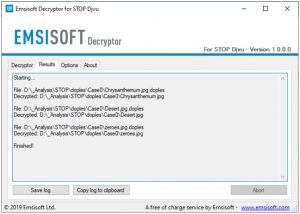
The decryptor will notify you as soon as the decryption procedure is completed. If you need the report for your personal papers, you can save it by choosing the “Save log” button. Note that it is also possible to copy it directly to your clipboard and to paste it into emails or messages here if you need to do so.
The Emsisoft Decryptor might display different messages after a failed attempt to restore your files:
✓ Error: Unable to decrypt file with ID: [your ID]
✓ No key for New Variant online ID: [your ID]
Notice: this ID appears to be an online ID, decryption is impossible
✓ Result: No key for new variant offline ID: [example ID]
This ID appears be an offline ID. Decryption may be possible in the future.
It can take a few weeks or months until the decryption key gets found and uploaded to the decryptor. Please follow updates regarding the decryptable DJVU versions here.
✓ Remote name could not be resolved
How to Restore .wwpl Files?
In some case ransomware is not doom for your files…
The Wwpl ransomware encryption mechanism sequence is next: it ciphers every file byte-by-byte, then saves a file copy, erasing (not overriding!) the initial file. Thus, the information of the file placement on the physical disk is lost, but the original file is not removed from the disk. The cell, or the sector where this file was stored, can still keep this file, but it is not present in the file system and can be overwritten by data that has been loaded to this disk after the removal. Hence, it is possible to retrieve your files using special software.
Anyway, after realizing it was an online algorithm, it is impossible to retrieve my encrypted files. I also had my backup drive plugged in at the time of the virus, and this was also infected, or so I thought. Every folder within my backup drive had been infected and was encrypted. However, despite losing some important files, I retrieved almost 80% of my 2TB storage.
When I started going through the folders, I noticed the readme.txt ransom note in every folder. I opened some of the folders and found that all files that were not in a subfolder within that folder had been encrypted. However, I found a flaw and glimmer of hope when I went into the subfolders in other folders and found that these files had not been encrypted. Every folder within my c and d drives, including subfolders, had been encrypted, but this was not the case with the backup drive. Having subfolders created within a folder has saved 80% of my data.
As I said, I believe this to be only a small loophole on a backup drive. I’ve since found a further 10 % of my data on another hard drive on a different pc. So my advice is if you use a backup drive, create subfolders. I was lucky, I guess. But I was also unlucky that the virus hit as I was transferring some files from my backup.
Hopefully, this can help some other people in my situation.
Jamie NewlandRecovering your files with PhotoRec
PhotoRec is an free open-source program, which is originally created for data recovery from damaged disks, or for file retrieval in case if they are unintentionally deleted. However, with time flow, this program got the ability to retrieve the files of 400 different extensions. Hence, it can be used for file restoration after the Wwpl attack.
First, you need to download this app. It is 100% free, but the developer states that there is no warranty that your files will be restored. PhotoRec is distributed together with other tool of the same developer – TestDisk. The resulting archive will bear TestDisk name, but don’t worry. PhotoRec files are right inside.
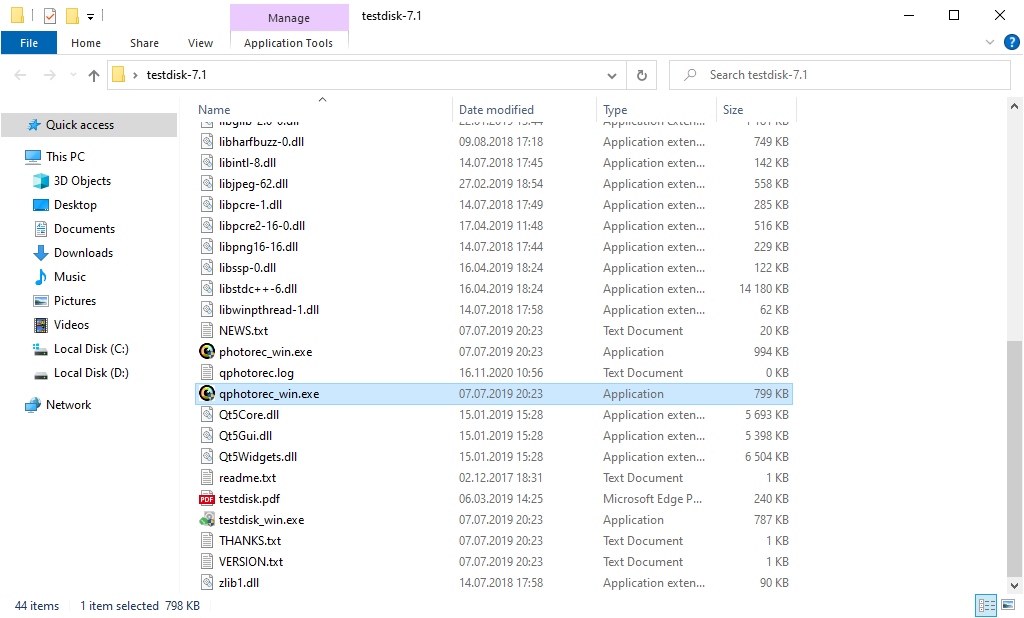
To open PhotoRec, you need to find and open “qphotorec_win.exe” file. No installation is required – the program has all the files it need inside of the archive, hence, you can fit it on your USB drive, and help your friends/parents/anyone who has been attacked by Wwpl ransomware.
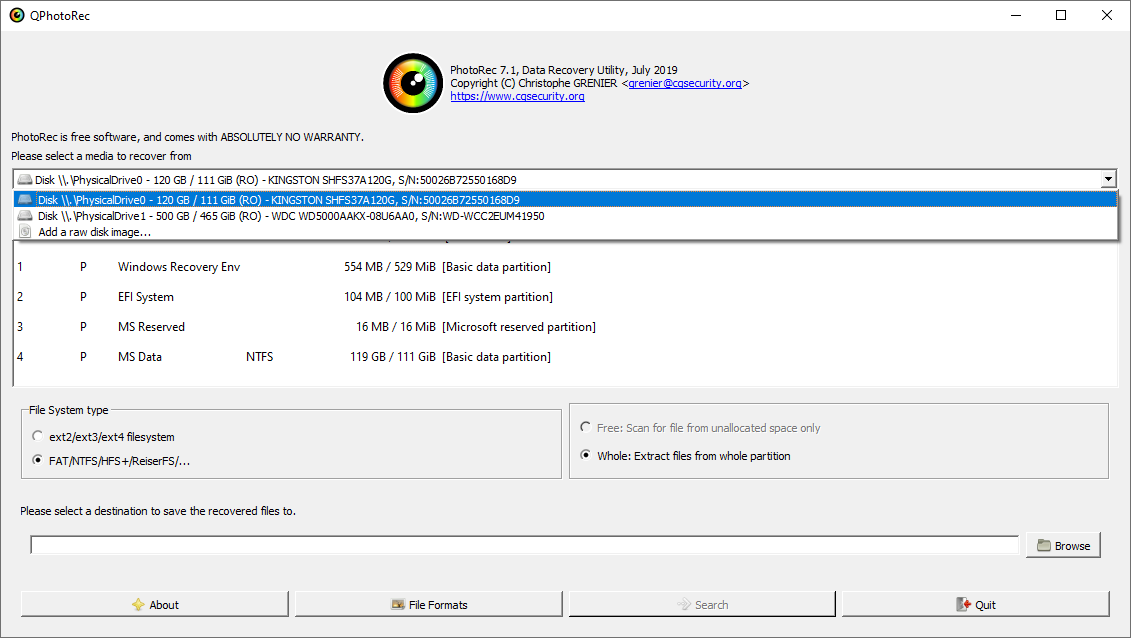
Upon the start, you will encounter the screen showing you the complete list of your disks. However, this information is probably futile, because the required menu is placed a bit higher. Click this menu, then choose the disk which was attacked by ransomware.
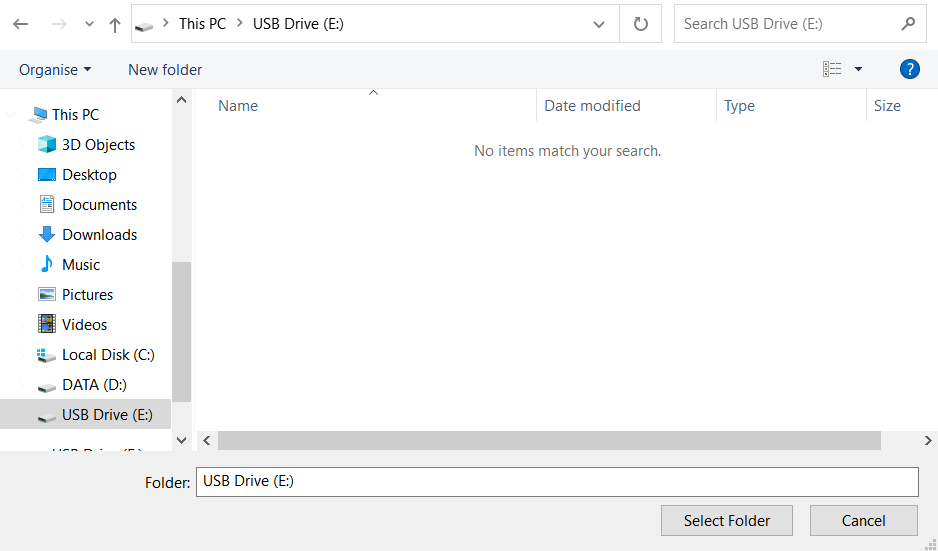
After selecting the disk, you need to pick the destination folder for the recovered files. This menu is located at the lower part of the PhotoRec window. The best choice is to export them on USB drive or any other type of removable disk.
Then, you need to designate the file formats. This choice is located at the bottom, too. As it was mentioned, PhotoRec can retrieve the files of about 400 different formats.
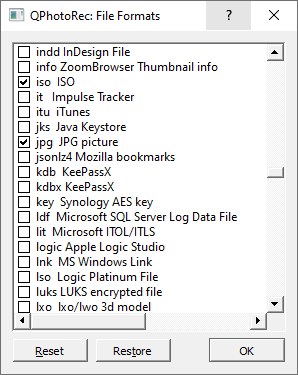
Finally, you can initiate files restoration by pressing the “Search” button. You will see the screen where the outcomes of the scan and recovery are shown.
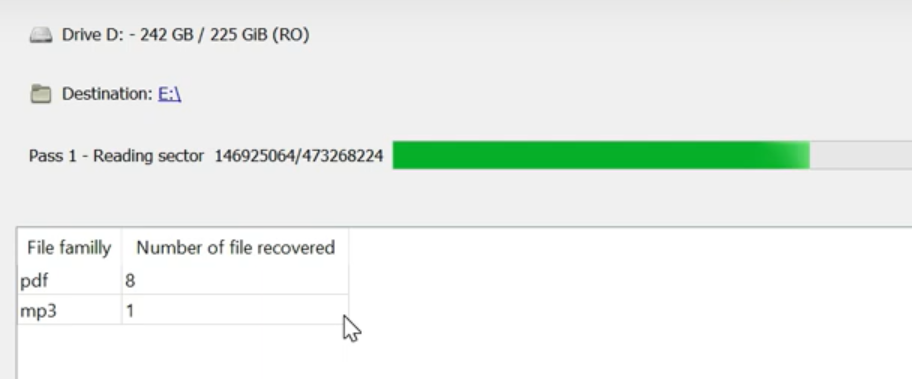
Wwpl files recovery Video Guide.
Frequently Asked Questions
I need your help to share this article.
It is your turn to help other people. I have written this guide to help people like you. You can use buttons below to share this on your favorite social media Facebook, Twitter, or Reddit.
Brendan SmithReferences
 German
  Japanese
  Spanish
  Portuguese (Brazil)
  French
  Turkish
  Chinese (Traditional)
  Korean
  Indonesian
  Hindi
Hindi  Italian


Leave a Comment