
The Sulinformatica virus falls under the ransomware type of infection. A harmful program of such sort encrypts all the data on your computer (photos, text files, excel tables, audio files, videos, etc) and appends its specific extension to every file, leaving the Instruction.txt text files in each directory with the encrypted files.
What is known about the Sulinformatica virus?
Sulinformatica will append its own .aes extension to every file’s title. For example, an image named “photo.jpg” will be renamed to “photo.jpg.aes”. Likewise, the Excel file with the name “table.xlsx” will be renamed to “table.xlsx.aes”, and so forth.
In each folder containing the encrypted files, a Instruction.txt file will be found. It is a ransom money memo. Therein you can find information about the ways of contacting the racketeers and some other information. The ransom note most probably contains instructions on how to purchase the decryption tool from the Sulinformatica developers. You can obtain this decrypting software after contacting [email protected] via email. That is how they do it.
Sulinformatica Summary:
| Name | Sulinformatica Virus |
| Extension | .aes |
| Ransomware note | Instruction.txt |
| Contact | [email protected] |
| Detection | Win32/Agent_AGen.BAE, TrojanRansom.Cerber, Ransom:Win32/MoneyMessage.A!ibt |
| Symptoms | Your files (photos, videos, documents) have a .aes extension and you can’t open them. |
| Fix Tool | See If Your System Has Been Affected by Sulinformatica virus |
The Instruction.txt document coming in package with the Sulinformatica ransomware provides the following dispiriting information:
Hello. I SULINFORMATICA. Your infrastructure has been hit and all files are encrypted. Be warned - this is complex multi-threaded encryption. All your files are intact, they will be fully accessible after decryption. All important files/documents/databases have been downloaded from your network. They are securely hidden and stored in order to further work with your company data. We suggest that you start negotiations to resolve the situation. You can get all the information on decryption at the contacts listed below. You can get all the information on the company\'s data and return it to you / or remove it from public access at the contacts listed below. We also inform you that every 24 hours delays will worsen the negotiating position. Contact us as soon as possible, we are ready to help and waiting for you. [email protected] [email protected] Or qTox messenger (available 24/7): 08DB45CC971A1A9779A532747F71BA40B6DFFF9F3D690F87EC4FF96C0F21E2007753D70B6D8E
In the picture below, you can see what a directory with files encrypted by the Sulinformatica looks like. Each filename has the “.aes” extension added to it.
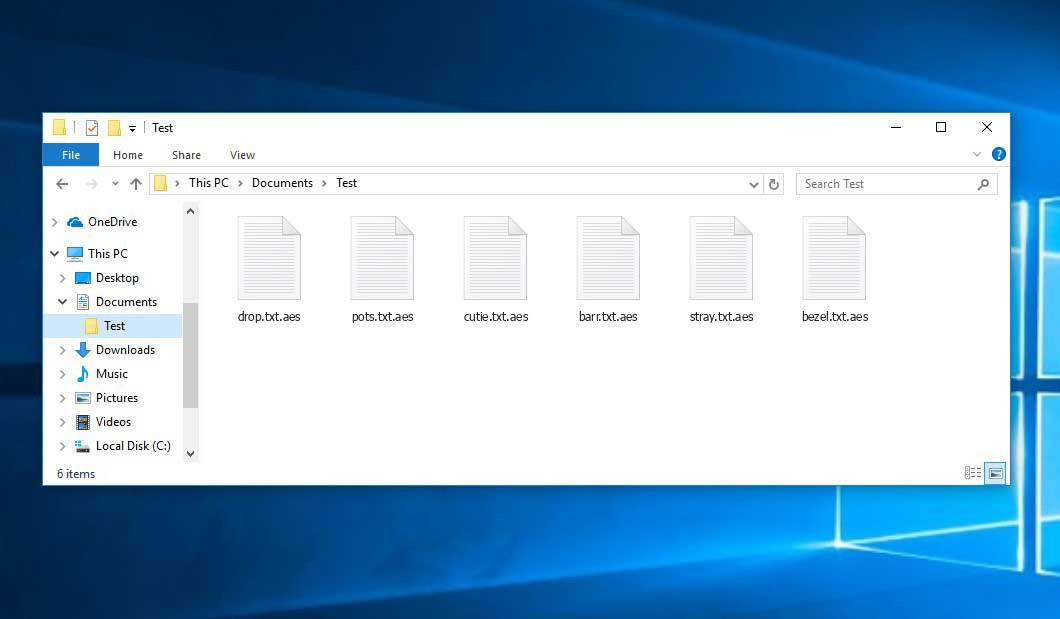
An example of encrypted .aes files.
How did my machine catch Sulinformatica ransomware?
There are plenty of possible ways of ransomware injection.
Nowadays, there are three most popular ways for evil-doers to have ransomware settled in your system. These are email spam, Trojan introduction and peer networks.
- Another option for ransom hunters is a Trojan horse scheme. A Trojan is a program that gets into your machine disguised as something different. For instance, you download an installer of some program you want or an update for some service. But what is unboxed reveals itself a harmful program that compromises your data. Since the update file can have any title and any icon, you’d better be sure that you can trust the source of the stuff you’re downloading. The optimal thing is to use the software companies’ official websites.
- As for the peer-to-peer file transfer protocols like torrents or eMule, the threat is that they are even more trust-based than the rest of the Web. You can never know what you download until you get it. Our suggestion is that you use trustworthy websites. Also, it is reasonable to scan the folder containing the downloaded items with the antivirus as soon as the downloading is complete.
How to remove ransomware?
It is important to note that besides encrypting your data, the Sulinformatica virus will probably install Vidar Stealer on your machine to get access to credentials to different accounts (including cryptocurrency wallets). The mentioned spyware can extract your logins and passwords from your browser’s auto-filling data.
How сan I avoid ransomware infection?
Sulinformatica ransomware has no superpower, so as any similar malware.
You can defend your computer from ransomware infiltration within several easy steps:
- Ignore any letters from unknown mailers with unknown addresses, or with content that has likely no connection to something you are waiting for (can you win in a money prize draw without even taking part in it?). In case the email subject is likely something you are waiting for, check all elements of the questionable email carefully. A fake letter will always have mistakes.
- Avoid using cracked or unknown software. Trojans are often spreaded as a part of cracked software, possibly under the guise of “patch” which prevents the license check. But dubious programs are difficult to tell from trustworthy ones, because trojans may also have the functionality you need. You can try searching for information on this program on the anti-malware forums, but the optimal way is not to use such software.
FAQ
🤔 How can I open “.aes” files?Is it possible to open“.aes” files?
Unfortunately, no. You need to decipher the “.aes” files first. Then you will be able to open them.
🤔 I really need to decrypt those “.aes” files ASAP. How can I do that?
It’s good if you have fаr-sightedly saved copies of these important files elsewhere. In case you haven’t, there is still a chance that you do have a Restore Point from some time ago to roll back the whole system to the moment when it had no virus yet, but already had your files. There are other ways to beat ransomware, but they take time.
🤔 What to do if the Sulinformatica virus has blocked my computer and I can’t get the activation code.
🤔 And what should I do now?
Many of the encrypted files might still be at your disposal
- If you sent or received your critical files through email, you could still download them from your online mailbox.
- You may have shared photographs or videos with your friends or family members. Simply ask them to post those images back to you.
- If you have initially downloaded any of your files from the Internet, you can try downloading them again.
- Your messengers, social media pages, and cloud drives might have all those files too.
- It might be that you still have the needed files on your old PC, a portable device, mobile, flash memory, etc.
HINT: You can employ data recovery programs1 to retrieve your lost information since ransomware blocks the copies of your files, removing the authentic ones. In the tutorial below, you can learn how to recover your files with PhotoRec, but be advised: you can do it only after you remove the virus with an anti-malware program.
I need your help to share this article.
It is your turn to help other people. I have written this article to help users like you. You can use the buttons below to share this on your favorite social media Facebook, Twitter, or Reddit.
Brendan SmithReferences
- Here’s the list of Top 10 Data Recovery Software Of 2023.


Leave a Comment