
PySilon RAT, a Python-based Remote Access Trojan, boasts an array of potent capabilities, including remote control, data theft, and privilege escalation. Its distribution is primarily facilitated through phishing and social engineering tactics.
Spread via deceptive downloads, malicious attachments in spam communications, and untrustworthy sources, PySilon thrives on disguising itself amid ordinary programs and media files. Once executed, it initiates a chain reaction, underscoring the persistent threat it poses to systems and user data.
PySilon RAT Overview
PySilon is a Python-based Remote Access Trojan (RAT) that empowers malicious actors with remote control over infected systems. This multifaceted tool executes a broad spectrum of commands, incorporating extensive spyware and data-stealing functionalities. Notably, PySilon possesses the capability to elevate privileges, gain admin permissions, and execute Command Prompt (CMD) commands.
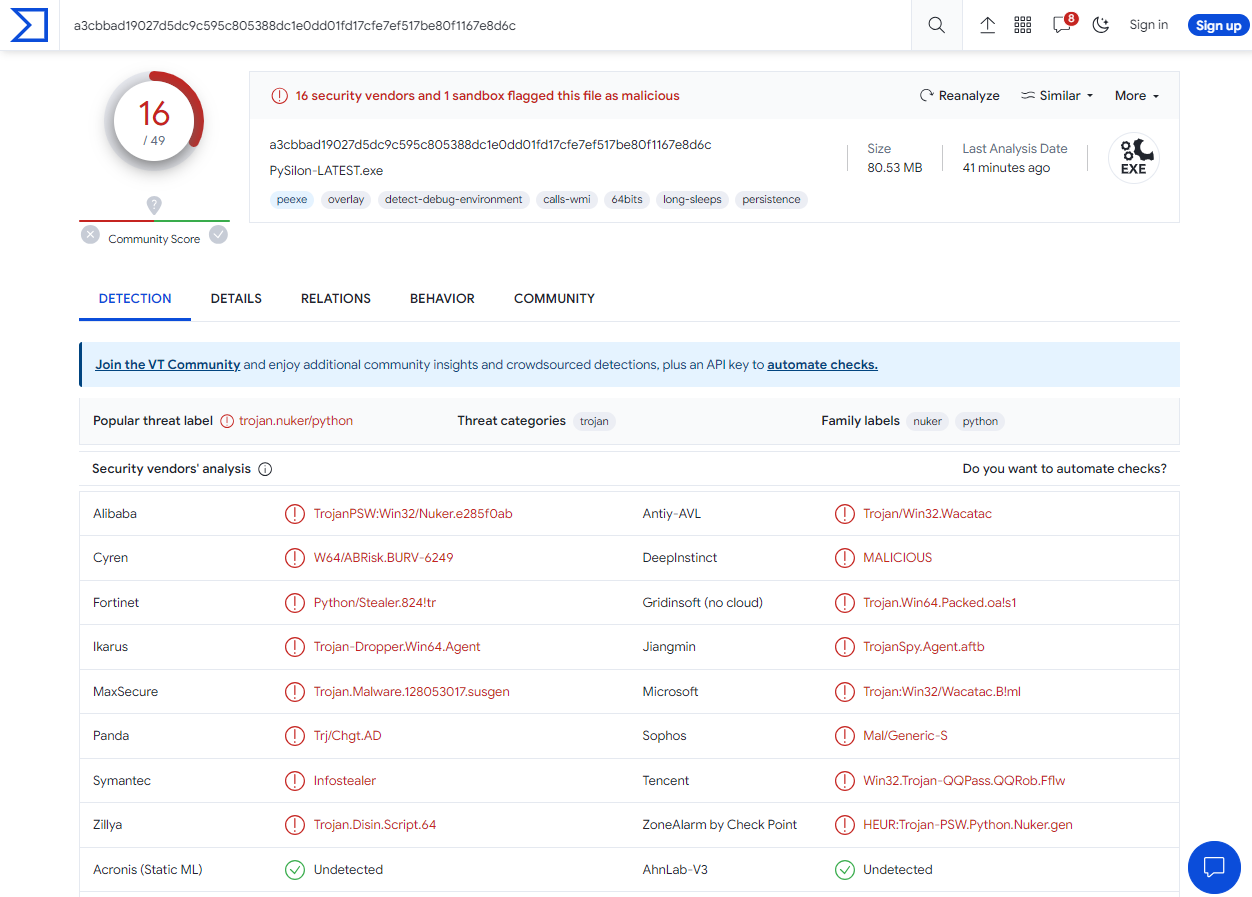
PySilon RAT on VirusTotal
To elude detection, PySilon employs anti-VM mechanisms, allowing it to discern when operating in a virtual environment. Furthermore, it demonstrates the self-preservation tactic of terminating its own processes and eradicating infection remnants. PySilon can scrutinize and terminate running processes.
| Name | PySilon RAT |
| Detection | Trojan:Win32/Wacatac.B!ml, Trojan.Win64.Packed.oa!s1 |
| Damage | Establishes remote unauthorised connection to your system, allows performing various malignant actions. |
| Similar Behavior | JanelaRAT, DarkVision RAT, SuperBear RAT |
PySilon Threat Analysis
The RAT excels in browsing and exfiltrating system and user files, while also facilitating the infiltration and execution of files, potentially propagating additional infections. Its spyware prowess includes capturing screenshots, recording screens and audio via microphones, and webcam snapshots. Keylogging functionality records keystrokes, enabling attackers to access all typed information and, remarkably, it can immobilize mouse and keyboard input.
In the realm of browsers, PySilon extracts browsing histories, Internet cookies, saved login credentials, and WiFi passwords. Discord tokens are also a target. Additionally, PySilon operates as a clipper, redirecting cryptocurrency transactions by replacing copied wallet addresses with those of cybercriminals. It can even provoke system crashes or launch fork bomb attacks.
It’s imperative to acknowledge that malware evolves, and potential future PySilon versions may exhibit additional or distinct capabilities. Promotional material hints at plans for stealing saved credit card details, accessing popular app sessions, ransomware deployment, and cryptocurrency mining. In particular, it aims for Exodus and MetaMask cryptowallets, Minecraft, Roblox, Steam, and several other games/game stores.
How does it spread?
Predominant distribution techniques encompass stealthy or deceptive drive-by downloads, online scams, and malicious attachments or links in spam messages. Malvertising, alongside untrustworthy sources for downloads like freeware and free file-hosting websites, Peer-to-Peer sharing networks, and pirated content, also serves as prolific vectors. Illegal software activation tools, commonly referred to as “cracks,” and fraudulent update notifications further facilitate its spread.


Leave a Comment