
Seeing the Trojan-Ransom.Win32.Purgen.hz malware detection usually means that your PC is in big danger. This virus can correctly be identified as ransomware – type of malware which ciphers your files and asks you to pay for their decryption. Stopping it requires some unusual steps that must be done as soon as possible.
Trojan-Ransom.Win32.Purgen.hz detection is a malware detection you can spectate in your computer. It frequently shows up after the preliminary activities on your computer – opening the dubious email, clicking the banner in the Web or installing the program from dubious resources. From the second it appears, you have a short time to take action before it starts its malicious activity. And be sure – it is far better not to wait for these harmful actions.
What is Trojan-Ransom.Win32.Purgen.hz virus?
Trojan-Ransom.Win32.Purgen.hz Summary
Summarizingly, Trojan-Ransom.Win32.Purgen.hz virus activities in the infected computer are next:
- SetUnhandledExceptionFilter detected (possible anti-debug);
- Behavioural detection: Executable code extraction – unpacking;
- Yara rule detections observed from a process memory dump/dropped files/CAPE;
- Creates RWX memory;
- Possible date expiration check, exits too soon after checking local time;
- Dynamic (imported) function loading detected;
- Enumerates running processes;
- CAPE extracted potentially suspicious content;
- The binary likely contains encrypted or compressed data.;
- Authenticode signature is invalid;
- Uses Windows utilities for basic functionality;
- Behavioural detection: Injection (Process Hollowing);
- Executed a process and injected code into it, probably while unpacking;
- Attempts to delete or modify volume shadow copies;
- Behavioural detection: Injection (inter-process);
- Created a process from a suspicious location;
- Steals private information from local Internet browsers;
- Installs itself for autorun at Windows startup;
- Exhibits possible ransomware file modification behavior;
- Likely virus infection of existing system binary;
- Creates a copy of itself;
- Harvests cookies for information gathering;
- Anomalous binary characteristics;
- Uses suspicious command line tools or Windows utilities;
- Ciphering the documents located on the target’s drives — so the victim cannot check these documents;
- Blocking the launching of .exe files of security tools
- Blocking the launching of installation files of security tools
Ransomware has been a horror story for the last 4 years. It is challenging to imagine a more harmful malware for both individual users and organizations. The algorithms utilized in Trojan-Ransom.Win32.Purgen.hz (typically, RHA-1028 or AES-256) are not hackable – with minor exclusions. To hack it with a brute force, you need more time than our galaxy already exists, and possibly will exist. But that malware does not do all these horrible things immediately – it may take up to several hours to cipher all of your documents. Therefore, seeing the Trojan-Ransom.Win32.Purgen.hz detection is a clear signal that you have to start the elimination process.
Where did I get the Trojan-Ransom.Win32.Purgen.hz?
Typical ways of Trojan-Ransom.Win32.Purgen.hz distribution are basic for all other ransomware examples. Those are one-day landing web pages where users are offered to download and install the free software, so-called bait emails and hacktools. Bait e-mails are a pretty new method in malware distribution – you get the e-mail that imitates some standard notifications about shipments or bank service conditions changes. Inside of the e-mail, there is an infected MS Office file, or a web link which opens the exploit landing page.
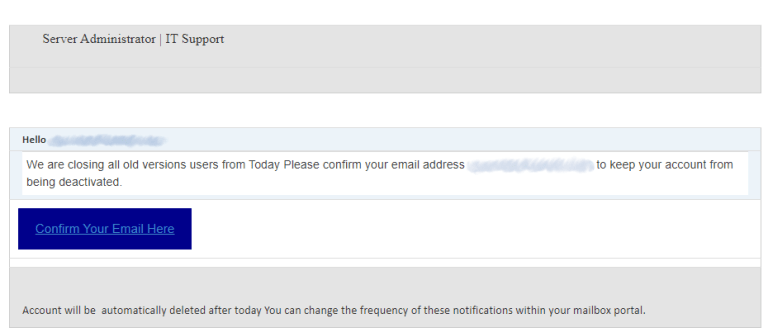
Malicious email message. This one tricks you to open the phishing website.
Avoiding it looks fairly easy, but still demands a lot of attention. Malware can hide in various places, and it is far better to prevent it even before it gets into your system than to trust in an anti-malware program. Standard cybersecurity awareness is just an important thing in the modern-day world, even if your relationship with a computer remains on YouTube videos. That may save you a great deal of time and money which you would certainly spend while looking for a fix guide.
Trojan-Ransom.Win32.Purgen.hz malware technical details
File Info:
name: C7E465AC5179EA88B38F.mlwpath: /opt/CAPEv2/storage/binaries/9be2d10f3a42026a6015fc6dca57febf4ca27fb0da5e4280f629a327a214a0b1crc32: 7BCE1FD9md5: c7e465ac5179ea88b38fae0963fd013fsha1: f375eb85ea977e67d460ad29b4f3249a9095ec32sha256: 9be2d10f3a42026a6015fc6dca57febf4ca27fb0da5e4280f629a327a214a0b1sha512: 40858db3db67cdbcb202dfe5295b5426fd0c9002fa142182fafb9366680ff62623b68c20df1e4b4a1ae500423fe12a62ada589449406241b1daca2563cfdd12fssdeep: 3072:oPtOASqXs/hcsSIGCDkxKVM8jY/PxOAVP1A9N6egSA+m7bY/STpN3ElG0WB:wOASqV4Tq8SVtA9N6EmSqpBElGBtype: PE32 executable (GUI) Intel 80386, for MS Windowstlsh: T115446D3A6394B5F3CE639A71CD44EAEF0029672FA6E76D4C2C1E3BAD2064DC5D05A1D0sha3_384: 80637e1b9ac47631b51f4a99c4c99fae827fe0ca099ce1404d97871bc835ff9e8b131ef674dfc1569bf27dc90205d866ep_bytes: e899230000e989feffff8bff558bec51timestamp: 2017-08-07 13:48:18Version Info:
0: [No Data]
Trojan-Ransom.Win32.Purgen.hz also known as:
| Bkav | W32.AIDetect.malware1 |
| Lionic | Trojan.Win32.Purgen.trwc |
| MicroWorld-eScan | Trojan.GenericKD.5784862 |
| CAT-QuickHeal | Trojan.Chapak.ZZ6 |
| McAfee | Emotet-FAX! |
| Malwarebytes | MachineLearning/Anomalous.100% |
| Zillya | Trojan.Purgen.Win32.64 |
| Sangfor | Trojan.Win32.Save.a |
| K7AntiVirus | Trojan ( 0051418e1 ) |
| BitDefender | Trojan.GenericKD.5784862 |
| K7GW | Trojan ( 00513f161 ) |
| Cybereason | malicious.c5179e |
| VirIT | Trojan.Win32.GlobeIMP2.K |
| Cyren | W32/S-f4afc55c!Eldorado |
| Symantec | Packed.Generic.525 |
| Elastic | malicious (high confidence) |
| ESET-NOD32 | Win32/Filecoder.FV |
| APEX | Malicious |
| Paloalto | generic.ml |
| ClamAV | Win.Trojan.Agent-6373513-0 |
| Kaspersky | Trojan-Ransom.Win32.Purgen.hz |
| Alibaba | Ransom:Win32/Purgen.d4b6cb10 |
| NANO-Antivirus | Trojan.Win32.Inject.etldiq |
| ViRobot | Trojan.Win32.S.Ransom.257024.B |
| Avast | Win32:Trojan-gen |
| Tencent | Win32.Trojan.Gen.Audm |
| Ad-Aware | Trojan.GenericKD.5784862 |
| Emsisoft | Trojan.GenericKD.5784862 (B) |
| Comodo | TrojWare.Win32.TrojanDownloader.Dofoil.GG@76l6kl |
| F-Secure | Trojan.TR/PSW.Fareit.OG |
| DrWeb | Trojan.Encoder.11539 |
| VIPRE | Trojan.GenericKD.5784862 |
| TrendMicro | Ransom_FAKEGLOBE.F117H8 |
| McAfee-GW-Edition | BehavesLike.Win32.Dropper.dc |
| Trapmine | malicious.high.ml.score |
| FireEye | Generic.mg.c7e465ac5179ea88 |
| Sophos | ML/PE-A + Mal/Ransom-FN |
| Ikarus | Trojan.SuspectCRC |
| GData | Win32.Trojan.Kryptik.HQ |
| Jiangmin | Trojan.Purgen.en |
| Webroot | W32.Trojan.Emotet |
| Avira | TR/PSW.Fareit.OG |
| Antiy-AVL | Trojan/Generic.ASMalwS.3C54 |
| Kingsoft | Win32.Troj.Generic_a.a.(kcloud) |
| Arcabit | Trojan.Generic.D58451E |
| SUPERAntiSpyware | Ransom.GlobeImposter/Variant |
| ZoneAlarm | Trojan-Ransom.Win32.Purgen.hz |
| Microsoft | Ransom:Win32/Ergop.A |
| Cynet | Malicious (score: 100) |
| AhnLab-V3 | Trojan/Win32.Globeimposter.R206261 |
| Acronis | suspicious |
| ALYac | Trojan.Ransom.GlobeImposter |
| TACHYON | Ransom/W32.Purgen.257024 |
| VBA32 | Hoax.Purgen |
| Cylance | Unsafe |
| TrendMicro-HouseCall | Ransom_FAKEGLOBE.F117H8 |
| Rising | Trojan.Ransom.GlobeImposter!1.AC9F (KTSE) |
| Yandex | Trojan.GenAsa!LhNf8kxKF+M |
| SentinelOne | Static AI – Malicious PE |
| MaxSecure | Trojan.Malware.300983.susgen |
| Fortinet | W32/Generic.AP.125C6E!tr |
| BitDefenderTheta | AI:Packer.ED285E3D21 |
| AVG | Win32:Trojan-gen |
| Panda | Trj/WLT.D |
| CrowdStrike | win/malicious_confidence_100% (W) |


Leave a Comment