
Altruistics.exe is not a normal Windows process. It is commonly reported as an unwanted or malicious process that consumes CPU resources, returns after reboot, or appears together with suspicious browser behavior and bundled software. If you see it in Task Manager, treat it as a security problem until you can prove otherwise.
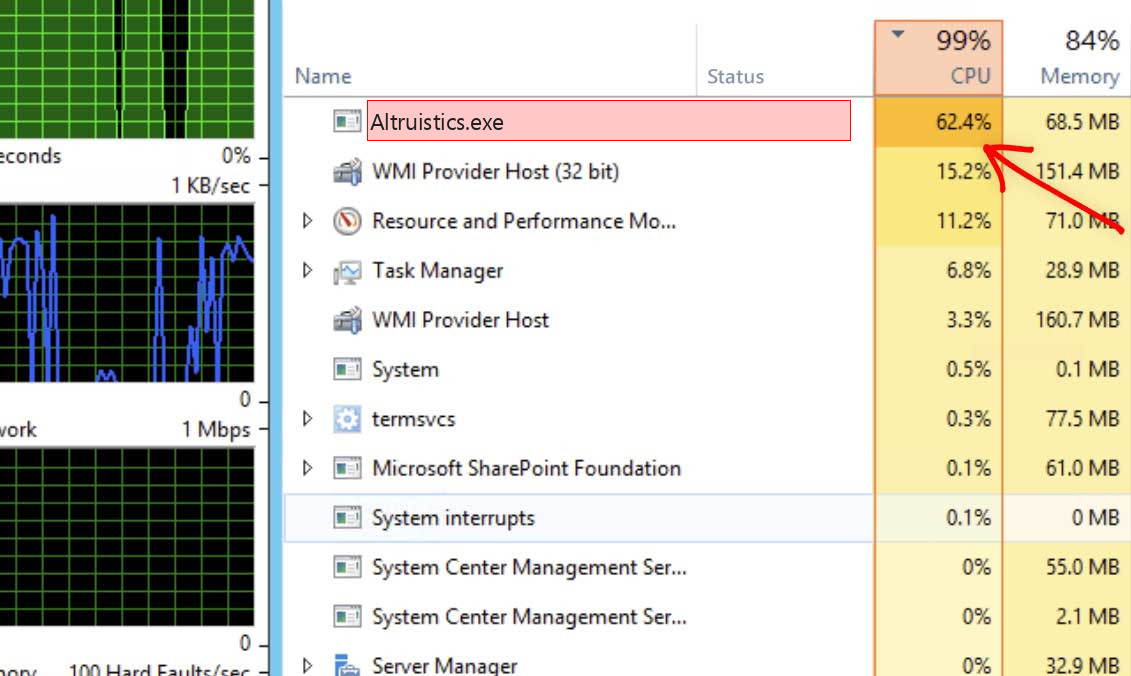
What is Altruistics.exe?
Altruistics.exe is usually associated with unwanted software rather than a legitimate Windows component. Many reports describe it as a process that uses high CPU, hides behind a generic service name, or resists simple deletion. Some versions are described as miner-like because they consume resources in the background.
The important part is persistence. If the process returns after you end it, there is likely a service, scheduled task, startup entry, or parent program reinstalling it.
Symptoms
- High CPU usage from Altruistics.exe or a related service.
- Fans running loudly while the PC is idle.
- The process returns after Task Manager termination.
- Unknown entries in startup apps, services, or Task Scheduler.
- Browser redirects, unwanted extensions, or new search settings.
- Recent installation of bundled freeware, fake updaters, cracks, or suspicious installers.
How to verify the file
- Open Task Manager, right-click Altruistics.exe, and choose Open file location.
- Check whether it runs from AppData, Temp, ProgramData, Startup, or another user-writable folder.
- Open file properties and check the publisher. Unknown or missing publisher is a warning sign.
- Check Startup Apps, Services, and Task Scheduler for entries created at the same time.
- Scan the exact file and the whole system before deleting only one visible process.
How to remove Altruistics.exe safely
- Disconnect from sensitive accounts if CPU usage is extreme or the system acts strangely.
- Uninstall suspicious programs installed around the same date.
- Disable suspicious startup entries and scheduled tasks.
- Boot into Safe Mode if the process prevents removal.
- Delete the parent folder only after identifying the service/task that launches it.
- Run a full malware scan and reboot.
- After reboot, confirm that Altruistics.exe does not return.
Check for leftovers
Altruistics.exe infections rarely exist alone. Review browser extensions, proxy settings, DNS settings, new local users, remote-access tools, and recently installed programs. If passwords were typed while the process was active, change important passwords from a clean device.
Why this page uses a stronger warning
Some process pages need a false-positive tone because the file is often legitimate. Altruistics.exe is different: it is not expected on a clean Windows install and is frequently tied to unwanted software. The correct approach is still evidence-based, but the default risk level is higher than for Corsair, HP, or Microsoft-signed processes.
Manual investigation checklist
Before deleting anything, collect the evidence. Note the folder path, file creation date, publisher, parent process, and whether the same folder contains other executables. Sort installed apps by date and look for programs added right before Altruistics.exe appeared. Also open Task Scheduler and check tasks created on the same day.
Use Autoruns or a similar startup viewer if you are comfortable with advanced tools. Look for entries that point to Altruistics.exe or to the same folder. Disable suspicious entries first, reboot, and confirm whether the process returns. That approach avoids a common mistake: deleting the EXE while the launcher remains active.
Browser and network checks
Because unwanted programs often arrive in bundles, inspect all browsers. Remove unknown extensions, reset search engine settings, and check notification permissions for suspicious sites. Then check proxy settings and DNS settings. If the system uses a proxy you did not configure, remove it and scan again.
After cleanup
After Altruistics.exe is gone, watch Task Manager for several minutes after reboot. Check that CPU usage stays normal and the file does not reappear in the same folder. Empty temporary folders only after the main threat is removed, then run another full scan. If you used the PC for banking, email, crypto wallets, or admin accounts while the process was active, change those passwords from a clean device.
Why one-click deletion often fails
Persistent unwanted software usually has more than one component. The visible process consumes CPU, while a service or task relaunches it. That is why a good cleanup removes the launcher, the parent app, browser changes, and leftovers. Otherwise the same problem can return after the next reboot.
How to confirm it stayed removed
A successful cleanup is not just an empty Task Manager. Reboot twice, then search the disk for Altruistics-related folders and check whether any startup entry points to a missing file. Missing-file startup errors are a clue that part of the unwanted program was removed but its launcher survived. Remove those launchers too.
When to use a second-opinion scanner
Use a second-opinion scanner when the process returns, when the file has no clear publisher, when browser settings keep changing, or when Defender/another antivirus reports additional detections. Resource-heavy unwanted software often arrives with downloaders or browser components, so one scanner may not show the full picture.
If removal tools detect related items with different names, remove them together. Altruistics.exe is often only the easiest component to notice.
FAQ
Is Altruistics.exe a Windows file?
No. It is not a normal Windows system process.
Why does it come back after I end it?
A service, scheduled task, startup entry, or parent program may be relaunching it.
Should I delete the EXE directly?
Only after you identify and remove the startup mechanism. Otherwise it may return after reboot.
 German
  Japanese
  Spanish
  Portuguese (Brazil)
  French
  Turkish
  Chinese (Traditional)
  Korean
  Indonesian
  Hindi
Hindi  Italian


Leave a Comment