
The “I have e-mailed you from your account” scam spreads via deceptive emails claiming to originate from recipients’ accounts. This phishing campaign falsely asserts access to users’ devices, citing malware from adult-themed sites.
Perpetrators threaten to release non-existent compromising videos unless a $250 Bitcoin ransom is paid within 48 hours. Users are warned against sharing the scam, reinforcing the need for caution in the face of these fraudulent emails.
What Is “I have e-mailed you from your account” Email Scam?
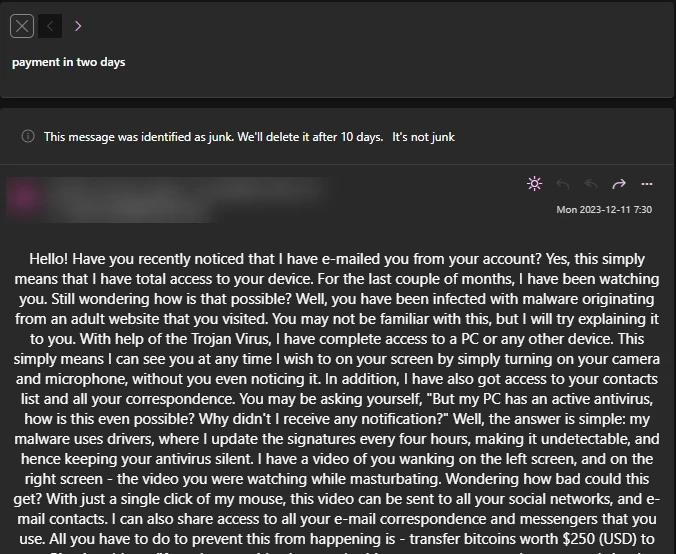
“I have e-mailed you from your account” Email Scam
| Name | “I have e-mailed you from your account” Email Scam |
| Threat Type | Phishing, Scam, Social Engineering |
| Distribution methods | Deceptive emails, rogue online pop-up ads, search engine poisoning techniques, misspelled domains. |
| Damage | Loss of sensitive private information, monetary loss, identity theft. |
| Similar Behavitor | “Some Bad News That You Are About To Hear” Email Scam, “Password Was Compromised Through A Legitimate Website” Email Scam |
How Does “I have e-mailed you from your account” Scam Work?
The scam emails titled “I have e-mailed you from your account” (often appearing as “payment in two days”) purport to have been sent from the recipient’s email accounts, creating a false impression that the sender has gained access to the users’ devices. These deceptive emails allege that the recipients’ systems were infected with malware traced back to an adult-themed website visited by the targets. The scammers assert that leveraging the non-existent malware infection, they have recorded a video using the cameras on the devices. The purported recording supposedly took place during the recipients’ visits to adult websites, capturing the user on one side and the content they were viewing on the other.
Furthermore, the scam emails claim that the scammers have acquired the recipients’ email and social media contact lists. To coerce compliance, the scammers threaten to distribute the fabricated video to these contacts unless the recipients transfer 250 USD of Bitcoin cryptocurrency to a specified cryptowallet address. The ransom payment is mandated within a 48-hour, commencing from the moment the recipient opens the “I have e-mailed you from your account” message. Recipients are explicitly cautioned that any attempt to share these emails will result in disseminating the recording to the extracted contacts. As emphasized earlier, all the assertions made in these emails are entirely false. Consequently, trusting these claims exposes users to financial losses and potential recurrence of scam attempts.
Is It Dangerous?
The email in question is only an immediate threat if the recipient falls prey to the demands made within. However, the primary risk associated with this communication is financial loss. Additionally, there is a potential for similar scams to be targeted at the individual, given the success of the initial attempt by scammers.
As previously stated, we advise recipients to ignore the email. Furthermore, labeling it as spam and blocking the sender is a protective measure that can shield the recipient and enhance anti-spam filters. Proactively taking this step may act as a deterrent, discouraging scammers from persistently targeting the individual.
How to Remove Malware from Your PC?
You can remove the threat manually, but we do not recommend doing so. As malware tries to gain persistence, it creates numerous instances of itself, making it nearly impossible to trace all the parts. As a result, manual removals may take time for low to no efficiency. I compiled the best removal practices for malware in the guide below.


Leave a Comment