
The “I sent you an email from your account” scam employs fear tactics, falsely claiming full access to recipients’ email accounts and threatening to expose compromising videos. Scammers allege a trojan infection, promising remote control of computers and real-time surveillance.
The phishing email spreads through widespread distribution, aiming for financial gain. To counteract this threat, recipients are urged to ignore the message, label it as spam, and block the sender to fortify their defenses against potential future scams.
What Is “I sent you an email from your account” Email Scam?
The email with the subject “I sent you an email from your account” is part of a spam email campaign commonly known as a scam. Cybercriminals employ this tactic to threaten recipients by releasing compromising or humiliating videos unless their ransom demands are met. This scheme is widespread and comes in various iterations.
If you receive such an email, it is strongly advised to disregard it and not trust any claims made within the message. The email is disseminated through “email spoofing,” which involves falsifying the sender’s email address. This method allows the scammers to create an illusion that the recipient is also the email’s sender.
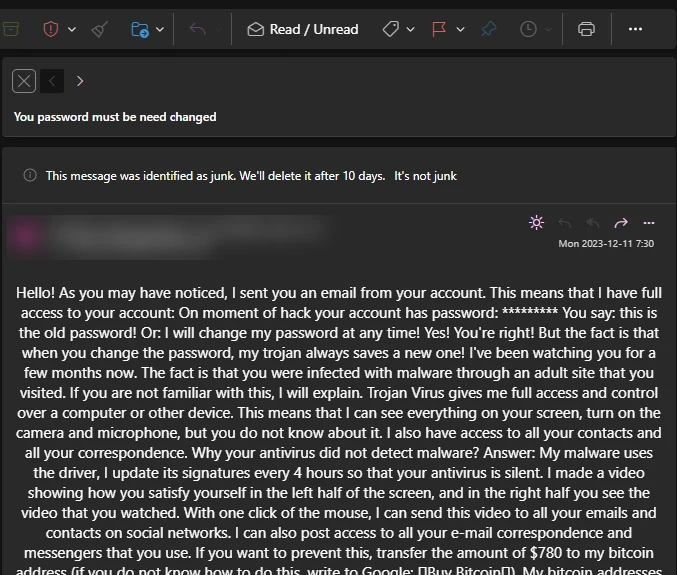
“I sent you an email from your account” Email
| Name | “I sent you an email from your account” Email Scam |
| Threat Type | Phishing, Scam, Social Engineering |
| Distribution methods | This scam is spread wide via spam email campaigns. |
| Damage | Loss of sensitive private information, monetary loss, identity theft. |
| Similar Behavitor | “Some Bad News That You Are About To Hear” Email Scam, “Your Account Was Hacked” Email Scam |
How Does “I sent you an email from your account” Scam Work?
In this scam, cybercriminals assert that they have gained complete access to the recipient’s email account, having acquired the password. They claim that the recipient’s computer is infected with a trojan, allowing them to alter the password at will, rendering any user-generated changes ineffective. The trojan was introduced during the recipient’s visit to an adult website. Additionally, the scammers purport to have the capability to remotely control the recipient’s computer remotely, enabling real-time monitoring of activities, activation of the camera and microphone, and more.
Is It Dangerous?
The email does not pose an immediate threat unless the recipient capitulates to its demands. The principal risk tied to this communication is financial loss. Additionally, there is a potential for an increase in similar scams targeting the individual, leveraging the success of the initial attempt by the scammers.
As reiterated earlier, our recommendation is to disregard the email. Furthermore, marking it as spam and blocking the sender serves as a protective measure, not only safeguarding the recipient but also contributing to the reinforcement of anti-spam filters. Proactively taking these measures may act as a deterrent, dissuading scammers from persistently targeting the individual’s email inbox.
How to Remove Malware from Your PC?
While it is possible to remove the threat manually, we do not recommend doing so. Malware tries to gain persistence by creating numerous instances of itself, making it nearly impossible to trace all the parts. Therefore, manual removals may take time and may not be entirely efficient. I have compiled the best removal practices for malware in the guide below.


Leave a Comment