
Trojan:Win32/Vidar.AA!MTB

If you spectate the alert of Trojan:Win32/Vidar.AA!MTB detection, it looks like that your PC has a problem. All malicious programs are dangerous, with no deviations. Vidar is a virus that aims at opening your system to further malware injection. Most of of the modern virus examples are complex, and can inject other viruses. Being infected with the Trojan:Win32/Vidar.AA!MTB virus often equals to getting a malicious thing which can act like spyware or stealer, downloader, and a backdoor. Spectating this detection means that you need to perform the malware removal as fast as you can.

What does the pop-up with Trojan:Win32/Vidar.AA!MTB detection mean?

The Trojan:Win32/Vidar.AA!MTB detection you can see in the lower right corner is displayed to you by Microsoft Defender. That anti-malware application is pretty good at scanning, but prone to be generally unreliable. It is prone to malware invasions, it has a glitchy user interface and bugged malware clearing features. Thus, the pop-up which states concerning the Vidar is just an alert that Defender has actually recognized it. To remove it, you will likely need to use a separate anti-malware program.
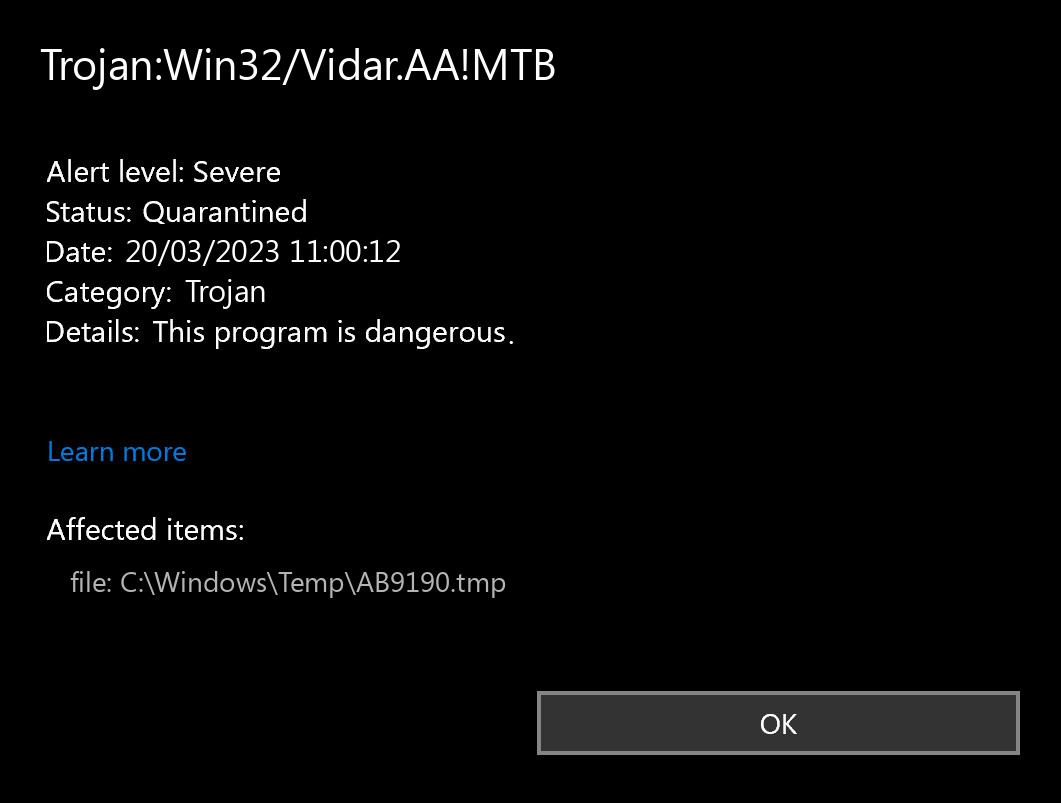
Trojan:Win32/Vidar.AA!MTB found

Microsoft Defender: “Trojan:Win32/Vidar.AA!MTB”

The exact Trojan:Win32/Vidar.AA!MTB virus is a really unpleasant thing. It sits inside of your PC disguised as a part of something legit, or as a part of the tool you downloaded from a forum. Then, it makes everything to make your system weaker. At the end of this “party”, it injects other viruses – ones which are wanted by crooks who control this malware. Hence, it is impossible to predict the effects from Vidar actions. And the unpredictability is one of the most upleasant things when we are talking about malware. That’s why it is better not to choose at all, and don’t let the malware to complete its task.

Threat Summary:

Name Vidar Trojan
Detection Trojan:Win32/Vidar.AA!MTB
Details Vidar tool that looks legitimate but can take control of your computer.
List of activities in the infected system
  • Executable code extraction. Cybercriminals often use binary packers to hinder the malicious code from reverse-engineered by malware analysts. A packer is a tool that compresses, encrypts, and modifies a malicious file’s format. Sometimes packers can be used for legitimate ends, for example, to protect a program against cracking or copying.
  • Creates RWX memory. There is a security trick with memory regions that allows an attacker to fill a buffer with a shellcode and then execute it. Filling a buffer with shellcode isn’t a big deal, it’s just data. The problem arises when the attacker is able to control the instruction pointer (EIP), usually by corrupting a function’s stack frame using a stack-based buffer overflow, and then changing the flow of execution by assigning this pointer to the address of the shellcode.
  • Reads data out of its own binary image. The trick that allows the malware to read data out of your computer’s memory.

    Everything you run, type, or click on your computer goes through the memory. This includes passwords, bank account numbers, emails, and other confidential information. With this vulnerability, there is the potential for a malicious program to read that data.

  • A process created a hidden window;
  • Drops a binary and executes it. Trojan-Downloader installs itself to the system and waits until an Internet connection becomes available to connect to a remote server or website in order to download additional malware onto the infected computer.
  • Unconventionial language used in binary resources: Russian;
  • Uses Windows utilities for basic functionality;
  • Attempts to repeatedly call a single API many times in order to delay analysis time. This significantly complicates the work of the virus analyzer. Typical malware tactics!
  • Steals private information from local Internet browsers;
  • Network activity contains more than one unique useragent.;
  • Creates a hidden or system file. The malware adds the hidden attribute to every file and folder on your system, so it appears as if everything has been deleted from your hard drive.
  • Attempts to modify proxy settings. This trick used for inject malware into connection between browser and server;
  • Harvests credentials from local FTP client software;
  • Harvests information related to installed instant messenger clients;
  • Collects information to fingerprint the system. There are behavioral human characteristics that can be used to digitally identify a person to grant access to systems, devices, or data. Unlike passwords and verification codes, fingerprints are fundamental parts of user’s identities. Among the threats blocked on biometric data processing and storage systems is spyware, the malware used in phishing attacks (mostly spyware downloaders and droppers), ransomware, and Banking Trojans as posing the greatest danger.
  • Anomalous binary characteristics. This is a way of hiding virus’ code from antiviruses and virus’ analysts.
Other names of Trojan:Win32/Vidar.AA!MTB
GridinSoft Trojan.Ransom.Gen
MicroWorld-eScan Gen:Variant.Razy.439913
Cylance Unsafe
BitDefender Gen:Variant.Razy.439913
APEX Malicious
GData Gen:Variant.Razy.439913
Kaspersky HEUR:Trojan-PSW.Win32.Vidar.vho
Rising Stealer.Vidar!1.B80D (RDMK:cmRtazoolbRoKj29ksc7bDYm9c3M)
Emsisoft Trojan-Dropper.Agent (A)
F-Secure Heuristic.HEUR/AGEN.1113288
DrWeb Trojan.Siggen9.41859
Invincea heuristic
MaxSecure Trojan-Ransom.Win32.Crypmod.zfq
Trapmine malicious.moderate.ml.score
FireEye Generic.mg.c84ce1ae851f1fac
Webroot W32.Trojan.Gen
Avira HEUR/AGEN.1113288
Arcabit Trojan.Razy.D6B669
ZoneAlarm HEUR:Trojan-PSW.Win32.Vidar.vho
Microsoft Trojan:Win32/Vidar.AA!MTB
AhnLab-V3 Malware/Win32.Generic.C3733562
MAX malware (ai score=85)
VBA32 BScope.Backdoor.Predator
Malwarebytes Trojan.Downloader
ESET-NOD32 a variant of Win32/PSW.Agent.OGR
Ikarus Trojan-PSW.Agent
eGambit Unsafe.AI_Score_99%
Fortinet W32/Agent.OGR!tr
BitDefenderTheta Gen:NN.ZexaF.34106.HmW@aicA!le
AVG Win32:PWSX-gen [Trj]
Cybereason malicious.e851f1
Avast Win32:PWSX-gen [Trj]
Qihoo-360 HEUR/QVM05.1.C3D7.Malware.Gen

Is Trojan:Win32/Vidar.AA!MTB dangerous?

As I have actually specified before, non-harmful malware does not exist. And Trojan:Win32/Vidar.AA!MTB is not an exclusion. This malware alters the system settings, modifies the Group Policies and Windows registry. All of these components are critical for proper system operating, even in case when we are not talking about system safety. Therefore, the malware which Vidar carries, or which it will download later, will squeeze out maximum profit from you. Cyber burglars can grab your personal data, and then sell it on the Darknet. Alternatively, hackers can use this data to impersonate you in further attacks.

How did I get this virus?

It is hard to trace the sources of malware on your computer. Nowadays, things are mixed up, and distribution ways chosen by adware 5 years ago can be utilized by spyware these days. But if we abstract from the exact distribution tactic and will think of why it has success, the reply will be quite uncomplicated – low level of cybersecurity knowledge. People click on ads on weird sites, click the pop-ups they get in their web browsers, call the “Microsoft tech support” assuming that the strange banner that says about malware is true. It is important to know what is legit – to stay away from misconceptions when attempting to figure out a virus.
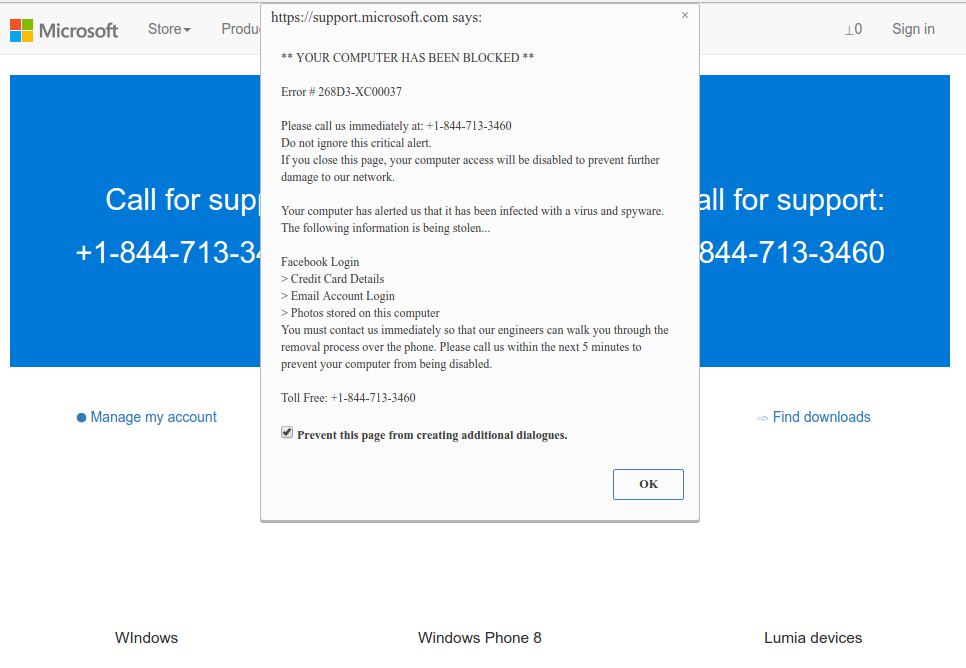
Microsoft Tech Support Scam

Microsoft Tech Support Scam

Nowadays, there are two of the most widespread methods of malware spreading – bait e-mails and injection into a hacked program. While the first one is not so easy to evade – you need to know a lot to understand a fake – the second one is easy to get rid of: just do not use cracked applications. Torrent-trackers and other providers of “free” applications (which are, exactly, paid, but with a disabled license checking) are just a giveaway place of malware. And Trojan:Win32/Vidar.AA!MTB is just within them.


How to remove the Trojan:Win32/Vidar.AA!MTB from my PC?

References

    About the author

    Robert Bailey

    Security engineer focused on malware behavior, removal workflows, and Windows hardening. Robert reviews threat articles for practical accuracy, checking detection names, symptoms, and cleanup steps before publication.

    1 Comment

    Leave a Comment