
Seeing the TrojanSpy:Win32/Delgent malware detection usually means that your system is in big danger. This malware can correctly be named as ransomware – sort of malware which ciphers your files and forces you to pay for their decryption. Removing it requires some unusual steps that must be done as soon as possible.
TrojanSpy:Win32/Delgent detection is a virus detection you can spectate in your computer. It usually appears after the provoking procedures on your PC – opening the dubious e-mail, clicking the banner in the Internet or mounting the program from untrustworthy resources. From the moment it appears, you have a short time to act before it begins its harmful action. And be sure – it is far better not to await these destructive actions.
What is TrojanSpy:Win32/Delgent virus?
TrojanSpy:Win32/Delgent Summary
Summarizingly, TrojanSpy:Win32/Delgent malware activities in the infected computer are next:
- Yara rule detections observed from a process memory dump/dropped files/CAPE;
- Presents an Authenticode digital signature;
- Creates RWX memory;
- Dynamic (imported) function loading detected;
- Enumerates running processes;
- Repeatedly searches for a not-found process, may want to run with startbrowser=1 option;
- The binary contains an unknown PE section name indicative of packing;
- Authenticode signature is invalid;
- Creates or sets a registry key to a long series of bytes, possibly to store a binary or malware config;
- Installs itself for autorun at Windows startup;
- Anomalous binary characteristics;
- Ciphering the files kept on the victim’s disk drives — so the victim cannot check these files;
- Blocking the launching of .exe files of anti-malware programs
- Blocking the launching of installation files of anti-malware apps
Ransomware has been a major problem for the last 4 years. It is hard to picture a more hazardous virus for both individuals and organizations. The algorithms used in TrojanSpy:Win32/Delgent (typically, RHA-1028 or AES-256) are not hackable – with minor exclusions. To hack it with a brute force, you need a lot more time than our galaxy already exists, and possibly will exist. However, that virus does not do all these unpleasant things without delay – it can take up to several hours to cipher all of your documents. Hence, seeing the TrojanSpy:Win32/Delgent detection is a clear signal that you have to begin the clearing procedure.
Where did I get the TrojanSpy:Win32/Delgent?
Ordinary ways of TrojanSpy:Win32/Delgent distribution are standard for all other ransomware variants. Those are one-day landing websites where victims are offered to download and install the free program, so-called bait emails and hacktools. Bait emails are a quite new method in malware distribution – you receive the e-mail that simulates some normal notifications about shippings or bank service conditions modifications. Within the e-mail, there is a corrupted MS Office file, or a web link which opens the exploit landing page.
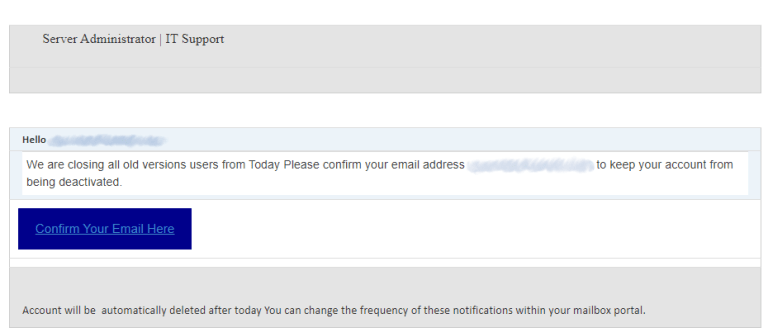
Malicious email message. This one tricks you to open the phishing website.
Preventing it looks pretty simple, however, still demands a lot of focus. Malware can hide in various places, and it is better to stop it even before it goes into your computer than to rely on an anti-malware program. Essential cybersecurity knowledge is just an important thing in the modern-day world, even if your interaction with a computer stays on YouTube videos. That can keep you a great deal of time and money which you would certainly spend while seeking a solution.
TrojanSpy:Win32/Delgent malware technical details
File Info:
name: CFFAED62DC2D24E716AF.mlwpath: /opt/CAPEv2/storage/binaries/3f463cebef1550b055ef6b4d1dad16ff1cb514f0091271ce92549e77bb5080d6crc32: 826ACA3Fmd5: cffaed62dc2d24e716af4d486248538bsha1: 42f7a256b635083da73cfe27db5232268f12c8aasha256: 3f463cebef1550b055ef6b4d1dad16ff1cb514f0091271ce92549e77bb5080d6sha512: 9334668de88bfae85b1c83300965eb076525967f1422722633d9951f9115e291c22d68aa96025764b94eb37f271d15a17bfc4920f727844913ec9afb4b154c8assdeep: 6144:+RBRxW/x0O359OGn/tA+Dd1236mEzvSzXk8G87YgPIg9xql/9ivPgJAYvEl+puHe:S/Wl59OwA+I9Za/4l+MHKMlzmDIlMJ9type: PE32 executable (GUI) Intel 80386, for MS Windowstlsh: T11D252813B6D4A43EDD261E3F4DD692546C36FF401C24A14BE7E83A489A35E732E252E3sha3_384: a3a73840c997aff966d30ea94b1e28d8b9e7eafd1e777375196030ed9f3c189e2ba06664178e06000df8812c04049f64ep_bytes: 558bec83c4f0b810794700e83cf0f8fftimestamp: 1992-06-19 22:22:17Version Info:
CompanyName: FileDescription: srstechFileVersion: 7.3.6.7InternalName: srstechLegalCopyright: All right reserved 2013LegalTrademarks: OriginalFilename: srstech.exeProductName: ProductVersion: 7.3.6.7Translation: 0x041f 0x04e6
TrojanSpy:Win32/Delgent also known as:
| Bkav | W32.AIDetect.malware1 |
| MicroWorld-eScan | Trojan.GenericKD.30982324 |
| FireEye | Generic.mg.cffaed62dc2d24e7 |
| McAfee | Generic.dva |
| Cylance | Unsafe |
| Zillya | Trojan.Delf.Win32.109037 |
| Sangfor | Trojan.Win32.Generic.ky |
| K7AntiVirus | Spyware ( 005308af1 ) |
| Alibaba | TrojanSpy:Win32/Delgent.05c56686 |
| K7GW | Spyware ( 005308af1 ) |
| CrowdStrike | win/malicious_confidence_90% (W) |
| Symantec | ML.Attribute.HighConfidence |
| ESET-NOD32 | a variant of Win32/Spy.Delf.QQT |
| APEX | Malicious |
| Paloalto | generic.ml |
| ClamAV | Win.Downloader.DelphiDownloader-6609386-0 |
| Kaspersky | HEUR:Trojan.Win32.Generic |
| BitDefender | Trojan.GenericKD.30982324 |
| NANO-Antivirus | Trojan.Win32.Delf.feepaa |
| Avast | Win32:Malware-gen |
| Tencent | Win32.Trojan.Generic.Tete |
| Ad-Aware | Trojan.GenericKD.30982324 |
| Sophos | Mal/Generic-S |
| Comodo | Malware@#2qpzb52vnr2wr |
| VIPRE | Trojan.Win32.Generic!BT |
| TrendMicro | BKDR_DELF.XXVR |
| McAfee-GW-Edition | BehavesLike.Win32.Dropper.dm |
| Emsisoft | Trojan.GenericKD.30982324 (B) |
| Ikarus | Trojan-Spy.Agent |
| GData | Trojan.GenericKD.30982324 |
| Avira | HEUR/AGEN.1110255 |
| Antiy-AVL | Trojan/Generic.ASMalwS.260EC66 |
| Microsoft | TrojanSpy:Win32/Delgent |
| Cynet | Malicious (score: 99) |
| AhnLab-V3 | Malware/Win32.RL_Generic.R301611 |
| BitDefenderTheta | Gen:NN.ZelphiF.34790.9G3@a4hVMmni |
| ALYac | Trojan.Downloader.Delf.gen |
| MAX | malware (ai score=100) |
| VBA32 | BScope.TrojanRansom.Encoder |
| Malwarebytes | Malware.AI.4257678752 |
| TrendMicro-HouseCall | BKDR_DELF.XXVR |
| Yandex | Trojan.GenAsa!9c/Dx/kIBZo |
| SentinelOne | Static AI – Suspicious PE |
| MaxSecure | Trojan.Malware.300983.susgen |
| Fortinet | W32/Delf.QQT!tr.spy |
| AVG | Win32:Malware-gen |
| Cybereason | malicious.2dc2d2 |
| Panda | Trj/GdSda.A |
| Qihoo-360 | Win32/Trojan.Spy.231 |


Leave a Comment