
StyleServ, a backdoor malware, operates in stealth mode and likely serves as an initial reconnaissance tool for advanced, targeted cyberattacks. While its functionality remains undisclosed, StyleServ utilizes covert distribution tactics, including phishing, deceptive attachments, and malicious links.
This malware poses a significant risk, potentially leading to data breaches, system failures, and privacy violations. Its elusive nature highlights the need for stringent security measures to counteract emerging cyberattack threats.
StyleServ Overview
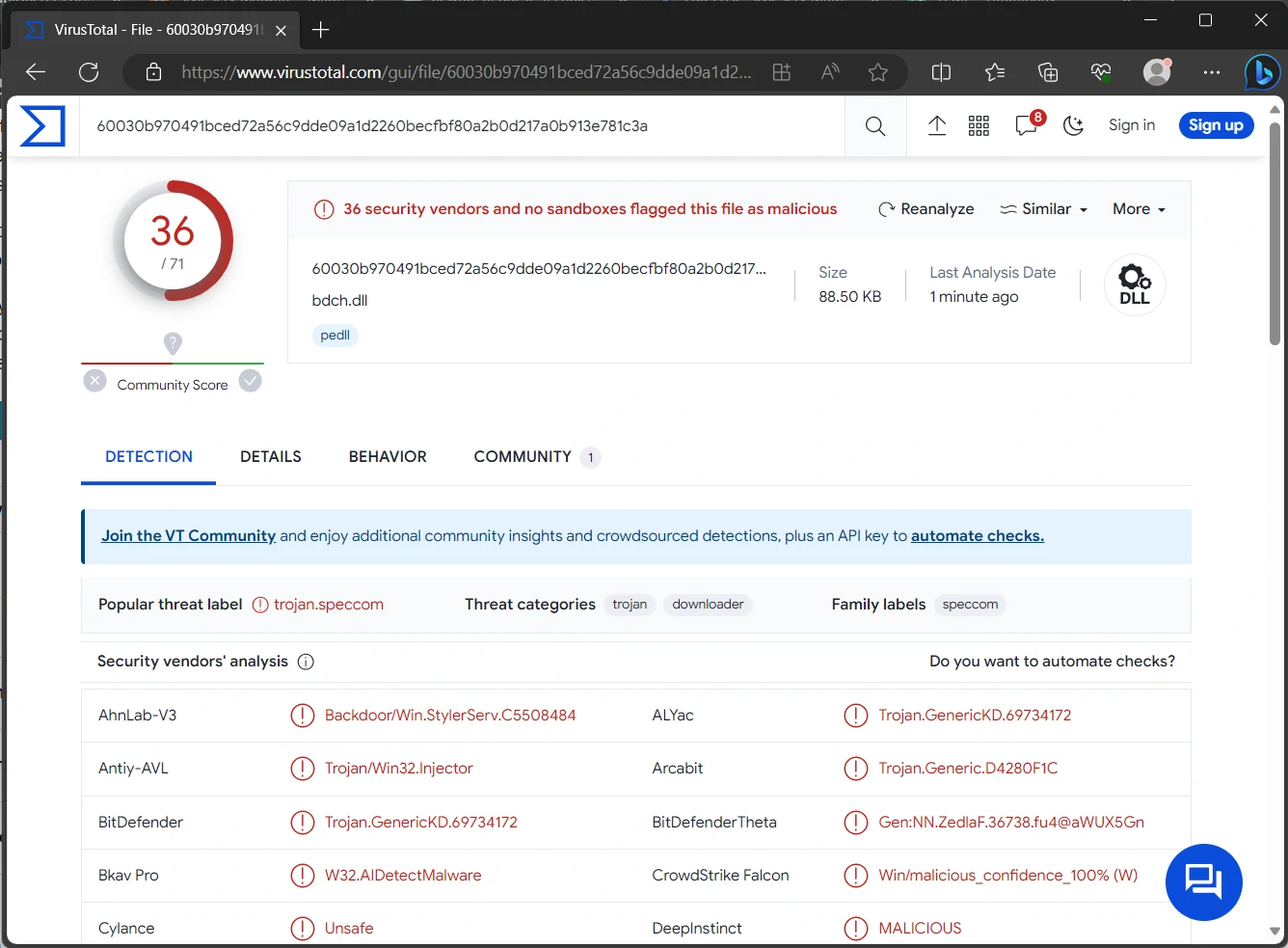
Detection results of vendors on virustotal
| Name | StyleServ |
| Detection | Trojan.Win32.Injector.dd!s1, Trojan:Win32/Injector!MSR (Microsoft) |
| Threat Type | Trojan, backdoor, loader. |
| Similar Behavitor | WhiskerSpy, MQsTTang |
| Damage | Stolen passwords and banking information, identity theft, the victim’s computer added to a botnet. |
Technical Analysis
As previously mentioned, StyleServ’s specific functions remain unclear at present. However, this malware is likely used in a preparatory role during targeted attacks, primarily focusing on scanning infiltrated networks for critical information that can advance the attack. This information may include identifying system vulnerabilities and security weaknesses. Such preparatory tools are instrumental in targeted attacks, providing flexibility as they adapt to the target’s unique security environment.
One notable technique associated with StyleServ infections is the use of DLL side-loading. This method exploits the Windows DLL search to utilize a legitimate program to execute a malicious payload. StyleServ is often involved in passive attacks, focusing on system monitoring, including scanning vulnerabilities and open ports. Passive attacks may involve minimal interaction with the compromised system, or they can engage in active reconnaissance, such as port scanning, to identify potential weaknesses and points of entry within the network.
In StyleServ infections, the malware creates multiple threads, each assigned to a different port, to monitor network activities. These threads periodically check for a file named “stylers.bin” and, if valid, serve it in network requests. This process effectively establishes encrypted connections on these ports for remote access and control. It’s worth noting that StyleServ has been tentatively associated with the Cur malware group. A sample of StyleServ was submitted by the same user who uploaded a variant of the CurLu loader, potentially linking both with the same threat actor operating within the Cur malware family.
The risks associated with StyleServ and similar infections depend on the malware’s capabilities and the attackers’ objectives. Typically, these infections pose threats, including diminished system performance, data loss, severe privacy breaches, financial losses, and potential identity theft. However, the consequences can be far more heavy when targeting high-value or sensitive entities.
StyleServ Overview
StyleServ often conceals itself within seemingly innocuous files or software packages in these covert operations. These can take on multiple forms, such as executable files, archives, Microsoft Office documents, or PDF files. Various cunning tactics characterize the distribution techniques favored by cybercriminals who deploy StyleServ. These include leveraging malicious attachments and deceptive links within spam, direct, private, and SMS emails. Drive-by downloads, designed to ensnare victims without their knowledge or consent, are also part of the repertoire. In addition, online scams, deceptive advertisements (malvertising), and questionable download sources, particularly on unofficial and free file-hosting websites and peer-to-peer (P2P) sharing networks, are commonly utilized.


Leave a Comment