
Seeing the Ransom:Win32/Conti.AD!MTB detection means that your PC is in big danger. This computer virus can correctly be identified as ransomware – type of malware which encrypts your files and forces you to pay for their decryption. Deleteing it requires some specific steps that must be taken as soon as possible.
Ransom:Win32/Conti.AD!MTB detection is a virus detection you can spectate in your system. It frequently appears after the preliminary activities on your computer – opening the dubious e-mail messages, clicking the banner in the Web or setting up the program from untrustworthy resources. From the moment it shows up, you have a short time to do something about it before it begins its destructive action. And be sure – it is better not to await these destructive actions.
What is Ransom:Win32/Conti.AD!MTB virus?
Ransom:Win32/Conti.AD!MTB Summary
Summarizingly, Ransom:Win32/Conti.AD!MTB malware actions in the infected PC are next:
- SetUnhandledExceptionFilter detected (possible anti-debug);
- Possible date expiration check, exits too soon after checking local time;
- Guard pages use detected – possible anti-debugging.;
- Attempts to connect to a dead IP:Port (255 unique times);
- Dynamic (imported) function loading detected;
- Enumerates running processes;
- A process created a hidden window;
- Authenticode signature is invalid;
- Uses Windows utilities for basic functionality;
- Attempts to delete or modify volume shadow copies;
- CAPE detected the Conti malware family;
- Creates a known ContiV2 ransomware decryption instruction / key file.;
- Ciphering the documents kept on the victim’s disk — so the victim cannot use these files;
- Blocking the launching of .exe files of anti-virus programs
- Blocking the launching of installation files of anti-virus programs
Ransomware has been a horror story for the last 4 years. It is hard to imagine a more damaging virus for both individuals and businesses. The algorithms utilized in Ransom:Win32/Conti.AD!MTB (typically, RHA-1028 or AES-256) are not hackable – with minor exclusions. To hack it with a brute force, you need to have a lot more time than our galaxy currently exists, and possibly will exist. However, that virus does not do all these unpleasant things immediately – it may take up to a few hours to cipher all of your documents. Hence, seeing the Ransom:Win32/Conti.AD!MTB detection is a clear signal that you need to begin the removal procedure.
Where did I get the Ransom:Win32/Conti.AD!MTB?
Common methods of Ransom:Win32/Conti.AD!MTB injection are typical for all other ransomware examples. Those are one-day landing websites where users are offered to download the free program, so-called bait e-mails and hacktools. Bait e-mails are a relatively new method in malware distribution – you receive the email that simulates some normal notifications about deliveries or bank service conditions updates. Inside of the email, there is a malicious MS Office file, or a link which opens the exploit landing site.
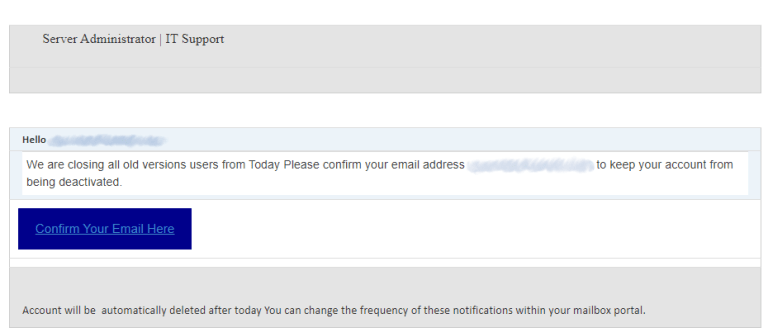
Malicious email message. This one tricks you to open the phishing website.
Preventing it looks quite easy, however, still requires a lot of recognition. Malware can hide in different spots, and it is better to stop it even before it goes into your system than to rely upon an anti-malware program. Basic cybersecurity awareness is just an important thing in the modern world, even if your relationship with a PC remains on YouTube videos. That may keep you a great deal of money and time which you would certainly spend while trying to find a solution.
Ransom:Win32/Conti.AD!MTB malware technical details
File Info:
name: D7DE1F5A581A8F7126DE.mlwpath: /opt/CAPEv2/storage/binaries/332690b41309c297ae8db8fc3ec793cfba5c00542549c12297e54059f39ad091crc32: 4A94C133md5: d7de1f5a581a8f7126de08ba0c4a44f9sha1: db69b789d78712a69b11bc2d312529b453e745f5sha256: 332690b41309c297ae8db8fc3ec793cfba5c00542549c12297e54059f39ad091sha512: a611fc4894cf4d7426b2e8ed95830649d20c846cdaa72ca5d6455d9c63a3e01240212de4e723e0ce1ed72941c08c4b8260f229d67469e201a69cc173adc5e4f0ssdeep: 3072:SVr3mFHO/Oi+3IrUzOHTC9fBPLrL6ek6uBSwjXoItjsTm7tTe5tDFwUKgvvvpCCI:S52ldT6HcBj6kuUu9sC5TenKEvECItype: PE32 executable (GUI) Intel 80386, for MS Windowstlsh: T190043984628D4BA4F56E987056E82D33599EB839079F99F7FBD1872409319C36B30F23sha3_384: 9a4409cf2579a1bd80d77bb179e668a1728ea2f67e5869bea96ba343abdafd93619b84146a0014947b6d1889851c16c8ep_bytes: e8c5020000e97afeffff558bec83ec0ctimestamp: 2022-05-02 16:12:45Version Info:
0: [No Data]
Ransom:Win32/Conti.AD!MTB also known as:
| Bkav | W32.AIDetect.malware1 |
| Cylance | Unsafe |
| Sangfor | Trojan.Win32.Save.a |
| Symantec | Ransom.Generic.1 |
| Elastic | malicious (high confidence) |
| ESET-NOD32 | a variant of Win32/Filecoder.Conti.H |
| APEX | Malicious |
| Avast | Win32:Conti-B [Ransom] |
| Cynet | Malicious (score: 100) |
| Kaspersky | VHO:Trojan-PSW.Win32.Agent.gen |
| BitDefender | Gen:Variant.Zusy.356529 |
| MicroWorld-eScan | Gen:Variant.Zusy.356529 |
| Ad-Aware | Gen:Variant.Zusy.356529 |
| Emsisoft | Gen:Variant.Zusy.356529 (B) |
| TrendMicro | Ransom.Win32.CONTI.SM.hp |
| FireEye | Generic.mg.d7de1f5a581a8f71 |
| Sophos | Generic ML PUA (PUA) |
| SentinelOne | Static AI – Malicious PE |
| GData | Gen:Variant.Zusy.356529 |
| Avira | HEUR/AGEN.1213132 |
| Arcabit | Trojan.Zusy.D570B1 |
| ZoneAlarm | VHO:Trojan-PSW.Win32.Agent.gen |
| Microsoft | Ransom:Win32/Conti.AD!MTB |
| AhnLab-V3 | Ransomware/Win.CONTI.C5028287 |
| VBA32 | BScope.Trojan.Mansabo |
| ALYac | Gen:Variant.Zusy.356529 |
| MAX | malware (ai score=84) |
| Malwarebytes | Malware.AI.1016454116 |
| TrendMicro-HouseCall | Ransom.Win32.CONTI.SM.hp |
| Rising | [email protected] (RDMK:cmRtazpbFL+GheP6U+CpNVRHWOOC) |
| Ikarus | Trojan-Ransom.Conti |
| Fortinet | W32/Conti.H!tr.ransom |
| BitDefenderTheta | Gen:NN.ZexaF.34638.kuW@aaDn@@ci |
| AVG | Win32:Conti-B [Ransom] |
| Cybereason | malicious.a581a8 |


Leave a Comment