
Burntcigar is a menacing malware often employed in ransomware attacks, particularly with the Cuba ransomware variant. It infiltrates systems through deceptive downloads, malicious email attachments, and software vulnerabilities.
Once inside, Burntcigar targets antivirus and security processes, disabling critical protections. This malware’s actions can lead to extensive data loss, financial harm, and system vulnerabilities, making it a significant cybersecurity threat.
Burntcigar Overview
| Name | Burntcigar |
| Detection | Trojan.Win32.Agent.sa, Program:Win32/Wacapew.C!ml (Microsoft) |
| Similar behavior | SapphireStealer, Luca Stealer |
| Damage | Data encryption, stolen passwords and banking information, identity theft, the victim’s computer added to a botnet, and other harm. |
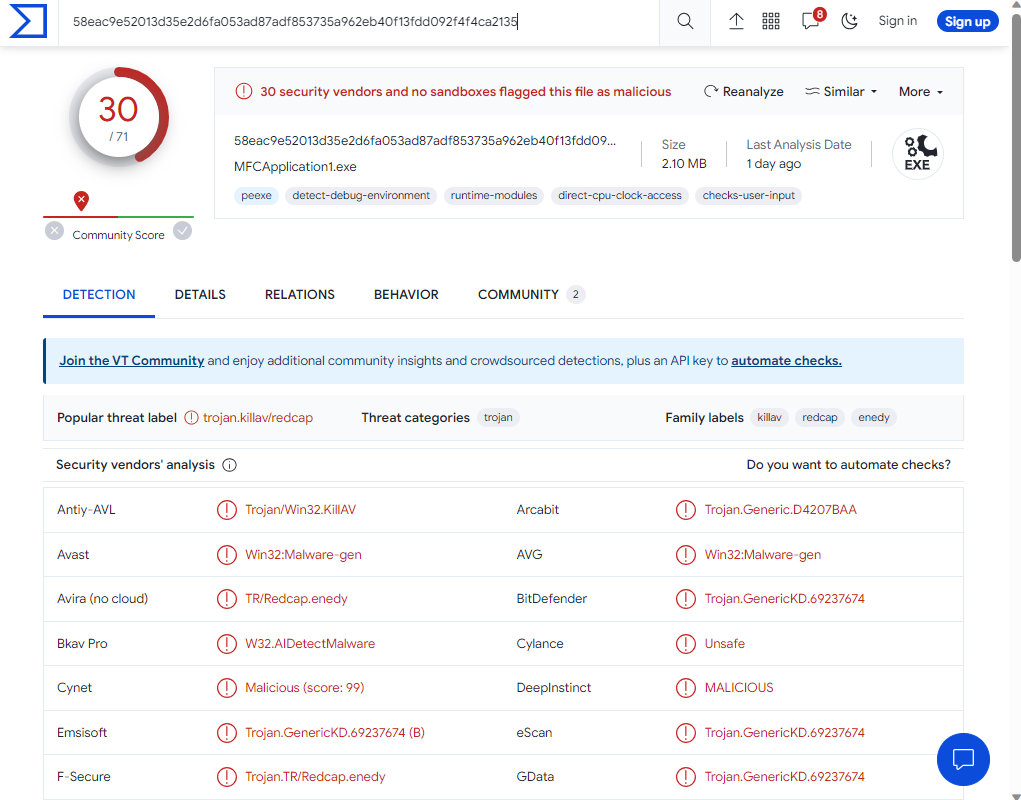
VirusTotal result
Technical Details
Burntcigar is a highly malicious strain of malware that has gained infamy in the realm of cyber threats. Cybercriminals frequently employ this malware to carry out ransomware attacks, explicitly focusing on infiltrating the systems of unsuspecting victims. Burntcigar uses a cunning modus operandi, including exploiting security vulnerabilities found in popular antivirus and endpoint detection and response (EDR) products. One of its notable tactics involves targeting processes associated with these security solutions and adding their process IDs to a termination list, ultimately disabling critical security measures on infected machines.
Furthermore, Burntcigar is known for its capability to compromise system integrity by exploiting drivers and the execution of malicious code. In some instances, it has been found to exploit the Avast anti-rootkit driver, thereby enabling unauthorized access to targeted systems. Additionally, the malware has been observed using BAT (Batch) files to install the insecure driver, providing attackers with a gateway to conduct their nefarious activities.
The potential damages inflicted by Burntcigar and similar malware are significant and can have far-reaching consequences. Firstly, victims may suffer extensive data loss, as the malware encrypts files, rendering them inaccessible without a decryption key. Secondly, there is a substantial risk of financial losses, as attackers typically demand a ransom in exchange for the decryption key, which victims may choose to pay, further incentivizing cybercriminals. Moreover, the disabling critical security measures by Burntcigar can leave systems vulnerable to other forms of malware, potentially leading to additional breaches, data theft, or system compromise.
Spreading Methods
Cybercriminals employ various tactics to infiltrate computers with Burntcigar and similar malware. One standard method is disguising Burntcigar within seemingly legitimate software or files available for download on untrustworthy or compromised websites. Another prevalent approach involves sending emails with infected attachments or links to malicious websites. Exploiting software vulnerabilities is another avenue cybercriminals use to deploy Burntcigar, with outdated or unpatched software being especially vulnerable. Additionally, malicious code may be injected into compromised websites, leading to automatic downloads and execution of Burntcigar on users’ systems without their knowledge or consent. Cybercriminals can also propagate Burntcigar through infected USB drives, external storage devices, or network shares.


Leave a Comment