
Spectating the Trojan:Win32/VirLock.RPR!MTB detection means that your system is in big danger. This virus can correctly be named as ransomware – sort of malware which ciphers your files and forces you to pay for their decryption. Stopping it requires some unusual steps that must be done as soon as possible.
Trojan:Win32/VirLock.RPR!MTB detection is a malware detection you can spectate in your computer. It often appears after the preliminary procedures on your PC – opening the untrustworthy email messages, clicking the advertisement in the Internet or mounting the program from dubious sources. From the instance it shows up, you have a short time to do something about it before it starts its malicious action. And be sure – it is far better not to wait for these destructive effects.
What is Trojan:Win32/VirLock.RPR!MTB virus?
Trojan:Win32/VirLock.RPR!MTB Summary
In total, Trojan:Win32/VirLock.RPR!MTB malware actions in the infected PC are next:
- Behavioural detection: Executable code extraction – unpacking;
- At least one process apparently crashed during execution;
- Creates RWX memory;
- The binary likely contains encrypted or compressed data.;
- Authenticode signature is invalid;
- Encrypting the documents kept on the victim’s disk drive — so the victim cannot check these documents;
- Blocking the launching of .exe files of anti-virus apps
- Blocking the launching of installation files of anti-virus apps
Ransomware has actually been a nightmare for the last 4 years. It is difficult to realize a more hazardous virus for both individual users and businesses. The algorithms utilized in Trojan:Win32/VirLock.RPR!MTB (typically, RHA-1028 or AES-256) are not hackable – with minor exclusions. To hack it with a brute force, you need more time than our galaxy currently exists, and possibly will exist. However, that malware does not do all these terrible things instantly – it may take up to several hours to cipher all of your files. Thus, seeing the Trojan:Win32/VirLock.RPR!MTB detection is a clear signal that you should start the clearing procedure.
Where did I get the Trojan:Win32/VirLock.RPR!MTB?
Standard methods of Trojan:Win32/VirLock.RPR!MTB spreading are common for all other ransomware variants. Those are one-day landing web pages where victims are offered to download and install the free program, so-called bait emails and hacktools. Bait emails are a pretty new strategy in malware spreading – you get the e-mail that mimics some routine notifications about shipments or bank service conditions changes. Within the e-mail, there is a malicious MS Office file, or a web link which leads to the exploit landing site.
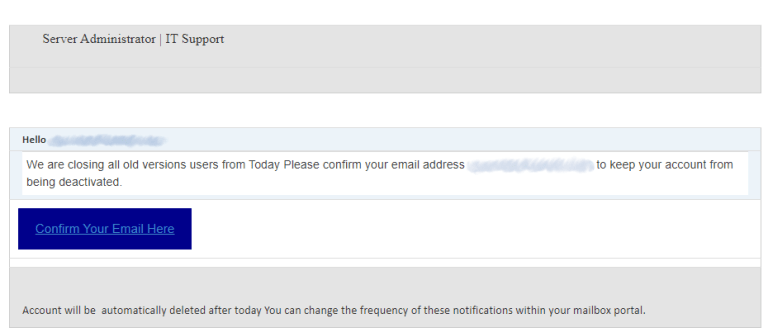
Malicious email message. This one tricks you to open the phishing website.
Preventing it looks quite uncomplicated, however, still requires a lot of focus. Malware can hide in different places, and it is far better to stop it even before it goes into your system than to rely on an anti-malware program. General cybersecurity awareness is just an important thing in the modern-day world, even if your interaction with a computer stays on YouTube videos. That may save you a great deal of money and time which you would spend while searching for a fixing guide.
Trojan:Win32/VirLock.RPR!MTB malware technical details
File Info:
name: D5435529C2271FC6254C.mlwpath: /opt/CAPEv2/storage/binaries/e3765c92fbf304ad8800e604ac9ed90f2678c86c8166a841e4dbfc0149180c2dcrc32: 79CFAA71md5: d5435529c2271fc6254c6668b9d370cfsha1: 9bac1973dda809cf0849d1bb8fc12738932b82e3sha256: e3765c92fbf304ad8800e604ac9ed90f2678c86c8166a841e4dbfc0149180c2dsha512: 15f2272b0744c7095cda0c45714f75d677d891bfe063528ff596cb3384ca45da620bd4db0d28ec52b3f739a39d9c59c9d35619efbf19334e8f97dc6a1bbbf446ssdeep: 12288:Juv9KShuDvPuENi1xlYmnhAZmmrp/09OLonqcsqaVrQ/Utx:Juv9Xhmek6TniZlrh02oquaLtxtype: PE32 executable (GUI) Intel 80386, for MS Windowstlsh: T102E4CE947B12FE0DC51976FEB520320273BD6E25BF5D96E35682AC1A84063ECA0FE54Csha3_384: 490ac90b64116b4050b146894bcee9db3a156d3bd832d3303e3787fd63f1e863ab1e075b330e477e9c51c88c70c9c05bep_bytes: 83ec48e827be0a00e901000000c3e816timestamp: 2015-02-07 09:53:36Version Info:
0: [No Data]
Trojan:Win32/VirLock.RPR!MTB also known as:
| Lionic | Trojan.Win32.Generic.mt7t |
| Elastic | malicious (high confidence) |
| MicroWorld-eScan | Win32.Virlock.Gen.3 |
| McAfee | W32/VirRansom.b!D5435529C227 |
| Malwarebytes | Malware.Heuristic.1001 |
| Sangfor | Suspicious.Win32.Save.a |
| K7AntiVirus | Trojan ( 0040fa5c1 ) |
| BitDefender | Win32.Virlock.Gen.3 |
| K7GW | Trojan ( 0040fa5c1 ) |
| Cybereason | malicious.9c2271 |
| Baidu | Win32.Virus.Virlock.e |
| Cyren | W32/S-11daff79!Eldorado |
| Symantec | W32.Virlock!gen1 |
| ESET-NOD32 | a variant of Win32/Virlock.J |
| APEX | Malicious |
| Paloalto | generic.ml |
| ClamAV | Win.Malware.Virlock-9935222-0 |
| Kaspersky | Virus.Win32.PolyRansom.f |
| Alibaba | Ransom:Win32/PolyRansom.9b188861 |
| NANO-Antivirus | Virus.Win32.Virlock.driqkj |
| Avast | Win32:Nabucur-B [Trj] |
| Rising | Malware.Heuristic!ET#98% (RDMK:cmRtazpCQOd+cjEimL804Tlpa44O) |
| Emsisoft | Win32.Virlock.Gen.3 (B) |
| Comodo | Virus.Win32.VirLock.GA@7lv9go |
| F-Secure | Trojan.TR/Crypt.ZPACK.Gen |
| DrWeb | Win32.VirLock.16 |
| VIPRE | Virus.Win32.Nabucur.c (v) |
| TrendMicro | PE_VIRLOCK.A-O |
| McAfee-GW-Edition | BehavesLike.Win32.VirRansom.jc |
| FireEye | Generic.mg.d5435529c2271fc6 |
| Sophos | ML/PE-A + W32/VirRnsm-E |
| Jiangmin | Win32/Polyransom.f |
| Avira | TR/Crypt.ZPACK.Gen |
| MAX | malware (ai score=85) |
| Antiy-AVL | Virus/Win32.PolyRansom.f |
| Microsoft | Trojan:Win32/VirLock.RPR!MTB |
| ZoneAlarm | Virus.Win32.PolyRansom.f |
| GData | Win32.Virlock.Gen.3 |
| Cynet | Malicious (score: 100) |
| AhnLab-V3 | Win32/Nabucur.D.X1506 |
| VBA32 | Virus.Virlock.gen.01 |
| ALYac | Win32.Virlock.Gen.3 |
| TACHYON | Virus/W32.VirRansom.D |
| Cylance | Unsafe |
| TrendMicro-HouseCall | PE_VIRLOCK.A-O |
| Tencent | Virus.Win32.Polyransom.f |
| SentinelOne | Static AI – Malicious PE |
| eGambit | Unsafe.AI_Score_100% |
| Fortinet | W32/Virlock.B |
| BitDefenderTheta | AI:FileInfector.AE99F02013 |
| AVG | Win32:Nabucur-B [Trj] |
| Panda | Trj/Genetic.gen |
| CrowdStrike | win/malicious_confidence_100% (W) |
| MaxSecure | Virus.PolyRansom.b |


Leave a Comment