
Trojan:Win32/SmokeLoader.YL

If you spectate the alert of Trojan:Win32/SmokeLoader.YL detection, it seems that your computer has a problem. All malicious programs are dangerous, without any deviations. SmokeLoader provides the criminals access to your system, or even connects it to the botnet.

What does the notification with Trojan:Win32/SmokeLoader.YL detection mean?

The Trojan:Win32/SmokeLoader.YL detection you can see in the lower right corner is displayed to you by Microsoft Defender. That anti-malware program is pretty good at scanning, however, prone to be generally unreliable. It is vulnerable to malware attacks, it has a glitchy user interface and bugged malware removal capabilities. Hence, the pop-up which states about the SmokeLoader is just a notification that Defender has found it. To remove it, you will likely need to use another anti-malware program.
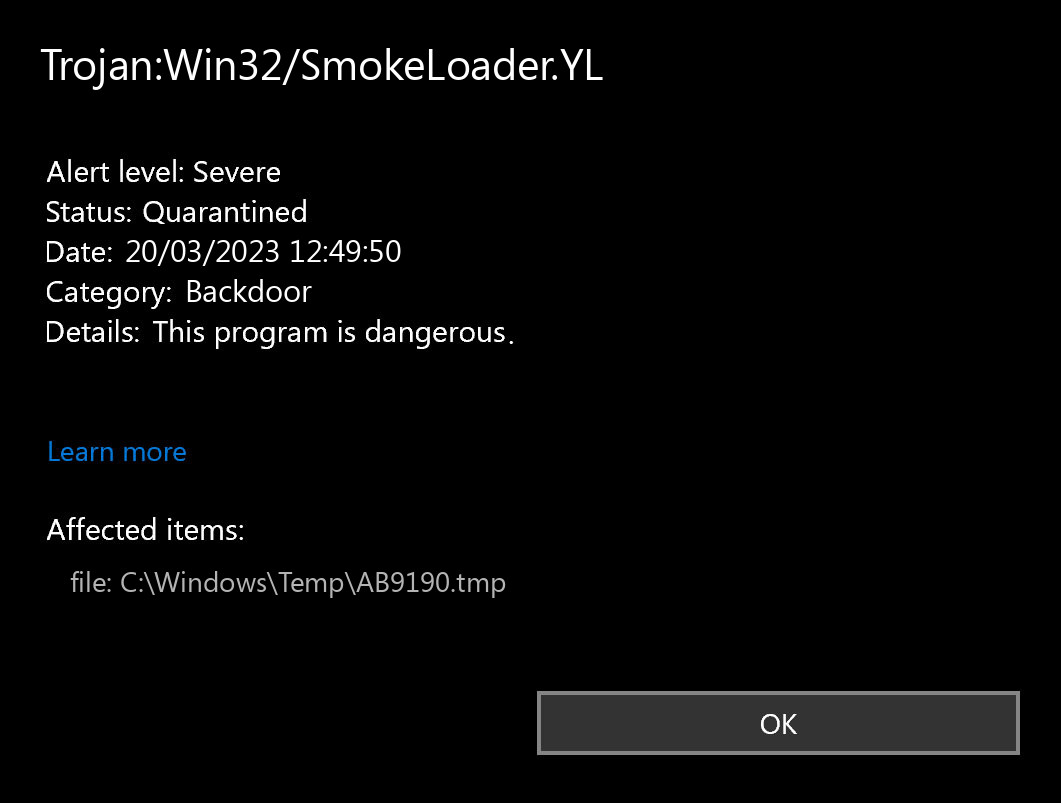
Trojan:Win32/SmokeLoader.YL found

Microsoft Defender: “Trojan:Win32/SmokeLoader.YL”

The exact Trojan:Win32/SmokeLoader.YL malware is a really nasty thing. This malware is created to be a stealthy intruder, which works as a remote-access tool. When you give someone remote access willingly, it is alright, however, SmokeLoader will not ask you if you wish to grant it. After connecting to your PC, crooks are able to do whatever they want – getting your files, reading your messages, collecting personal information, et cetera. Backdoors commonly bring an additional stealer – the virus that is made to collect all possible information about you. Nevertheless, far more common use of the backdoors is establishing the botnet. Then, the network of attacked systems may be used to conduct DDoS attacks or to inflate the poll results on various sites.

Backdoor Summary:

Name SmokeLoader Backdoor
Detection Trojan:Win32/SmokeLoader.YL
Damage Gain access to the operating system to perform various malicious actions.
Similar Msil Androme, Lotok, Quasarrat, Asyncrat, Smokeloader, Msil Dcrat, Rewritehttp, Msil Darkcommet
Fix Tool See If Your System Has Been Affected by SmokeLoader backdoor

Properties of Trojan:Win32/SmokeLoader.YL

Smokeloader.YL actions
  • Executable code extraction. Cybercriminals often use binary packers to hinder the malicious code from reverse-engineered by malware analysts. A packer is a tool that compresses, encrypts, and modifies a malicious file’s format. Sometimes packers can be used for legitimate ends, for example, to protect a program against cracking or copying.
  • Injection (inter-process);
  • Injection (Process Hollowing);
  • Creates RWX memory. There is a security trick with memory regions that allows an attacker to fill a buffer with a shellcode and then execute it. Filling a buffer with shellcode isn’t a big deal, it’s just data. The problem arises when the attacker is able to control the instruction pointer (EIP), usually by corrupting a function’s stack frame using a stack-based buffer overflow, and then changing the flow of execution by assigning this pointer to the address of the shellcode.
  • A process attempted to delay the analysis task.;
  • Attempts to connect to a dead IP:Port (13 unique times);
  • Starts servers listening on 0.0.0.0:9666;
  • Reads data out of its own binary image. The trick that allows the malware to read data out of your computer’s memory.

    Everything you run, type, or click on your computer goes through the memory. This includes passwords, bank account numbers, emails, and other confidential information. With this vulnerability, there is the potential for a malicious program to read that data.

  • A process created a hidden window;
  • Performs some HTTP requests;
  • Uses Windows utilities for basic functionality;
  • Enumerates services, possibly for anti-virtualization;
  • Executed a process and injected code into it, probably while unpacking;
  • Creates or sets a registry key to a long series of bytes, possibly to store a binary or malware config;
  • Installs itself for autorun at Windows startup.

    There is simple tactic using the Windows startup folder located at:
    C:\Users\[user-name]\AppData\Roaming\Microsoft\Windows\StartMenu\Programs\Startup Shortcut links (.lnk extension) placed in this folder will cause Windows to launch the application each time [user-name] logs into Windows.

    The registry run keys perform the same action, and can be located in different locations:

    • HKEY_LOCAL_MACHINE\Software\Microsoft\Windows\CurrentVersion\Run
    • HKEY_CURRENT_USER\Software\Microsoft\Windows\CurrentVersion\Run
    • HKEY_LOCAL_MACHINE\Software\Microsoft\Windows\CurrentVersion\RunOnce
    • HKEY_CURRENT_USER\Software\Microsoft\Windows\CurrentVersion\RunOnce
  • A possible cryptomining command was executed;
  • Attempts to interact with an Alternate Data Stream (ADS);
  • Anomalous binary characteristics. This is a way of hiding virus’ code from antiviruses and virus’ analysts.
Other names of Trojan:Win32/SmokeLoader.YL
GridinSoft Trojan.Ransom.Gen
Bkav W32.AIDetectVM.malware1
Elastic malicious (high confidence)
ClamAV Win.Dropper.Tofsee-7174622-0
FireEye Generic.mg.7278fedadb69f721
McAfee GenericRXHS-BZ!7278FEDADB69
Cylance Unsafe
Sangfor Malware
BitDefender Trojan.Mint.Zamg.Q
Cybereason malicious.adb69f
TrendMicro Trojan.Win32.ELENOOKA.SM.hp
Cyren W32/Emotet.VV.gen!Eldorado
Symantec Ransom.Cerber
APEX Malicious
Cynet Malicious (score: 100)
Kaspersky HEUR:Trojan.Win32.Generic
NANO-Antivirus Trojan.Win32.GenKryptik.fpxinl
MicroWorld-eScan Trojan.Mint.Zamg.Q
Rising Trojan.Kryptik!1.BCEB (CLASSIC)
Ad-Aware Trojan.Mint.Zamg.Q
Sophos Mal/Elenoocka-G
F-Secure Heuristic.HEUR/AGEN.1111254
DrWeb Trojan.Siggen11.2115
Invincea ML/PE-A + Mal/Elenoocka-G
McAfee-GW-Edition BehavesLike.Win32.Emotet.rh
Emsisoft Trojan.Mint.Zamg.Q (B)
Ikarus Trojan.Win32.Tofsee
Avira HEUR/AGEN.1111254
MAX malware (ai score=87)
Microsoft Trojan:Win32/SmokeLoader.YL
Gridinsoft Trojan.Heur!.03012021
Arcabit Trojan.Mint.Zamg.Q
ZoneAlarm HEUR:Trojan.Win32.Generic
GData Trojan.Mint.Zamg.Q
AhnLab-V3 Malware/Win32.RL_Generic.R269696
Acronis suspicious
VBA32 Trojan.FakeAV.01657
ALYac Trojan.Mint.Zamg.Q
Malwarebytes Trojan.MalPack.VAK
ESET-NOD32 a variant of Win32/Kryptik.GSHH
TrendMicro-HouseCall Trojan.Win32.ELENOOKA.SM.hp
Yandex Trojan.GenAsa!9pxhj5tDvTg
SentinelOne Static AI – Malicious PE
MaxSecure Trojan.Malware.300983.susgen
Fortinet W32/Kryptik.GSVZ!tr
BitDefenderTheta Gen:NN.ZexaF.34590.@xW@ayHNY7mi
AVG FileRepMalware
CrowdStrike win/malicious_confidence_100% (D)
Qihoo-360 HEUR/QVM19.1.38DF.Malware.Gen
Shortly about backdoors

Is Trojan:Win32/SmokeLoader.YL dangerous?

As I have actually mentioned previously, non-harmful malware does not exist. And Trojan:Win32/SmokeLoader.YL is not an exception. This backdoor does not deal a lot of harm just after it launches. However, it will be a very bad surprise when an occasional online forum or website in the Web will not let you in, due to the fact that your IP-address is banned after the DDoS attack. However, even if it is not important for you – is it positive at all to know that somebody can easily access your computer, check out your conversations, open your documents, and spectate what you do?

The spyware that is frequently present as a supplement to the Trojan:Win32/SmokeLoader.YL virus will likely be just one more reason to remove it as fast as you can. Nowadays, when users’ information is priced exceptionally high, it is too illogical to provide the burglars such an opportunity. Even worse if the spyware will somehow handle to thieve your financial information. Seeing zeros on your financial account is the most awful headache, in my judgement.

How did I get this virus?

It is hard to trace the sources of malware on your PC. Nowadays, things are mixed up, and distribution ways chosen by adware 5 years ago can be utilized by spyware these days. But if we abstract from the exact spreading way and will think of why it has success, the answer will be very simple – low level of cybersecurity knowledge. Individuals click on advertisements on strange sites, click the pop-ups they receive in their browsers, call the “Microsoft tech support” assuming that the odd banner that states about malware is true. It is necessary to understand what is legitimate – to avoid misunderstandings when attempting to identify a virus.
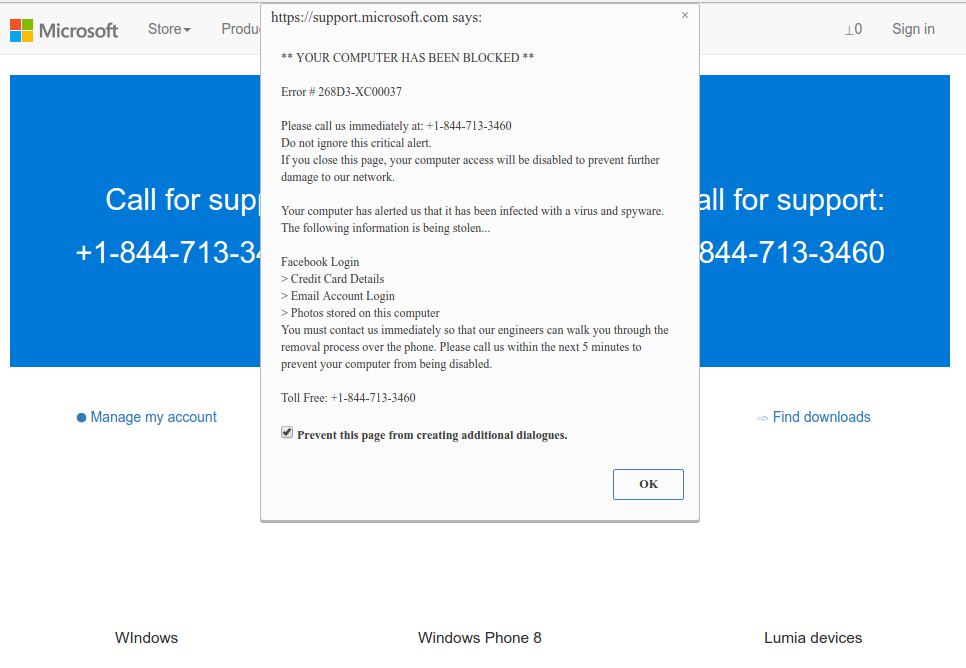
Microsoft Tech Support Scam

Microsoft Tech Support Scam

Nowadays, there are two of the most common ways of malware spreading – lure emails and also injection into a hacked program. While the first one is not so easy to stay away from – you must know a lot to understand a counterfeit – the 2nd one is simple to address: just do not utilize hacked programs. Torrent-trackers and other sources of “totally free” applications (which are, exactly, paid, but with a disabled license checking) are just a giveaway point of malware. And Trojan:Win32/SmokeLoader.YL is simply among them.

How to remove the Trojan:Win32/SmokeLoader.YL from my PC?

References

  1. Gossip about the backdoor in Intel processors on Reddit.

About the author

Robert Bailey

Security engineer focused on malware behavior, removal workflows, and Windows hardening. Robert reviews threat articles for practical accuracy, checking detection names, symptoms, and cleanup steps before publication.

Leave a Comment
