
Spectating the Trojan:Win32/Gozi.RD!MTB detection name usually means that your system is in big danger. This malware can correctly be named as ransomware – type of malware which encrypts your files and forces you to pay for their decryption. Deleteing it requires some specific steps that must be taken as soon as possible.
Trojan:Win32/Gozi.RD!MTB detection is a malware detection you can spectate in your system. It usually shows up after the provoking activities on your computer – opening the dubious email, clicking the advertisement in the Internet or setting up the program from untrustworthy resources. From the second it appears, you have a short time to take action until it begins its destructive activity. And be sure – it is much better not to await these harmful effects.
What is Trojan:Win32/Gozi.RD!MTB virus?
Trojan:Win32/Gozi.RD!MTB Summary
Summarizingly, Trojan:Win32/Gozi.RD!MTB virus activities in the infected system are next:
- Behavioural detection: Executable code extraction – unpacking;
- Uses Windows utilities for basic functionality;
- Performs HTTP requests potentially not found in PCAP.;
- Reads data out of its own binary image;
- CAPE extracted potentially suspicious content;
- Drops a binary and executes it;
- The binary likely contains encrypted or compressed data.;
- Authenticode signature is invalid;
- Uses Windows utilities to create a scheduled task;
- Behavioural detection: Injection (inter-process);
- Behavioural detection: Injection with CreateRemoteThread in a remote process;
- Attempts to modify proxy settings;
- Deletes executed files from disk;
- Uses suspicious command line tools or Windows utilities;
- Ciphering the files kept on the target’s disk drives — so the victim cannot use these documents;
- Blocking the launching of .exe files of anti-malware apps
- Blocking the launching of installation files of security tools
Ransomware has actually been a headache for the last 4 years. It is hard to realize a more damaging malware for both individual users and corporations. The algorithms used in Trojan:Win32/Gozi.RD!MTB (typically, RHA-1028 or AES-256) are not hackable – with minor exclusions. To hack it with a brute force, you need to have a lot more time than our galaxy actually exists, and possibly will exist. But that virus does not do all these terrible things instantly – it may require up to several hours to cipher all of your files. Therefore, seeing the Trojan:Win32/Gozi.RD!MTB detection is a clear signal that you should begin the clearing procedure.
Where did I get the Trojan:Win32/Gozi.RD!MTB?
Ordinary methods of Trojan:Win32/Gozi.RD!MTB injection are typical for all other ransomware variants. Those are one-day landing websites where victims are offered to download and install the free software, so-called bait emails and hacktools. Bait e-mails are a quite new method in malware spreading – you receive the e-mail that simulates some standard notifications about deliveries or bank service conditions modifications. Inside of the e-mail, there is an infected MS Office file, or a link which opens the exploit landing page.
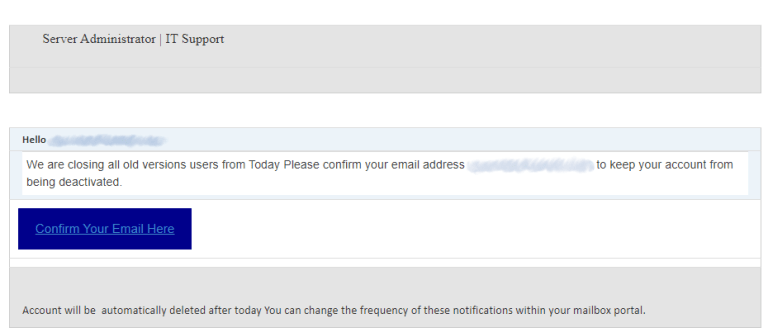
Malicious email message. This one tricks you to open the phishing website.
Preventing it looks quite uncomplicated, but still demands a lot of awareness. Malware can hide in various spots, and it is much better to stop it even before it invades your PC than to trust in an anti-malware program. Standard cybersecurity awareness is just an essential item in the modern world, even if your interaction with a PC remains on YouTube videos. That can save you a lot of time and money which you would spend while seeking a solution.
Trojan:Win32/Gozi.RD!MTB malware technical details
File Info:
name: 64591BD1F0727CB974BB.mlwpath: /opt/CAPEv2/storage/binaries/9e0e00754886c2ff6f008df7647eb575ef157d54a16071d18bed8ebd87cd7c48crc32: 75AF0395md5: 64591bd1f0727cb974bbfb07dff3da0esha1: dcd0051af818ef79e5b86c0a25dd701440b60c7dsha256: 9e0e00754886c2ff6f008df7647eb575ef157d54a16071d18bed8ebd87cd7c48sha512: f3c553519c54e1e9c784d910b10dd92890af87a3716c275fd8cb4bf1bb2f9dbf9e441a607c091734009bbcc6738551942eb8dd30fcfce583ef3d6373d4788cabssdeep: 3072:vBI5ArKGCnhgU1XA+ArXjeaMoh6lgUaVwQ+/76bSSN+PS7VyoCeJ6ikpm:vK5ArKjbAxXSaegUqGeGpBohMptype: PE32 executable (GUI) Intel 80386, for MS Windowstlsh: T1E30412FA8E5E8D06D268CC3436B3FF6B10B76375D6EF8E23874E4052C24055C6A5B61Asha3_384: 6161f991b393a3082af1b32972a9edf6341cb6bd2f4b3c1745b67bdde803dbd3d51160ea956ec772f2d2108dd12aff59ep_bytes: ff1528c04200a300d04200e8dffdfffftimestamp: 2023-04-23 20:41:05Version Info:
0: [No Data]
Trojan:Win32/Gozi.RD!MTB also known as:
| Bkav | W32.AIDetectMalware |
| MicroWorld-eScan | Win32.Doboc.Gen.1 |
| FireEye | Generic.mg.64591bd1f0727cb9 |
| CAT-QuickHeal | Trojan.Mauvaise.SL1 |
| Skyhigh | BehavesLike.Win32.DocumentCrypt.cc |
| McAfee | W32/DocumentCrypt |
| Malwarebytes | Generic.Malware.AI.DDS |
| Zillya | Virus.PolyRansom.Win32.3 |
| Sangfor | Suspicious.Win32.Save.a |
| K7AntiVirus | Trojan ( 0040fa661 ) |
| BitDefender | Win32.Doboc.Gen.1 |
| K7GW | Trojan ( 0040fa661 ) |
| CrowdStrike | win/malicious_confidence_100% (W) |
| BitDefenderTheta | AI:FileInfector.1210116D11 |
| VirIT | Trojan.Win32.Inject1.DAQO |
| Symantec | W32.Tempedreve.E!inf |
| Elastic | malicious (high confidence) |
| ESET-NOD32 | Win32/Spy.Tuscas.K |
| Cynet | Malicious (score: 100) |
| APEX | Malicious |
| ClamAV | Win.Trojan.Doboc-320 |
| Kaspersky | Virus.Win32.PolyRansom.c |
| Alibaba | Ransom:Win32/PolyRansom.1005 |
| NANO-Antivirus | Trojan.Win32.PolyRansom.dpzfcr |
| Rising | [email protected] (RDML:Hn2MrbEIcLVePNgkExY0pw) |
| TACHYON | Trojan/W32.Doboc |
| Sophos | W32/MPhage-B |
| Baidu | Win32.Trojan.Kryptik.iq |
| F-Secure | Trojan.TR/Crypt.ZPACK.Gen |
| DrWeb | Trojan.Inject1.53269 |
| VIPRE | Win32.Doboc.Gen.1 |
| TrendMicro | PE_URSNIF.E-O |
| Trapmine | malicious.high.ml.score |
| Emsisoft | Win32.Doboc.Gen.1 (B) |
| Ikarus | Trojan.Win32.Crypt |
| Jiangmin | Virus.PolyRansom.dv |
| Webroot | W32.Trojan.Ursnif |
| Varist | W32/Virus.LSLV-1164 |
| Avira | TR/Crypt.ZPACK.Gen |
| Antiy-AVL | Virus/Win32.PolyRansom.c |
| Kingsoft | malware.kb.a.1000 |
| Microsoft | Trojan:Win32/Gozi.RD!MTB |
| Xcitium | TrojWare.Win32.Ursnif.KIL@5jjifs |
| Arcabit | Win32.Doboc.Gen.1 |
| SUPERAntiSpyware | Trojan.Agent/Gen-Kryptik |
| ZoneAlarm | Virus.Win32.PolyRansom.c |
| GData | Win32.Trojan.PSE.10EM3L6 |
| Detected | |
| AhnLab-V3 | Trojan/Win32.Ursnif.R239873 |
| ALYac | Win32.Doboc.Gen.1 |
| MAX | malware (ai score=88) |
| DeepInstinct | MALICIOUS |
| VBA32 | SScope.Trojan.FakeAV.01681 |
| Cylance | unsafe |
| Panda | W32/CryptD.C |
| TrendMicro-HouseCall | PE_URSNIF.E-O |
| Tencent | Trojan.Win32.Tuscas.a |
| Yandex | Trojan.GenAsa!RK3x+npEgzs |
| SentinelOne | Static AI – Malicious PE |
| MaxSecure | Virus.w32.PolyRansom.C |
| Fortinet | W32/Tuscas.A!tr |
| AVG | Win32:WormX-gen [Wrm] |
| Cybereason | malicious.af818e |
| Avast | Win32:WormX-gen [Wrm] |


Leave a Comment