
Spectating the Trojan-Ransom.Win32.Blocker.fgsy malware detection usually means that your computer is in big danger. This computer virus can correctly be identified as ransomware – type of malware which ciphers your files and forces you to pay for their decryption. Stopping it requires some unusual steps that must be taken as soon as possible.
Trojan-Ransom.Win32.Blocker.fgsy detection is a malware detection you can spectate in your system. It often shows up after the provoking activities on your PC – opening the untrustworthy email, clicking the advertisement in the Internet or setting up the program from unreliable resources. From the instance it appears, you have a short time to take action until it begins its harmful action. And be sure – it is far better not to wait for these malicious things.
What is Trojan-Ransom.Win32.Blocker.fgsy virus?
Trojan-Ransom.Win32.Blocker.fgsy Summary
In summary, Trojan-Ransom.Win32.Blocker.fgsy virus actions in the infected computer are next:
- Sample contains Overlay data;
- Yara rule detections observed from a process memory dump/dropped files/CAPE;
- Reads data out of its own binary image;
- Drops a binary and executes it;
- The binary likely contains encrypted or compressed data.;
- Authenticode signature is invalid;
- Uses Windows utilities for basic functionality;
- Uses Windows utilities for basic functionality;
- Deletes executed files from disk;
- Encrypting the files kept on the target’s drive — so the victim cannot check these documents;
- Blocking the launching of .exe files of security tools
- Blocking the launching of installation files of anti-virus programs
Ransomware has been a headache for the last 4 years. It is hard to realize a more dangerous virus for both individual users and businesses. The algorithms used in Trojan-Ransom.Win32.Blocker.fgsy (typically, RHA-1028 or AES-256) are not hackable – with minor exclusions. To hack it with a brute force, you need to have more time than our galaxy actually exists, and possibly will exist. However, that virus does not do all these unpleasant things without delay – it may require up to a few hours to cipher all of your documents. Therefore, seeing the Trojan-Ransom.Win32.Blocker.fgsy detection is a clear signal that you must begin the removal procedure.
Where did I get the Trojan-Ransom.Win32.Blocker.fgsy?
Routine methods of Trojan-Ransom.Win32.Blocker.fgsy spreading are common for all other ransomware variants. Those are one-day landing websites where victims are offered to download and install the free app, so-called bait e-mails and hacktools. Bait e-mails are a relatively new tactic in malware distribution – you get the email that imitates some regular notifications about deliveries or bank service conditions updates. Within the e-mail, there is a malicious MS Office file, or a link which leads to the exploit landing site.
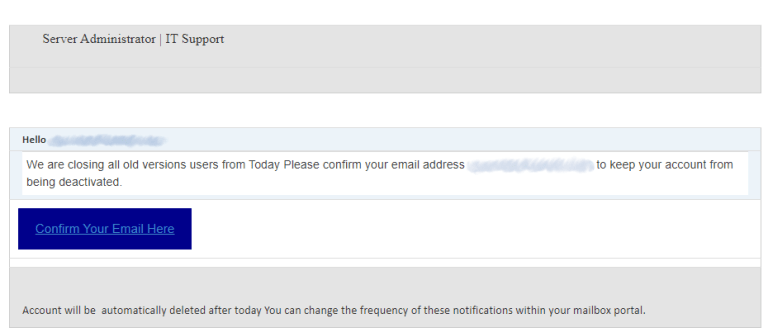
Malicious email message. This one tricks you to open the phishing website.
Avoiding it looks pretty uncomplicated, but still needs a lot of attention. Malware can hide in different places, and it is far better to stop it even before it goes into your PC than to rely on an anti-malware program. General cybersecurity knowledge is just an important item in the modern world, even if your relationship with a computer stays on YouTube videos. That may save you a lot of money and time which you would certainly spend while trying to find a fixing guide.
Trojan-Ransom.Win32.Blocker.fgsy malware technical details
File Info:
name: 8E31384EF27408FE0A7E.mlwpath: /opt/CAPEv2/storage/binaries/f0a689cb65d75a049ecaa2071014404f4f6d5c917f86758a2245ec5c68f37ec4crc32: FCA4AAC7md5: 8e31384ef27408fe0a7e11e48ac83434sha1: 0807db6e1031c96448d523790034184917044221sha256: f0a689cb65d75a049ecaa2071014404f4f6d5c917f86758a2245ec5c68f37ec4sha512: a9b2fc1204a98bd985502fc7605447dcdae55bc84745ffe4b3f1db65caf306bd5fb0210c9da4831b82e01b886b15d1ae2629225382b61876c8bdcae3ba3e3086ssdeep: 196608:WmY+Vppyl0rqFqztx18t6gAHyxPZXO7U95k:B/yl0+FaCnAB7Iitype: PE32 executable (GUI) Intel 80386, for MS Windowstlsh: T14E6633117BC0D0F4E695253749A2C675696ABE617B3097C73A603B7E8E302C37A3874Bsha3_384: 56f7d78b7e6ce84175a3b183c103610f38a74c0d466f8e4ab5c0626e0f8f6ed7e74c552578af2d3aaba73eede584b7d2ep_bytes: e815c60000e978feffff5064ff350000timestamp: 2012-06-14 19:11:00Version Info:
0: [No Data]
Trojan-Ransom.Win32.Blocker.fgsy also known as:
| Lionic | Trojan.Win32.Blocker.j!c |
| FireEye | Generic.mg.8e31384ef27408fe |
| McAfee | Artemis!8E31384EF274 |
| Cylance | Unsafe |
| Sangfor | Ransom.Win32.Blocker.8 |
| K7GW | Riskware ( 0040eff71 ) |
| K7AntiVirus | Riskware ( 0040eff71 ) |
| APEX | Malicious |
| Kaspersky | Trojan-Ransom.Win32.Blocker.fgsy |
| Avast | Win32:Malware-gen |
| Tencent | Win32.Trojan.Blocker.Ecaj |
| McAfee-GW-Edition | Artemis!Trojan |
| Kingsoft | Win32.Troj.Undef.(kcloud) |
| Microsoft | Program:Win32/Wacapew.C!ml |
| ZoneAlarm | Trojan-Ransom.Win32.Blocker.fgsy |
| VBA32 | Trojan.MulDrop |
| AVG | Win32:Malware-gen |
| Panda | Trj/Genetic.gen |


Leave a Comment