
SparkRAT, a malware developed in Go, poses a significant threat across Windows, Linux, and macOS systems. It spreads through malicious email attachments, compromised websites, and unsafe software downloads.
Once installed, SparkRAT Malware enables comprehensive control via features like process management, file exploration, and system command execution. Its capabilities extend from mere observation to direct system manipulation, making it a critical security concern.
SparkRAT Malware Overview
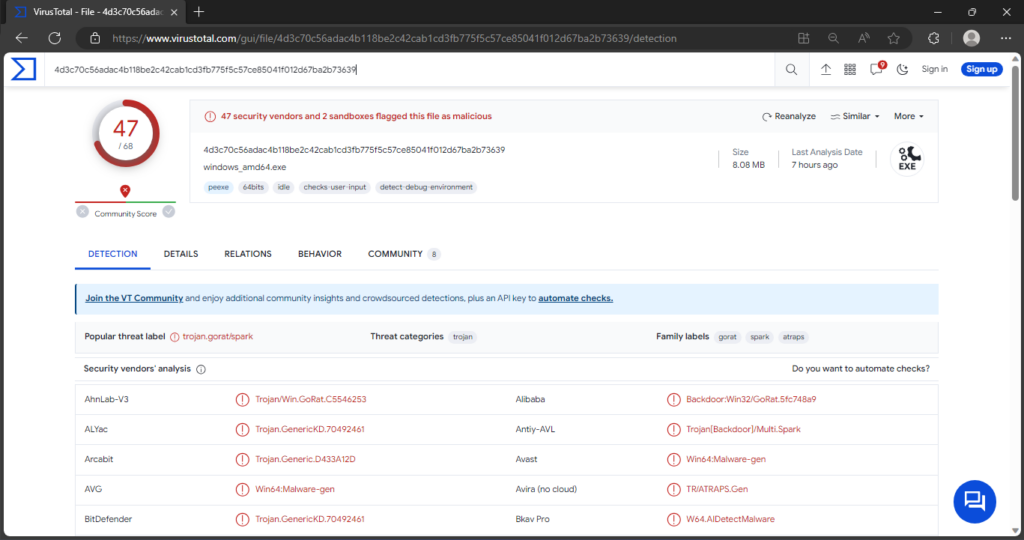
SparkRAT Malware on Virus Total site
| Name | SparkRAT |
| Threat Type | Remote Administration Trojan (RAT) |
| Symptoms | Remote Access Trojans are designed to stealthily infiltrate the victim’s computer and remain silent, and thus no particular symptoms are clearly visible on an infected machine. |
| Distribution methods | Infected email attachments, malicious online advertisements, social engineering, software ‘cracks’. |
| Similar Behavior | PySilonRAT, JanelaRAT, DarkVisionRAT |
| Detection | Microsoft (Trojan:Win32/GoRat.DA!MTB), Gridinsoft (Ransom.Win64.Wacatac.oa!s1) |
| Damage | Stolen passwords and banking information, identity theft, the victim’s computer added to a botnet. |
Technical Analysis of SparkRAT
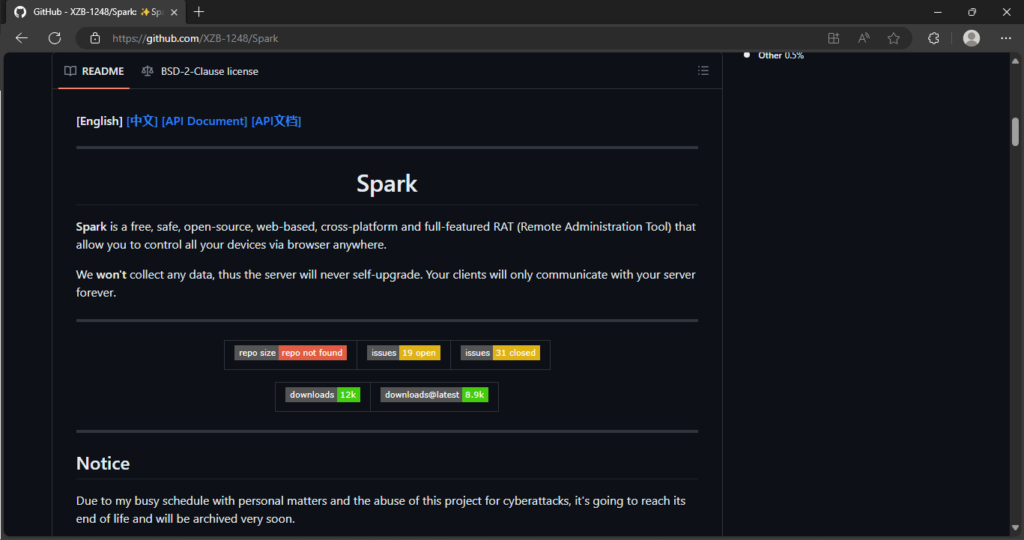
SparkRAT promoted on GitHub
The malware’s capability to gather system information and access the terminal strengthens its control over core system functionalities. SparkRAT also empowers the operator to execute various commands, including system shutdown, reboot, log off, sleep, hibernate, and lock screen. This level of control surpasses simple observation and file manipulation, giving operators extensive authority over the infected system.
Spreading methods
Computers can be infected with malware in several ways. A common method involves malicious email attachments or links. Threat actors send emails with infected attachments or links, which, when opened or clicked, inject malware into the system. Visiting compromised or malicious websites is another frequent infection route. These sites may contain malicious code that exploits browser or operating system vulnerabilities, causing malware to download and install unintentionally. Malicious ads can also lead to infections.
Downloading software or files from unreliable sources, like unofficial websites, third-party downloaders, or peer-to-peer networks, also poses a risk. This includes pirated software and cracking tools, which often harbor malicious software, increasing the likelihood of computer infection.
How to remove the SparkRAT Malware from my PC?
While manual removal of the threat is technically possible, I strongly discourage this method. In its pursuit of establishing persistence, Malware generates numerous instances of itself, making it exceedingly difficult to trace all its components manually. Consequently, manual removal can be time-consuming and often yield minimal to no results. Below, I have assembled a guide outlining the most effective removal practices for SparkRAT Malware.


Leave a Comment