
Recently, our diligent monitoring of dark web forums and Telegram channels led to a significant discovery: the emergence of a formidable menace known as The Meduza Stealer.
Imbued with its creator’s enigmatic aura, the malware, masterminded by an individual bearing the name ‘Meduza’, exhibits a meticulous focus on targeting Windows users and organizations. It possesses an unsettling reach, sparing only ten specific countries from its pernicious grasp.
The primary objective of The Meduza Stealer is nothing short of comprehensive data theft. Its insidious nature involves surreptitiously extracting a wide array of browser-related data, delving deep into users’ online activities. From the critical login credentials that safeguard our digital existence to the cherished records of browsing history and carefully curated bookmarks, no digital artifact is safe from its clutches. Even the seemingly impregnable fortresses of crypto wallet extensions, password managers, and 2FA extensions are rendered vulnerable.
Should this insidious threat go unchecked, the consequences for those ensnared within its grip could prove catastrophic. The aftermath may entail severe financial losses and the grim specter of large-scale data breaches, whose far-reaching implications could cast a somber shadow over the very fabric of affected organizations.
What is Meduza Stealer?
Meduza is a type of malware created using the C++ programming language, specifically designed to steal information. It targets various applications and clients, including web browsers and cryptocurrency wallets, with the objective of collecting sensitive data. This malicious software is available for purchase on the black market, priced at $199 per month.
Meduza is a sophisticated information-stealing malware that possesses an extensive range of data collection capabilities. It is specifically designed to target and extract sensitive information from various sources. This includes harvesting data from 100 different web browsers, as well as gathering information from 107 cryptocurrency wallets.
In addition to browser-related data, Meduza also has the ability to collect the browser history and bookmarks from the infected device, along with the autocomplete fields. It can also target specific applications, such as 2 Telegram clients, collecting data from those platforms.
Furthermore, Meduza has the capability to access and retrieve information from the Steam folder, Discord tokens, and data stored in 27 password managers. Additionally, it can extract OpenVPN configuration files.
| Name | Meduza Stealer |
| Detection | Trojan:Win32/Sabsik.TE.B!ml link |
| Damage | The Meduza Stealer brazenly pilfers users’ browsing activities, expertly extracting a diverse range of browser-related data. It leaves no stone unturned, targeting critical login credentials that serve as gatekeepers to our digital lives. It voraciously devours the valuable records of browsing history, meticulously curated bookmarks, and other digital artifacts that users hold dear. Shockingly, not even the seemingly fortified bastions of crypto wallet extensions, password managers, and 2FA extensions are spared from its insidious grasp. |
Overall, Meduza is a highly potent malware designed to gather a wide range of sensitive information, posing a significant threat to user privacy and security.
Marketing of the Meduza Stealer
The administrator behind the Meduza Stealer has employed sophisticated marketing tactics to promote this nefarious malware. In a calculated move to gain trust and instill confidence, they have undertaken comprehensive static and dynamic scans of the Meduza Stealer file using renowned antivirus software in the industry. Screenshots were then shared, demonstrating that this potent malware could successfully evade detection by top-tier antivirus solutions.
What sets the Meduza Stealer apart is its cunning operational design. Unlike many similar threats, this binary does not employ obfuscation techniques, making it more challenging to identify and trace. Additionally, it cleverly establishes a connection with the attacker’s server before initiating the theft of data from targeted machines. If this connection fails, the Meduza Stealer terminates promptly, further complicating efforts to trace its activities.
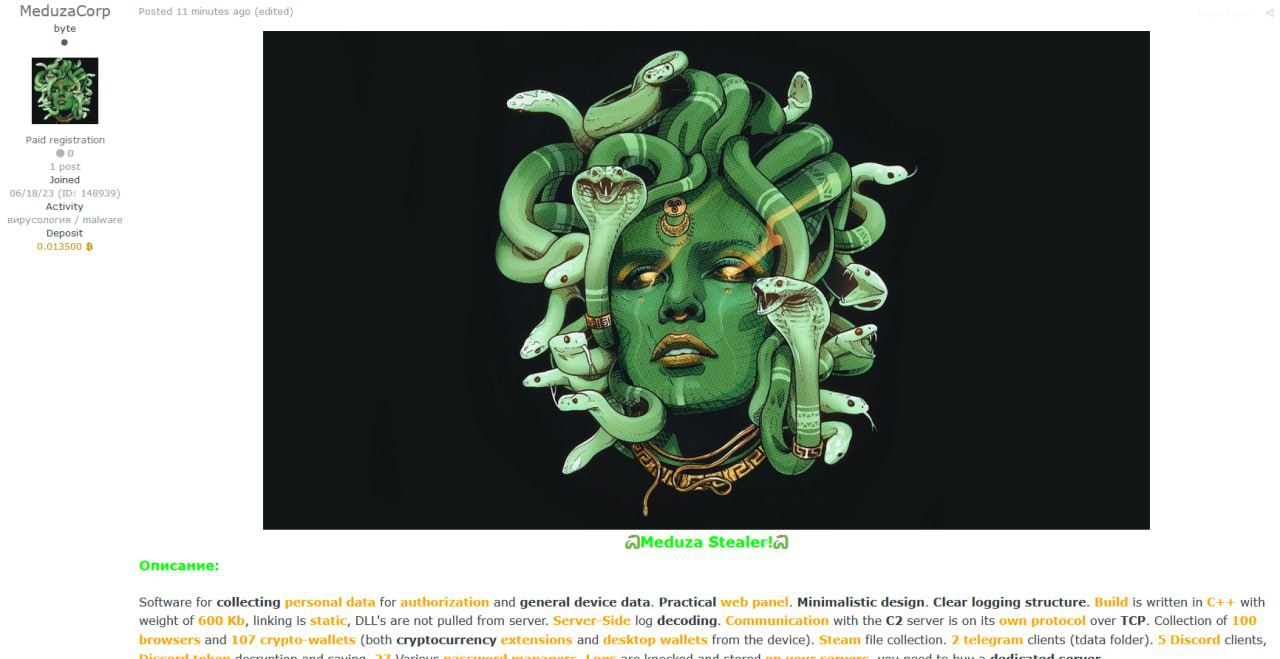
Meduza stealer – ads marketing in the forum
The marketing efforts extend beyond proving the malware’s efficacy. As evidenced by screenshots, the administrator has aggressively advertised the Meduza Stealer on various cybercrime forums and prominent Telegram channels, maximizing its exposure to potential users.
Possible damage
Users can face various detrimental consequences by having a computer infected with Meduza. The extensive data collection capabilities of Meduza put users at risk of financial loss, as it can compromise data from over a hundred cryptocurrency wallets, potentially leading to the theft of digital assets.
Moreover, the extraction of data from web browsers poses a significant threat to user privacy and increases the risk of identity theft and other issues. Additionally, the access to data from password managers further exacerbates the potential for unauthorized access to various online platforms, amplifying the risk of financial fraud and compromising personal accounts.
How did Meduza infiltrate my computer?
Users may inadvertently acquire infected files or software from untrustworthy sources, such as suspicious websites or file-sharing platforms. These downloads have the potential to contain malware, which becomes active on the computer upon execution. In addition, cybercriminals commonly employ email to deceive users into interacting with harmful email attachments or clicking on malicious links.
Vulnerabilities in outdated software, particularly operating systems, and applications, create opportunities for cybercriminals to exploit and gain unauthorized access to computers. Users who neglect to update their software regularly are more susceptible to infections.
Furthermore, visiting compromised or malicious websites can expose users to drive-by downloads, wherein malware is automatically and silently downloaded and installed without the user’s awareness or consent.
Upon successful infiltration of a targeted machine, the Meduza Stealer swiftly initiates its operations. The first crucial step involves performing a geolocation check. If the victim’s location is found within the stealer’s predefined list of excluded countries, the malware operation is promptly aborted. However, if the location does not match the list, the Meduza Stealer proceeds to the next phase.
In the subsequent phase, the Meduza Stealer verifies the accessibility of the attacker’s server. If the server is not reachable, the stealer promptly terminates its activities, ensuring it remains elusive. However, if the server is accessible, the Meduza Stealer proceeds to gather a vast array of information from the infected machine.
This comprehensive information-gathering process includes collecting system information, extracting browser data, capturing details from password managers, retrieving mining-related registry information, and compiling data regarding installed games. The Meduza Stealer meticulously compiles this extensive set of data, packaging it for uploading to the attacker’s server.
Once the data is securely packaged, it is dispatched to the attacker’s server, completing the Meduza Stealer’s operation within the infected machine. This comprehensive process allows the malicious actor to acquire a significant amount of sensitive information from the victim, potentially leading to severe consequences for the affected individual or organization.
The following table presents the names and corresponding country codes from the exclusion list:
Exclusion List:
| Country Name | Country Code |
|---|---|
| Russia | RU |
| Kazakhstan | KZ |
| Belarus | BY |
| Georgia | GE |
| Turkmenistan | TM |
| Uzbekistan | UZ |
| Armenia | AM |
| Kyrgyzstan | KG |
| Moldova | MD |
| Tajikistan | TJ |
How to avoid installation of malware?
In order to enhance your computer or device’s security, it is advisable to install trustworthy antivirus or anti-malware software. Keep this software up to date and perform regular scans to identify and eliminate potential threats. Exercise caution when interacting with links, downloading files, or opening email attachments, particularly if they originate from unfamiliar or suspicious sources.
Be observant with emails containing attachments or links. Carefully examine suspicious and irrelevant emails before clicking or opening anything. Also, it is recommended to avoid visiting untrusted websites and clicking on pop-up ads. Maintaining the latest updates for your operating system, web browsers, and other software is also important.


Leave a Comment