
Lisp is a DJVU family of ransomware-type infections1. The infection encrypts important personal files (video, photos, documents). The infected files can be tracked by specific “.lisp” extension. So, you can’t use them at all.
In this tutorial I will try to help you remove Lisp virus without any payment. Also, I will assist you in decoding your encrypted files.
What is “Lisp”?
☝️ Lisp can be correctly identify as a ransomware infection.
Ransomware is a specific kind of virus that encrypted your documents and then forces you to pay for them. DJVU (aka STOP) ransomware family was first revealed and analyzed by virus analyst Michael Gillespie2.Lisp is similar to other ransomware like: Ribd, Sglh, Vvoa, Epor. Lisp encrypted all common file types. Hence, you cannot use the own documents or photos. Lisp adds its particular “.lisp” extension into all files. For instance, the file “video.avi”, will be amended into “video.avi.lisp”. As soon as the encryption is successfully accomplished, Lisp drops a special file “_readme.txt” and drop it into all folders that contain the modified files.
Here is a short info for the Lisp virus:
| Ransomware family3 | DJVU/STOP4 ransomware |
| Extension | .lisp |
| Ransomware note | _readme.txt |
| Ransom | From $490 to $980 (in Bitcoins) |
| Contact | [email protected], [email protected] |
| Detection | Bulz.207360, BScope.Trojan.Cobalt, Trojan.Win32.Generic |
| Symptoms | Most of your files (photos, videos, documents) have a .lisp extension and you can’t open it |
| Fix Tool | See If Your System Has Been Affected by .lisp file virus |
This text asking payment is for get files back via decryption key:
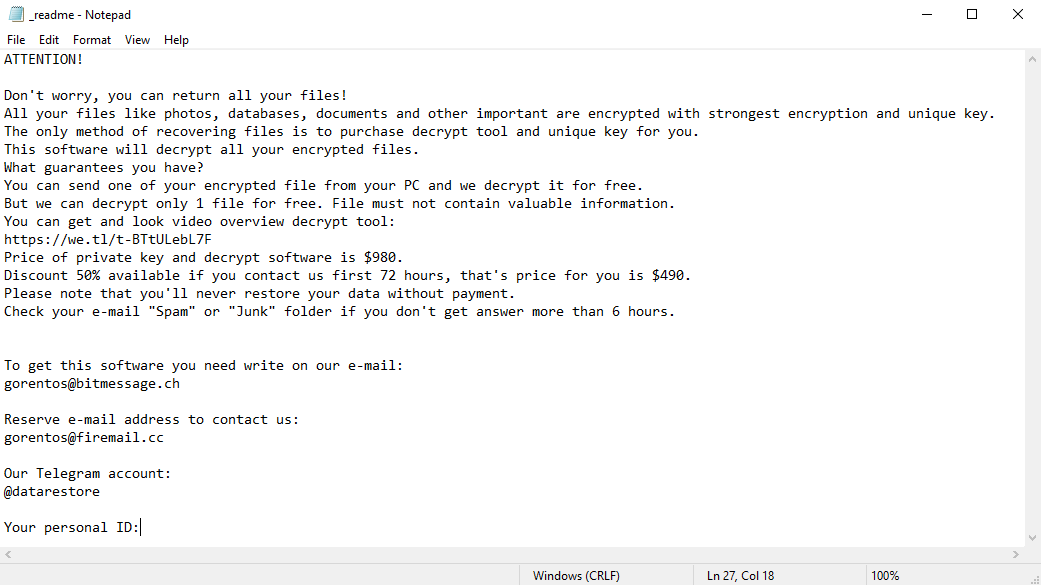
The scary alert demanding from users to pay the ransom to decrypt the compromised data contains these frustrating warnings
The cryptography algorithm used by Lisp is AES-256. So, if your files got encrypted with a specific decryption key, which is totally unique and there are no other copies. The sad reality is that it is impossible to recover the information without the unique key available.
In case if Lisp worked in online mode, it is impossible for you to gain access to the AES-256 key. It is stored on a remote server owned by the criminals who distibute the Lisp ransomware.
For receiving decryption key the payment should be $980. To obtain the payment details, the victims are encouraged by the message to contact the frauds by email ([email protected]), or via Telegram.
Do not pay for Lisp!
Please, try to use the available backups, or Decrypter tool
_readme.txt file also indicates that the computer owners must get in touch with the Lisp representatives during 72 hours starting from the moment files were encrypted. On the condition of getting in touch within 72 hours, users will be granted a 50% rebate. Thus the ransom amount will be minimized down to $490). However, stay away from paying the ransom!
I definitely recommend that you do not contact these crooks and do not pay. The one of the most real working solution to recover the lost data – just using the available backups, or use Decrypter tool.
The peculiarity of all such viruses apply a similar set of actions for generating the unique decryption key to recover the ciphered data.
Thus, unless the ransomware is still under the stage of development or possesses with some hard-to-track flaws, manually recovering the ciphered data is a thing you can’t perform. The only solution to prevent the loss of your valuable data is to regularly make backups of your crucial files.
Note that even if you do maintain such backups regularly, they ought to be put into a specific location without loitering, not being connected to your main workstation.
For instance, the backup may be kept on the USB flash drive or some alternative external hard drive storage. Optionally, you may refer to the help of online (cloud) information storage.
Needless to mention when you maintain your backup data on your common device, it may be similarly ciphered as well as other data.
For this reason, locating the backup on your main computer is surely not a good idea.
How I was infected?
Lisp has a various methods to built into your system. But it doesn’t really matter what way had place in your case.
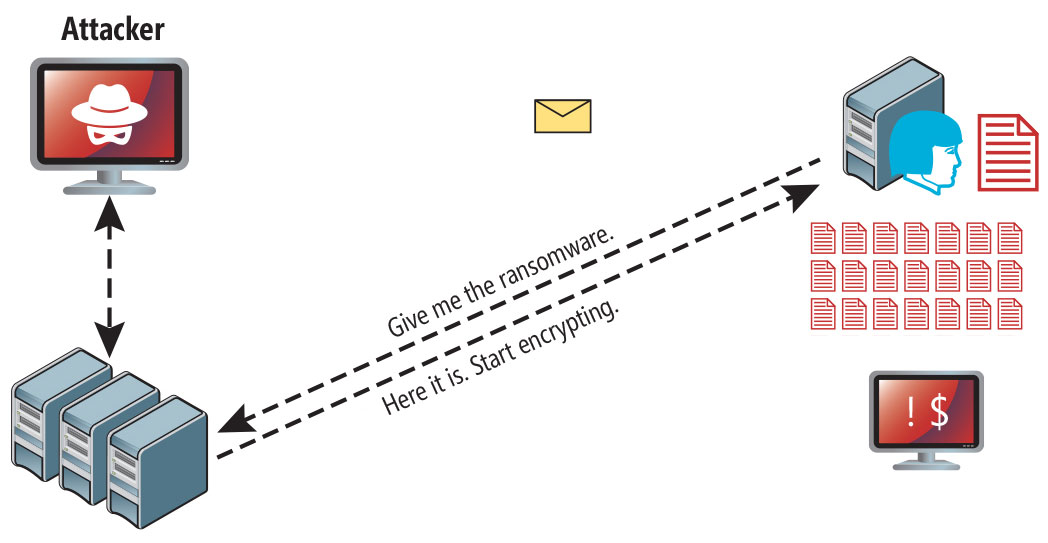
Lisp ransomware attack following a successful phishing attempt.
- hidden installation along with other apps, especially the utilities that work as freeware or shareware;
- dubious link in spam emails leading to the Lisp installer
- online free hosting resources;
- using illegal peer-to-peer (P2P) resources for downloading pirated software.
There were cases when the Lisp virus was disguised as some legitimate tool, for example, in the messages demanding to initiate some unwanted software or browser updates. This is typically the way how some online frauds aim to force you into installing the Lisp ransomware manually, by actually making you directly participate in this process.
Surely, the bogus update alert will not indicate that you are going to actually inject the Lisp ransomware. This installation will be concealed under some alert mentioning that allegedly you should update Adobe Flash Player or some other dubious program whatsoever.
Of course, the cracked apps represent the damage too. Using P2P is both illegal and may result in the injection of serious malware, including the Lisp ransomware.
To sum up, what can you do to avoid the injection of the Lisp ransomware into your device? Even though there is no 100% guarantee to prevent your PC from getting damaged, there are certain tips I want to give you to prevent the Lisp penetration. You must be cautious while installing free software today.
Make sure you always read what the installers offer in addition to the main free program. Stay away from opening dubious email attachments. Do not open files from the unknown addressees. Of course, your current security program must always be updated.
The malware does not speak openly about itself. It will not be mentioned in the list of your available programs. However, it will be masked under some malicious process running regularly in the background, starting from the moment when you launch your PC.
The message by the Lisp ransomware states the following frustrating information:
ATTENTION!

Don't worry, you can return all your files!

All your files like photos, databases, documents and other important are encrypted with strongest encryption and unique key.
The only method of recovering files is to purchase decrypt tool and unique key for you.
This software will decrypt all your encrypted files.

What guarantees you have?

You can send one of your encrypted file from your PC and we decrypt it for free.
But we can decrypt only 1 file for free. File must not contain valuable information.

You can get and look video overview decrypt tool:

https://we.tl/t-WJa63R98Ku

Price of private key and decrypt software is $980.
Discount 50% available if you contact us first 72 hours, that's price for you is $490.

Please note that you'll never restore your data without payment.

Check your e-mail "Spam" or "Junk" folder if you don't get answer more than 6 hours.

To get this software you need write on our e-mail:

[email protected]

Reserve e-mail address to contact us:

[email protected]

Your personal ID:
XXXXXXXXXXXXXXXXXXXXXXXXXXXXXXX
The image below gives a clear vision of how the files with “.lisp” extension look like:
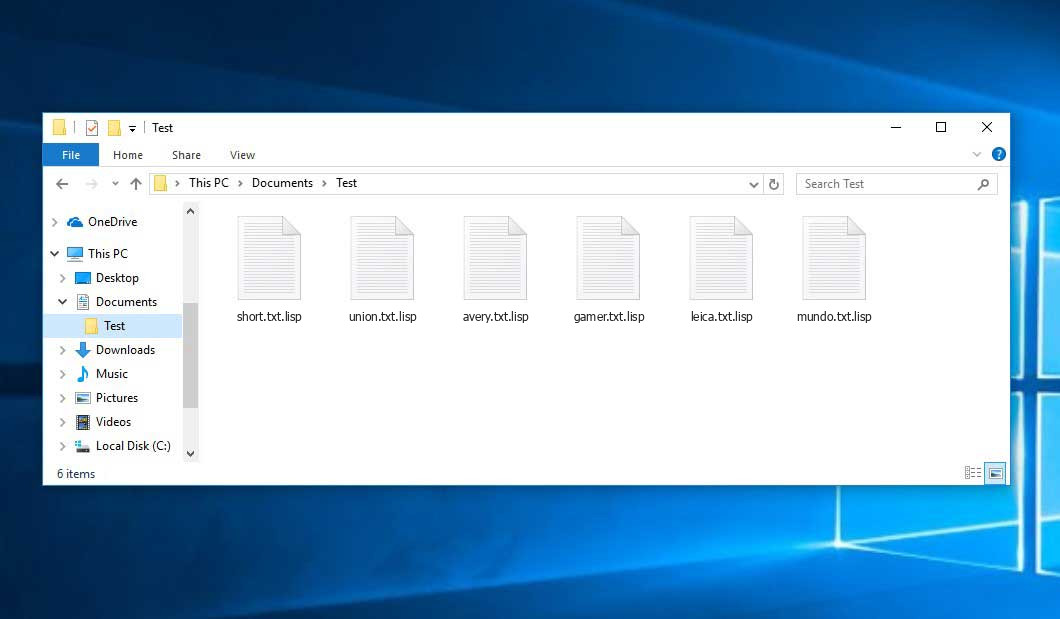
Example of encrypted .lisp files
How to remove Lisp virus?
In addition to encode a victim’s files, the Lisp infection has also started to install the Azorult Spyware on system to steal account credentials, cryptocurrency wallets, desktop files, and more.
Reasons why I would recommend GridinSoft5
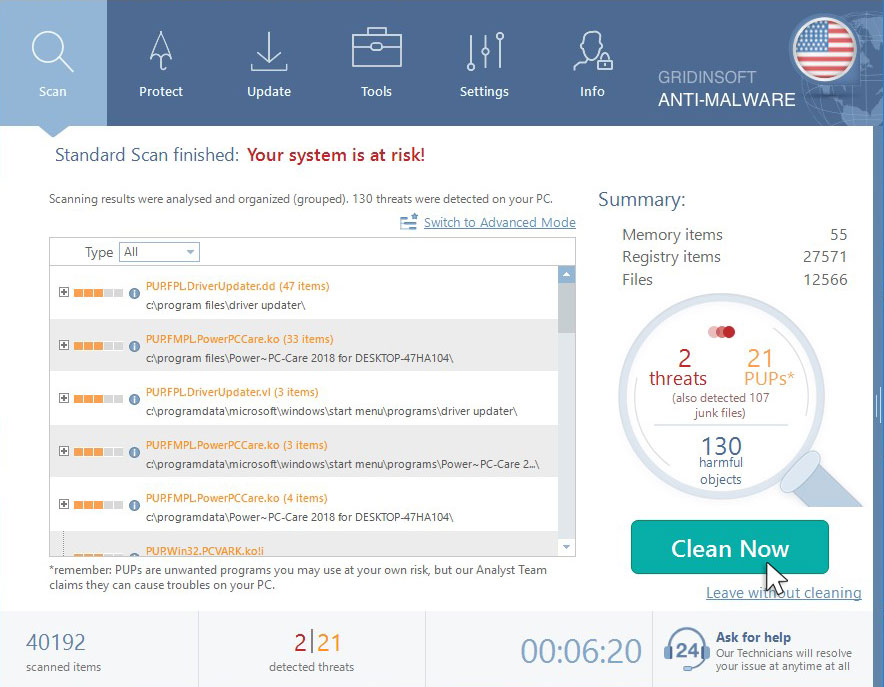
Download Removal Tool.
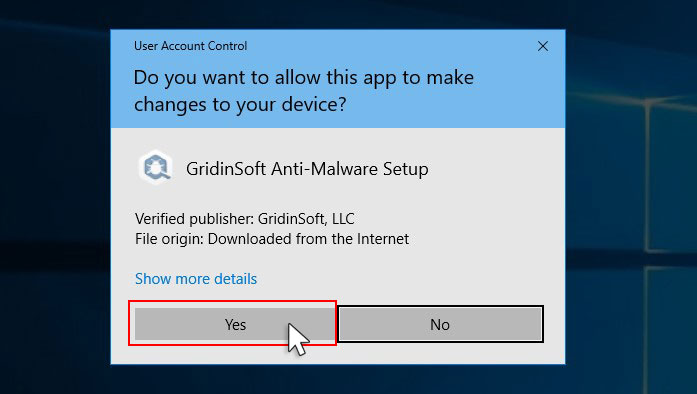
Run the setup file.
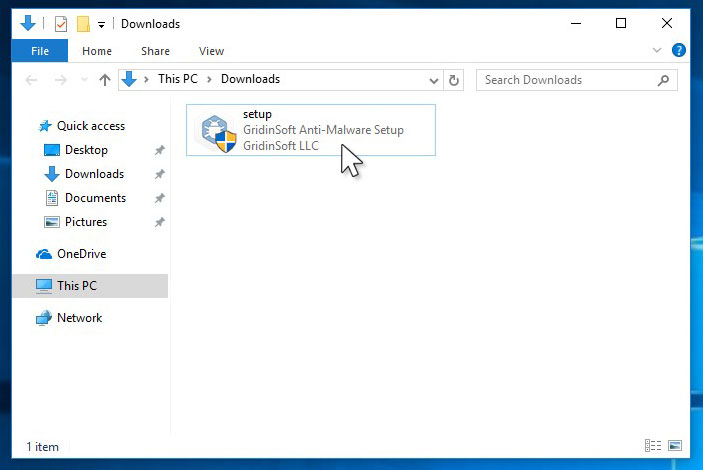
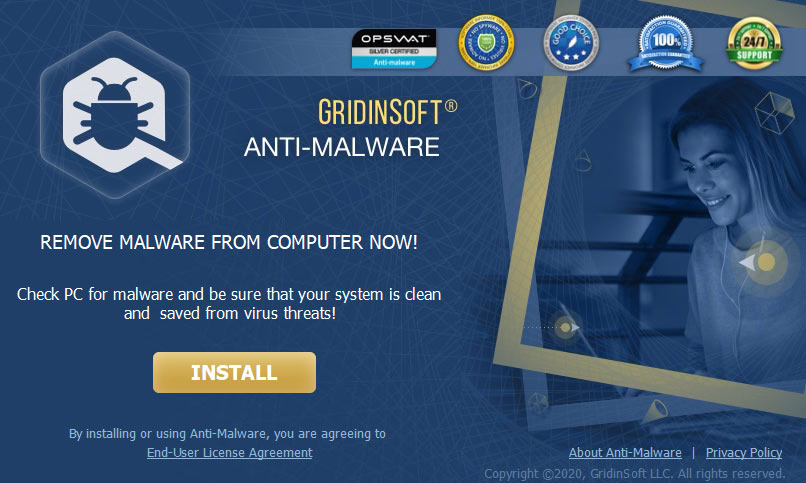
Press “Install” button.
Once installed, Anti-Malware will automatically run.
Wait for the Anti-Malware scan to complete.
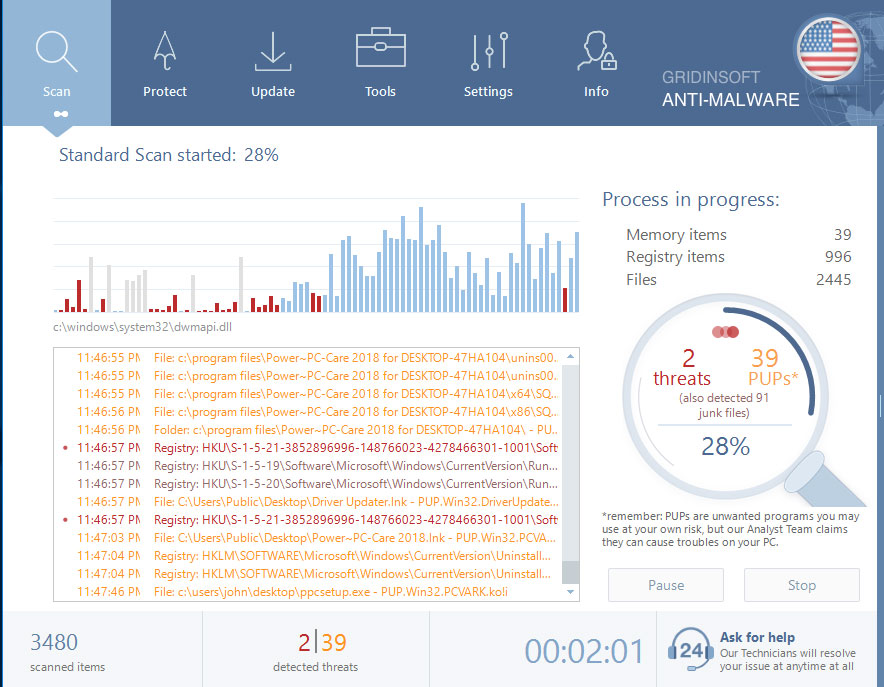
Click on “Clean Now”.
How to decrypt .lisp files?
Restore solution for big “.lisp files“
Try removing .lisp extension on a few BIG files and opening them. Either the Lisp ransomware read and did not encrypt the file, or it bugged and did not add the filemarker. If your files are very large (2GB+), the latter is most likely. Please, let me know in comments if that will work for you.
The newest extensions released around the end of August 2019 after the criminals made changes. This includes Vvoa, Agho, Agho, etc.
As a result of the changes made by the criminals, STOPDecrypter is no longer supported. It has been removed and replaced with the Emsisoft Decryptor for STOP Djvu Ransomware developed by Emsisoft and Michael Gillespie.
You can download free decryption tool here: Decryptor for STOP Djvu.
Download and run decryption tool.
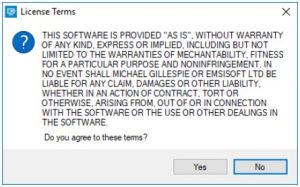
Make sure to launch the decryption utility as an administrator. You need to agree with the license terms that will come up. For this purpose, click on the “Yes” button:
As soon as you accept the license terms, the main decryptor user interface comes up:
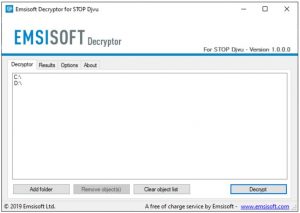
Select folders for decryption.
Based on the default settings, the decryptor will automatically populate the available locations in order to decrypt the currently available drives (the connected ones), including the network drives. Extra (optional) locations can be selected with the help of the “Add” button.
Decryptors normally suggest several options considering the specific malware family. The current possible options are presented in the Options tab and can be activated or deactivated there. You may locate a detailed list of the currently active Options below.
Click on the “Decrypt” button.
As soon as yo add all the desired locations for decryption into the list, click on the “Decrypt” button in order to initiate the decryption procedure.
Note that the main screen may turn you to a status view, letting you know of the active process and the decryption statistics of your data:
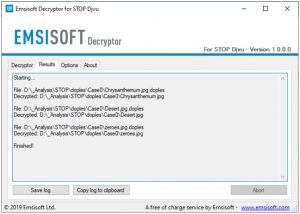
The decryptor will notify you as soon as the decryption procedure is completed. If you need the report for your personal papers, you can save it by choosing the “Save log” button. Note that it is also possible to copy it directly to your clipboard and to paste it into emails or forum messages if you need to do so.
How to Restore .lisp files?
In some case Lisp ransomware is not doom for your files…
Lisp ransomware encryption mechanism feature is next: it encrypts every file byte-by-byte, then saves a file copy, deleting (and not overriding!) the original file. Hence, the information of the file location on the physical disk is lost, but the original file is not deleted from the physical disk. The cell, or the sector where this file was stored, can still contain this file, but it is not listed by the file system and can be overwritten by data that has been loaded to this disk after the deletion. Hence, it is possible to recover your files using special software.
Recovering your files with PhotoRec
PhotoRec is an open-source program, which is originally created for files recovery from damaged disks, or for files recovery in case if they are deleted. However, as time has gone by, this program got the ability to recover the files of 400 different extensions 7. Hence, it can be used for data recovery after the ransomware attack
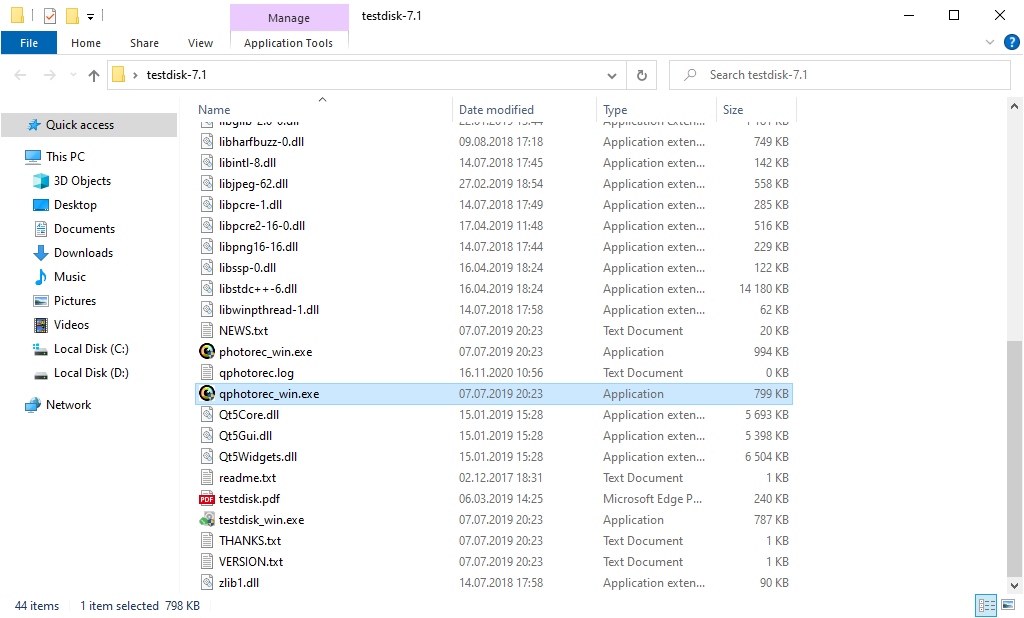
At first, you need to download this app. It is 100% free, but the developer states that there is no guarantee that your files will be recovered. PhotoRec is distributed in a pack with other utility of the same developer – TestDisk. The downloaded archive will have TestDisk name, but don’t worry. PhotoRec files are right inside.
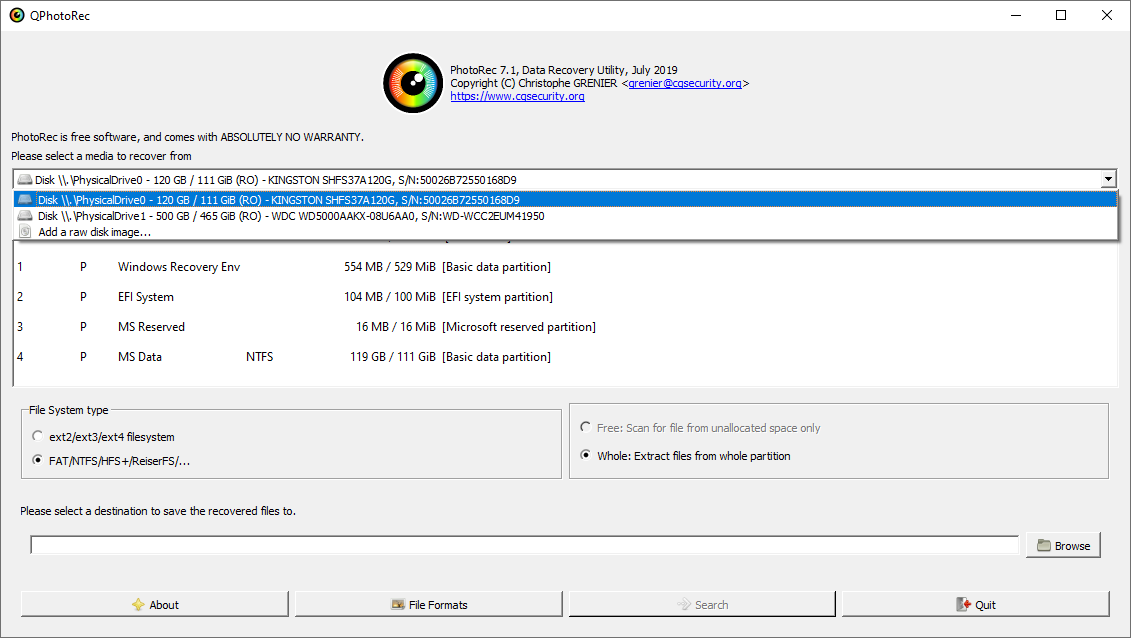
After the launch, you will see the screen showing you the full list of your disk spaces. However, this information is likely useless, because the required menu is placed a bit higher. Click this bar, then choose the disk which was attacked by ransomware.
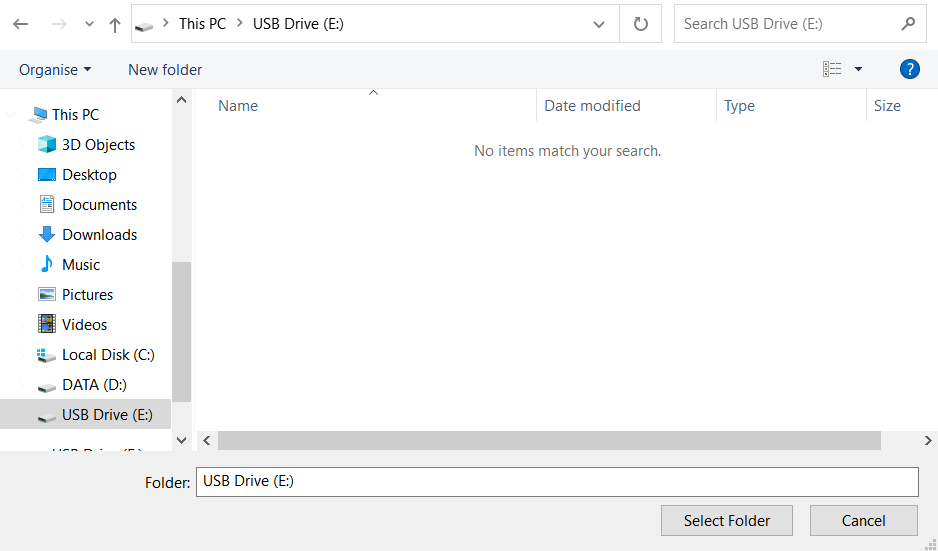
After choosing the disk, you need to choose the destination folder for the recovered files. This menu is located at the lower part of the PhotoRec window. The best desicion is to export them on USB drive or any other type of removable disk.
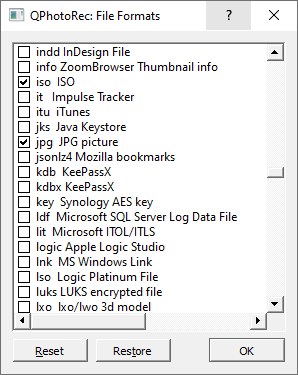
Then, you need to specify the file formats. This option is located at the bottom, too. As it was mentioned, PhotoRec can recover the files of about 400 different formats.
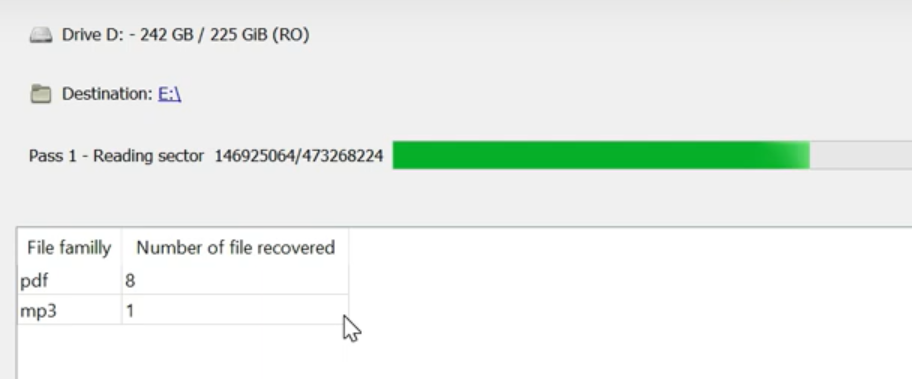
Finally, you can start files recovery by pressing the “Search” button. You will see the screen where the results of the scan and recovery are shown.
PhotoRec video tutorial
Frequently Asked Questions
Video Guide
It’s my favorite video tutorial: How to use GridinSoft Anti-Malware and Emsisoft Decryptor for fix ransomware infections.
I need your help to share this article.
It is your turn to help other people. I have written this guide to help people like you. You can use the buttons below to share this on your favorite social media Facebook, Twitter, or Reddit.
Brendan SmithReferences
- Ransomware-type infection: https://en.wikipedia.org/wiki/Ransomware
- Twitter: https://twitter.com/demonslay335
- My files are encrypted by ransomware, what should I do now?
- About DJVU (STOP) Ransomware.
- More recovering tools you can find in our review: Best File Recovery Tools
 German
  Japanese
  Spanish
  Portuguese (Brazil)
  French
  Turkish
  Chinese (Traditional)
  Korean


Hai Brendan,
Thank you for help by the article, but still i cant decrypt my lisp file. Can you help me?
Hi mate
my system was infected to .LISP virus,
and I copied all necessary files to one flash memory and after that format the HDD and install new O/S
now I need to remove .LISP extension from my files on flash memory and used again of my files.
all files are with (JPG,PDF,xlms,DOC)extension.
could you help me?
Hi Brendan,
As guided by your post I tried to dycrypt the .lisp files using decrypt_STOPDjvu after removing the ransomeware but couldn’t. It says this is new online ……… not possible to dycrypt. this is id given in the readme file generated by lisp.
Your personal ID:
0267OrjkMORalFk4lvsMG3i3xjntzhJtcqF2lWPXQlIHNWmN.
Do you have any idea how can I proceed futher for dycrption.
Thanks,
sudip