
Kazuar, a formidable backdoor-type malware linked to the Russian Federal Security Service (FSB), employs sophisticated social engineering and targeted phishing for dissemination. Known since 2017, it conceals itself within various file formats and exhibits anti-analysis traits.
Kazuar’s extensive profiling capabilities include data theft, script execution, and automated tasks. Its propagation methods involve malicious -attachments in spam, deceptive downloads, malvertising, online scams, and self-spreading through local networks and removable storage devices. A potent tool in geopolitical cyber-espionage, Kazuar excels in stealth and strategic infiltration.
Kazuar Malware Overview
Kazuar stands as a backdoor-type malware operational since at least 2017, with numerous identified variants over the years. The most recent manifestation surfaced during an assault on the Ukrainian defense sector in July 2023. Pensive Ursa, alias Turla or Uroburos, orchestrates the deployment of Kazuar. This threat actor maintains ties to the Federal Security Service of the Russian Federation (FSB). Geopolitical objectives steer the application of Kazuar, evident in its targeting of entities associated with European governments and militaries.
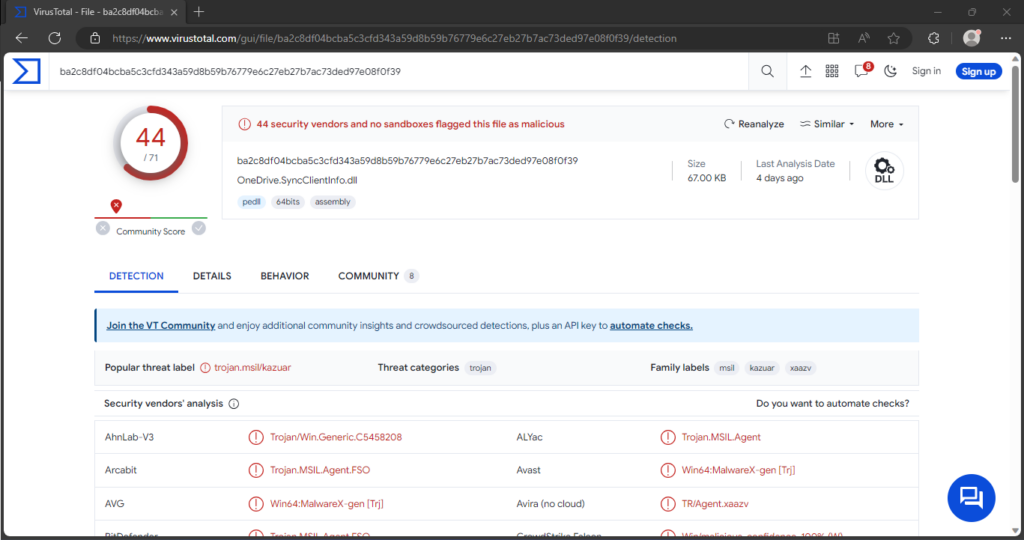
Kazuar on Virus Total site
| Name | Kazuar |
| Threat Type | Trojan, backdoor, spyware. |
| Distribution methods | Infected email attachments, malicious online advertisements, social engineering, software ‘cracks’. |
| Detection Names | Microsoft (Trojan:ASP/DeliveryCheck!dha), Gridinsoft (Trojan.Heur!.0311A2C2) |
| Similar Behavitor | Cur, NightClub |
| Damage | Stolen passwords and banking information, identity theft, the victim’s computer added to a botnet. |
Technical Analysis of Kazuar
Kazuar, deployed in the second stage of infections, often follows the initial Capibar backdoor and combines with an array of tools.
Designed for stealth, Kazuar employs advanced anti-analysis techniques, actively seeking specific debuggers and analysis tools like dnSpy, Process Monitor, Wireshark, and x32dbg. It evades detection by steering clear of honeypots and sandbox environments, employing obfuscation and encryption.
Miscellaneous applications targeted by Kazuar malware:
- OpenVPN
- Microsoft Outlook
- FileZilla
- Signal
- Git SCM
- WinSCP
Spreading methods
Common methods for spreading malware encompass the use of malicious attachments or links in spam mail, stealthy drive-by downloads, malvertising, online scams, dubious download channels, pirated content, illegal software activation tools (“cracks”), and deceptive fake updates. Additionally, certain malicious programs possess self-spreading capabilities, propagating through local networks and removable storage devices like external hard drives and USB flash drives.
How to remove the Kazuar Malware from my PC?
While manual removal of the threat is technically possible, I strongly discourage this method. The malware generates numerous instances of itself in its pursuit of establishing persistence, making it exceedingly difficult to trace all its components manually. Consequently, manual removal can be time-consuming and often yield minimal to no results. Below, I have assembled a guide outlining the most effective removal practices for Kazuar.


Leave a Comment