
BiBi, a destructive wiper malware, targets both Linux and Windows systems, aiming to erase or damage data irreversibly. Affiliated with the Hamas terrorist group, BiBi selectively destroys files while avoiding critical extensions like .exe, .dll, and .sys.
It employs malvertising, email attachments, and malicious links for distribution, posing a significant threat to users’ data integrity and system functionality. The malware’s motivations align with ideological and political objectives, showcasing its destructive capabilities in disrupting targeted systems.
BiBi Malware Overview
BiBi is a type of malware categorized as a wiper, designed to cause irreversible damage to data on infected systems. It targets Linux and Windows users, with two variants tailored to different operating systems. The creation of BiBi is attributed to a hacker group with alleged ties to Hamas.
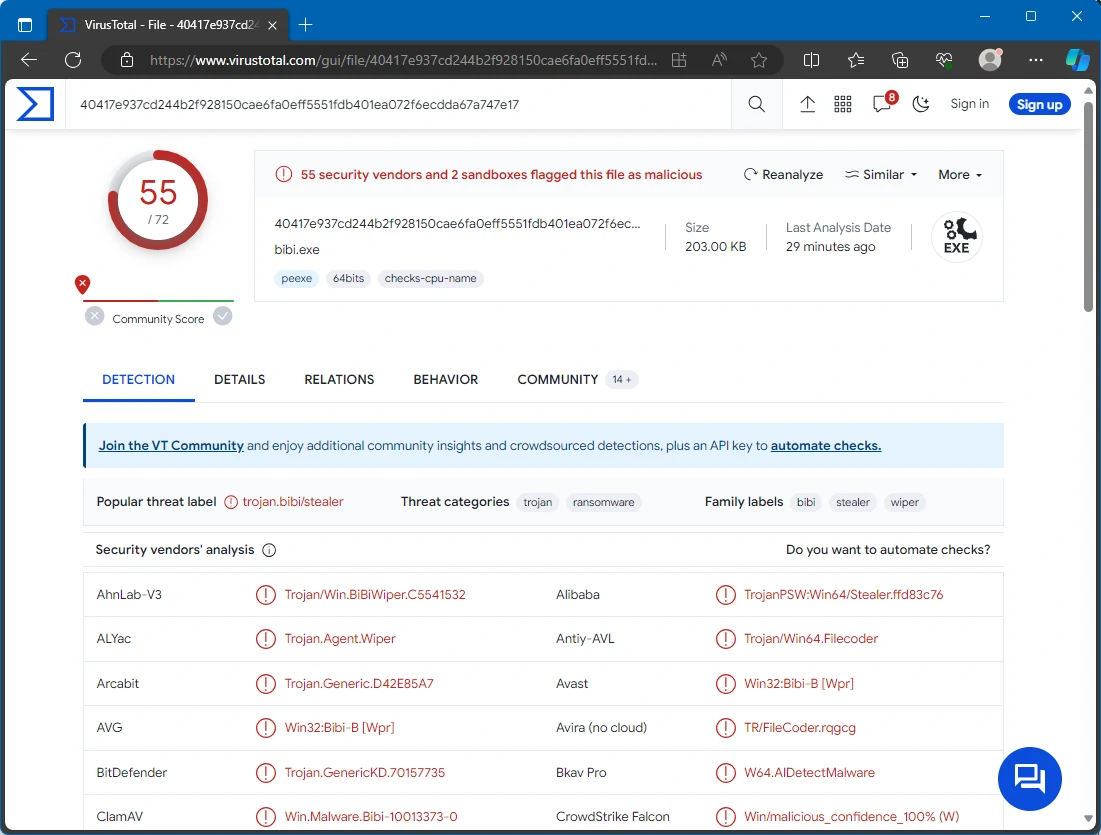
Detect results on VirusTotal
| Name | BiBi data wiper |
| Detection | Ransom.Win64.Stealer.sa, DoS:Win32/WprBlightre.B!dha (Microsoft) |
| Damage | Data loss |
| Similar Behavitor | Trojan:BAT/SysWiper |
Technicsl Analysis
BiBi, a wiper malware, is malicious software crafted explicitly to erase or damage data on infected systems irreversibly. Unlike other malware types that may focus on theft, surveillance, or financial gain, wiper malware, exemplified by BiBi, aims to cause severe disruption and destruction to targeted systems.
Its primary objective is to render data and often entire systems unusable, resulting in operational paralysis and data loss. BiBi employs various techniques to make data recovery challenging or impossible, such as overwriting critical files, modifying system configurations, or encrypting data beyond recovery.
The motivations behind wiper malware attacks vary widely, including ideological, political, or strategic objectives. In the case of BiBi, it appears to be utilized by hackers affiliated with the Hamas group. BiBi stands out for its selective destruction of files, excluding those with .exe, .dll, and .sys extensions crucial for proper computer functioning. These specific extensions are hardcoded in the malware, ensuring they are bypassed during the wiping process, allowing it to execute its intended destructive course.
During the wiping operation, targeted files transform and are filled with random bytes, making them unusable and irrecoverable. The malware extends its functionality to delete shadow copies within the system, posing a significant challenge for users attempting recovery unless they have an offline backup.
Spreading Methods
BiBi typically infiltrates computers through deceptive methods, such as email attachments or links containing malicious payloads. Users may unwittingly download and execute the malware when interacting with these elements. Additionally, malvertising, involving malicious code injection into online ads, can lead to malware infections if users click on compromised ads.


Leave a Comment