
The “Firewall Update Required” scam employs explicit content as a backdrop to deceive users into believing their Windows firewall is outdated. It prompts victims to call a fake helpline, perpetuating the ruse.
The scam progresses with false alerts of system failure and requests for passwords. Scammers pose as tech support, often seeking remote access. Users should be wary of unsolicited tech support alerts and never grant remote access to unknown parties, avoiding severe security risks.
“Firewall Update Required” scam overview
Uncovered during a routine examination of deceptive websites, the “Firewall Update Required” scam is identified as a technical support scam. The deceptive content falsely asserts that the user’s device is compromised due to an outdated Windows firewall. The primary aim is to trick victims into reaching out to fake tech support, engaging them in a complex scheme that may lead to severe consequences.
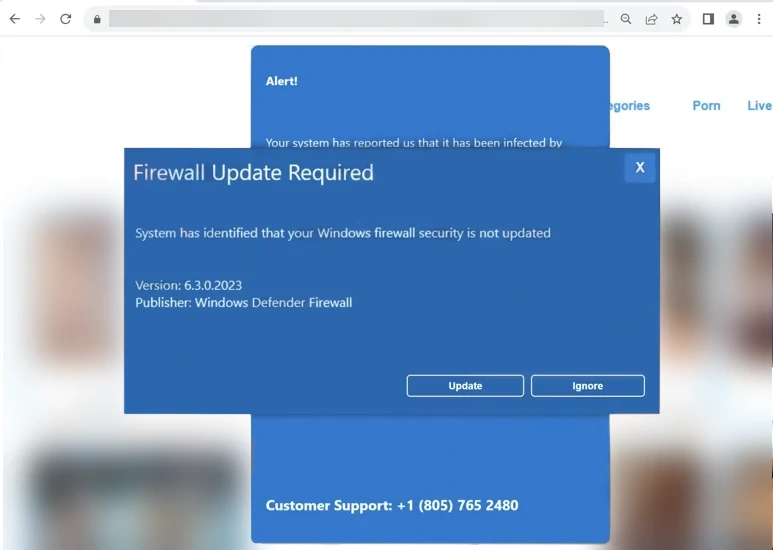
Firewall Update Required pop-up scam
| Name | “Firewall Update Required” tech support scam |
| Threat Type | Phishing, Scam, Social Engineering |
| Damage | Loss of sensitive private information, monetary loss, identity theft, possible malware infections. |
| Similar Behavitor | “Threat Service Has Stopped” Pop-up, “Your PC Is Infected With 5 Viruses!” Pop-up |
Technical Analysis
Upon accessing a site running the “Firewall Update Required” scam, visitors encounter explicit adult-oriented content overlaid with pop-ups mimicking the Windows color palette and formatting. The topmost pop-up, titled “Firewall Update Required,” falsely claims that the “Windows firewall security” is outdated, prompting users to call “Customer Support.”
After pressing the “Update” button, the window is closed, revealing another pop-up detailing malware infections. As a result, this prompts users to call support. The scheme unfolds with fake alerts, including a “System Failure” message, urging users to unlock their device with a password.
How did I open this website?
Scam websites may open forcibly when accessing a site that employs rogue advertising networks. It can be also through redirects generated by interacting with hosted content like pop-ups, text input fields, ads, or links. Mistyped URLs can lead to redirects to these pages. Spam browser notifications and intrusive ads are common tactics. Adware displaying ads promoting scams or forcibly opening scam sites is another avenue. Additionally, spam through various channels is used for scam promotion.


Leave a Comment