
The “Threat Service Has Stopped” scam employs deceptive tactics to present a fake solution for a non-existent issue. It urges users to call a provided helpline.
Triggered through phishing emails or misleading ads, the scam aims to create urgency and coerce users into calling scammers. The displayed error message and subsequent actions are designed to mislead users, emphasizing the fraudulent nature of the scam and the risks associated with falling victim to such tactics.
“Threat Service Has Stopped” Pop-up Overview
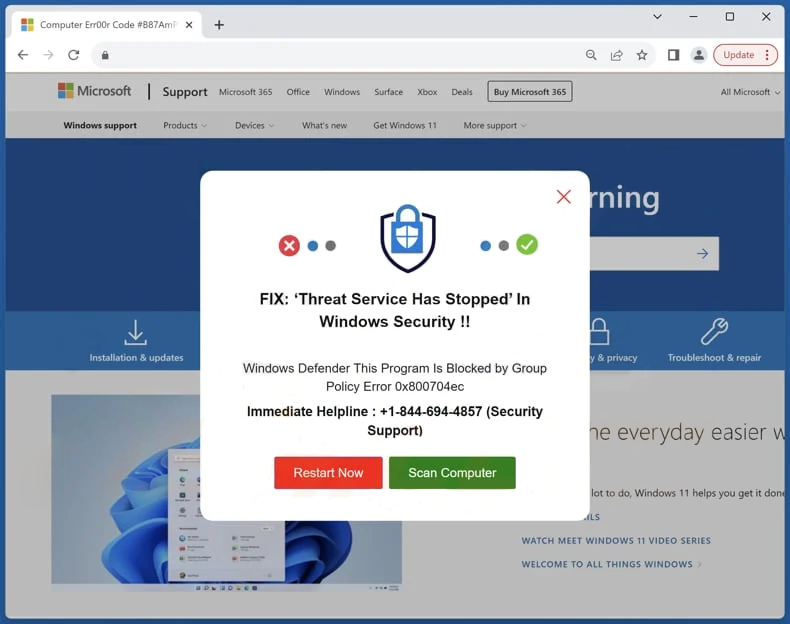
Pop-up with a fake alert “Threat Service Has Stopped”
| Name | “Threat Service Has Stopped” Pop-up |
| Threat Type | Phishing, Scam, Social Engineering |
| Damage | Loss of sensitive private information, monetary loss, identity theft, possible malware infections. |
| Similar Behavitor | “Your Browser Is (62%) DAMAGED By Tor.Jack Malware” Scam, “Virus/Malware Infections Have Been Recognized” Scam |
Technical Analysis
The deceptive message on the technical support scam page claims to provide a solution for a fictitious issue, citing an error (0x800704ec) and offering an immediate helpline number, +1-844-694-4857, labeled as “Security Support” to enhance urgency and legitimacy.
The page features two action buttons, “Restart Now” and “Scan Computer,” both leading to another scam page (“Windows Defender Security Center”). The primary objective of this scam is to deceive users into calling scammers.
How did I open this website?
Users might unknowingly access scam websites through deceptive links in phishing emails or messages, where fraudsters imitate legitimate sources to trick users into clicking on malicious links. Malicious ads or pop-ups on seemingly harmless websites can redirect users to scam pages upon interaction. Misleading search engine results, manipulated through SEO tactics, may lead users to deceptive sites. Additionally, the presence of adware can contribute to redirecting users to unreliable pages.


Leave a Comment