
Seeing the Win32/Injector.CEU detection usually means that your system is in big danger. This malware can correctly be identified as ransomware – type of malware which encrypts your files and forces you to pay for their decryption. Stopping it requires some peculiar steps that must be taken as soon as possible.
Win32/Injector.CEU detection is a malware detection you can spectate in your system. It generally appears after the preliminary procedures on your computer – opening the untrustworthy email, clicking the advertisement in the Web or setting up the program from unreliable resources. From the second it appears, you have a short time to act until it begins its destructive action. And be sure – it is far better not to await these destructive actions.
What is Win32/Injector.CEU virus?
Win32/Injector.CEU Summary
In summary, Win32/Injector.CEU ransomware activities in the infected system are next:
- Behavioural detection: Executable code extraction – unpacking;
- Sample contains Overlay data;
- The binary contains an unknown PE section name indicative of packing;
- Authenticode signature is invalid;
- Anomalous binary characteristics;
- Encrypting the files kept on the victim’s disk drive — so the victim cannot use these documents;
- Blocking the launching of .exe files of security tools
- Blocking the launching of installation files of anti-virus programs
Ransomware has actually been a headache for the last 4 years. It is challenging to picture a more hazardous virus for both individual users and organizations. The algorithms used in Win32/Injector.CEU (generally, RHA-1028 or AES-256) are not hackable – with minor exclusions. To hack it with a brute force, you need to have a lot more time than our galaxy actually exists, and possibly will exist. But that malware does not do all these horrible things without delay – it can require up to a few hours to cipher all of your files. Therefore, seeing the Win32/Injector.CEU detection is a clear signal that you should start the removal process.
Where did I get the Win32/Injector.CEU?
General ways of Win32/Injector.CEU injection are common for all other ransomware examples. Those are one-day landing sites where users are offered to download and install the free app, so-called bait e-mails and hacktools. Bait emails are a pretty modern tactic in malware distribution – you receive the email that simulates some normal notifications about shipments or bank service conditions updates. Within the email, there is a malicious MS Office file, or a web link which leads to the exploit landing site.
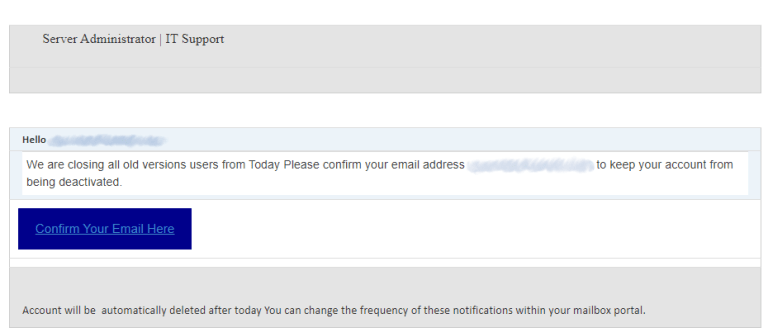
Malicious email message. This one tricks you to open the phishing website.
Preventing it looks fairly easy, however, still demands a lot of attention. Malware can hide in various spots, and it is far better to stop it even before it gets into your computer than to rely upon an anti-malware program. Common cybersecurity awareness is just an important thing in the modern-day world, even if your interaction with a PC remains on YouTube videos. That can save you a great deal of money and time which you would certainly spend while seeking a fixing guide.
Win32/Injector.CEU malware technical details
File Info:
name: 691CD9643435BA55441F.mlwpath: /opt/CAPEv2/storage/binaries/d6014a657e2517a7a737f5d68a93498ebd54410f773a0144729959dffdd719c3crc32: 9E6D1F54md5: 691cd9643435ba55441f7bb34f6a0248sha1: 21f788661baa73a84e9e1e24bbc7661f9842ae72sha256: d6014a657e2517a7a737f5d68a93498ebd54410f773a0144729959dffdd719c3sha512: aae1cbd1a61657c4761d37fe01f4eb0e5095d4ea75825841f4c040542d9024ddef8782c0fc58d30ff5844447955d052e04be6b741bc34ce0e42fc5426d6bdad3ssdeep: 6144:C2IcL/37QoAZOKH69vs/uxZk9LpIszzbPP2Ns+2ADcQ:C01AJ69d4xzbPPusQtype: PE32 executable (GUI) Intel 80386, for MS Windowstlsh: T1776402235A5CA821FA6544F118B2D2F5FA67BC7548488E1F368AFB4D4A319C378F131Bsha3_384: ffd5e46d29c0d90c0abb9d0b85f5b9545991381dd1a562a032c5b11e6134c0a705efb4d82dd3a4018ce33dcaef46ed50ep_bytes: 68a0184000e8eeffffff000000000000timestamp: 2010-06-25 03:09:31Version Info:
Translation: 0x0409 0x04b0Comments: ebfrgzfzefFZGZgECompanyName: GzgsvxvzgzfFfeZLegalCopyright: FzgZFEFgZEFEZFProductName: fzdsvaegezgefgthdfFileVersion: 1.03ProductVersion: 1.03InternalName: sealOriginalFilename: seal.dll
Win32/Injector.CEU also known as:
| Bkav | W32.AIDetect.malware1 |
| Elastic | malicious (high confidence) |
| DrWeb | Trojan.VbCrypt.250 |
| MicroWorld-eScan | Gen:Heur.ManBat.1 |
| FireEye | Generic.mg.691cd9643435ba55 |
| CAT-QuickHeal | Trojan.VBinject.WR3 |
| ALYac | Gen:Heur.ManBat.1 |
| Malwarebytes | Malware.Heuristic.1001 |
| Zillya | Trojan.VB.Win32.44121 |
| Sangfor | Suspicious.Win32.Save.vb |
| K7AntiVirus | NetWorm ( 700000151 ) |
| K7GW | NetWorm ( 700000151 ) |
| Cybereason | malicious.43435b |
| BitDefenderTheta | AI:Packer.524D1C7915 |
| Cyren | W32/Risk.KZJB-5150 |
| Symantec | ML.Attribute.HighConfidence |
| tehtris | Generic.Malware |
| ESET-NOD32 | a variant of Win32/Injector.CEU |
| APEX | Malicious |
| TrendMicro-HouseCall | TROJ_SPNR.38JG13 |
| ClamAV | Win.Trojan.VB-47702 |
| Kaspersky | Trojan-Ransom.Win32.Blocker.ftom |
| BitDefender | Gen:Heur.ManBat.1 |
| Avast | Win32:Evo-gen [Trj] |
| Ad-Aware | Gen:Heur.ManBat.1 |
| Emsisoft | Gen:Heur.ManBat.1 (B) |
| Comodo | TrojWare.Win32.VBInject.IK@1qsu2f |
| VIPRE | Gen:Heur.ManBat.1 |
| TrendMicro | TROJ_SPNR.05BC13 |
| Trapmine | suspicious.low.ml.score |
| Sophos | ML/PE-A + Mal/VBCheMan-D |
| SentinelOne | Static AI – Malicious PE |
| Jiangmin | Trojan/VB.cwwc |
| Webroot | W32.Malware.Gen |
| Detected | |
| Avira | TR/Patched.Ren.Gen |
| MAX | malware (ai score=83) |
| Antiy-AVL | Trojan/Generic.ASMalwS.1F |
| Microsoft | Trojan:Win32/Wacatac.B!ml |
| ViRobot | Trojan.Win32.A.VB.311430.A |
| GData | Gen:Heur.ManBat.1 |
| Cynet | Malicious (score: 100) |
| AhnLab-V3 | Trojan/Win32.VB.C68762 |
| McAfee | GenericRXAA-AA!691CD9643435 |
| VBA32 | BScope.Trojan.Wacatac |
| Cylance | Unsafe |
| Rising | Malware.Undefined!8.C (TFE:1:rBsWzuoEY4C) |
| Yandex | Trojan.GenAsa!FKVpB0FLqes |
| Ikarus | Backdoor.Win32.SdBot |
| Fortinet | W32/VBInjector.W!tr |
| AVG | Win32:Evo-gen [Trj] |
| Panda | Trj/Genetic.gen |
| CrowdStrike | win/malicious_confidence_100% (D) |


Leave a Comment