
Spectating the Trojan:Win32/Raccrypt.GK!MTB malware detection usually means that your PC is in big danger. This virus can correctly be identified as ransomware – type of malware which ciphers your files and asks you to pay for their decryption. Stopping it requires some peculiar steps that must be done as soon as possible.
Trojan:Win32/Raccrypt.GK!MTB detection is a virus detection you can spectate in your system. It generally appears after the provoking procedures on your computer – opening the dubious email messages, clicking the advertisement in the Internet or installing the program from unreliable sources. From the second it appears, you have a short time to act before it begins its destructive activity. And be sure – it is far better not to await these destructive effects.
What is Trojan:Win32/Raccrypt.GK!MTB virus?
Trojan:Win32/Raccrypt.GK!MTB Summary
Summarizingly, Trojan:Win32/Raccrypt.GK!MTB virus actions in the infected PC are next:
- SetUnhandledExceptionFilter detected (possible anti-debug);
- Behavioural detection: Executable code extraction – unpacking;
- At least one process apparently crashed during execution;
- Executed a command line with /C or /R argument to terminate command shell on completion which can be used to hide execution;
- Yara rule detections observed from a process memory dump/dropped files/CAPE;
- Creates RWX memory;
- Dynamic (imported) function loading detected;
- Reads data out of its own binary image;
- A process created a hidden window;
- CAPE extracted potentially suspicious content;
- Drops a binary and executes it;
- Unconventionial language used in binary resources: Uzbek (Latin);
- Authenticode signature is invalid;
- Uses Windows utilities for basic functionality;
- Enumerates services, possibly for anti-virtualization;
- Behavioural detection: Injection (Process Hollowing);
- Executed a process and injected code into it, probably while unpacking;
- Behavioural detection: Injection (inter-process);
- Installs itself for autorun at Windows startup;
- Installs itself for autorun at Windows startup;
- CAPE detected the Tofsee malware family;
- Deletes executed files from disk;
- Anomalous binary characteristics;
- Uses suspicious command line tools or Windows utilities;
- Ciphering the files kept on the victim’s drive — so the victim cannot use these files;
- Blocking the launching of .exe files of anti-malware programs
- Blocking the launching of installation files of security tools
Ransomware has actually been a nightmare for the last 4 years. It is hard to picture a more harmful malware for both individuals and corporations. The algorithms used in Trojan:Win32/Raccrypt.GK!MTB (typically, RHA-1028 or AES-256) are not hackable – with minor exclusions. To hack it with a brute force, you need a lot more time than our galaxy already exists, and possibly will exist. However, that malware does not do all these bad things instantly – it may require up to a few hours to cipher all of your documents. Hence, seeing the Trojan:Win32/Raccrypt.GK!MTB detection is a clear signal that you have to begin the elimination process.
Where did I get the Trojan:Win32/Raccrypt.GK!MTB?
Ordinary ways of Trojan:Win32/Raccrypt.GK!MTB spreading are common for all other ransomware examples. Those are one-day landing web pages where users are offered to download and install the free program, so-called bait emails and hacktools. Bait e-mails are a pretty new tactic in malware spreading – you receive the email that simulates some standard notifications about deliveries or bank service conditions updates. Inside of the e-mail, there is a corrupted MS Office file, or a link which leads to the exploit landing page.
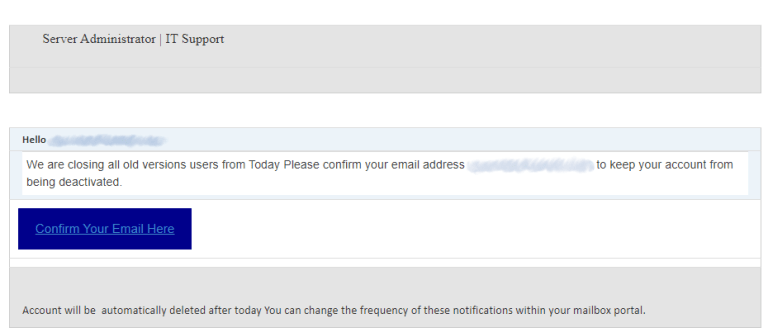
Malicious email message. This one tricks you to open the phishing website.
Avoiding it looks fairly simple, but still demands a lot of focus. Malware can hide in different places, and it is much better to prevent it even before it invades your computer than to rely upon an anti-malware program. Simple cybersecurity awareness is just an essential item in the modern-day world, even if your relationship with a computer stays on YouTube videos. That may save you a lot of money and time which you would spend while trying to find a fixing guide.
Trojan:Win32/Raccrypt.GK!MTB malware technical details
File Info:
name: 7FF4CB6FFD7E78C5AEA2.mlwpath: /opt/CAPEv2/storage/binaries/005b609a6708768ebccdfd4a853850493e6b3f2155743be668d489653fcb74f5crc32: 849F4D3Dmd5: 7ff4cb6ffd7e78c5aea22c8ebc1e643esha1: 7d9880e20986c447943324e2035425a025a0f943sha256: 005b609a6708768ebccdfd4a853850493e6b3f2155743be668d489653fcb74f5sha512: 5efe1aa717bb9791ff0b816e3c1ba06c11aa3fad139ea1b959fa7c29d8dc045f0fc08c391e4d76cd3b1c7063b37728d10b7867af1d360097afb5575ec58c5da4ssdeep: 12288:74iPv+xiaf7pqS6g3h36wwlT099999999999999999999999999999999999999H:7tHR+7pqiClTtype: PE32 executable (GUI) Intel 80386, for MS Windowstlsh: T1B9C67C0577D8D959D3A52AB2593686A65A36FCDBE92403CB320C7F0FBC325844E81F63sha3_384: 91d2724daff7647cd070d66a2d02c5d9d949afce70252d3b098a80dd08ad78ffde68399309601546b2bcdc62b74c2609ep_bytes: 8bff558bece876d10000e8110000005dtimestamp: 2021-05-17 04:13:23Version Info:
Translations: 0x0293 0x02bb
Trojan:Win32/Raccrypt.GK!MTB also known as:
| Bkav | W32.AIDetect.malware2 |
| Elastic | malicious (high confidence) |
| MicroWorld-eScan | Trojan.GenericKDZ.87671 |
| FireEye | Generic.mg.7ff4cb6ffd7e78c5 |
| CAT-QuickHeal | Ransom.Stop.P5 |
| McAfee | Packed-GDT!7FF4CB6FFD7E |
| Cylance | Unsafe |
| VIPRE | Trojan.GenericKDZ.87671 |
| Sangfor | Trojan.Win32.Save.a |
| K7AntiVirus | Trojan ( 00592d311 ) |
| K7GW | Trojan ( 00592d311 ) |
| Cyren | W32/Kryptik.GNZ.gen!Eldorado |
| Symantec | ML.Attribute.HighConfidence |
| tehtris | Generic.Malware |
| ESET-NOD32 | a variant of Win32/Kryptik.HPON |
| ClamAV | Win.Dropper.Stopcrypt-9950158-0 |
| Kaspersky | HEUR:Trojan-Spy.Win32.Stealer.gen |
| BitDefender | Trojan.GenericKDZ.87671 |
| NANO-Antivirus | Trojan.Win32.Tofsee.joxshb |
| Avast | Win32:BotX-gen [Trj] |
| Rising | Trojan.Kryptik!1.DE4C (CLASSIC) |
| Ad-Aware | Trojan.GenericKDZ.87671 |
| Emsisoft | Trojan.GenericKDZ.87671 (B) |
| DrWeb | Trojan.Siggen17.50693 |
| Zillya | Trojan.Kryptik.Win32.3766425 |
| McAfee-GW-Edition | BehavesLike.Win32.Worm.wm |
| SentinelOne | Static AI – Malicious PE |
| Trapmine | malicious.high.ml.score |
| Sophos | ML/PE-A |
| APEX | Malicious |
| GData | Win32.Trojan.PSE.1400VVW |
| Jiangmin | TrojanSpy.Stealer.upw |
| Avira | HEUR/AGEN.1250196 |
| MAX | malware (ai score=87) |
| Antiy-AVL | Trojan/Generic.ASMalwS.5E49 |
| Microsoft | Trojan:Win32/Raccrypt.GK!MTB |
| Cynet | Malicious (score: 100) |
| AhnLab-V3 | Trojan/Win.MalPE.R492069 |
| Acronis | suspicious |
| Malwarebytes | Trojan.MalPack.GS |
| Tencent | Trojan.Win32.Agent.zaj |
| Ikarus | Trojan-Ransom.StopCrypt |
| Fortinet | W32/Packed.GDT!tr |
| AVG | Win32:BotX-gen [Trj] |
| Panda | Trj/GdSda.A |
| CrowdStrike | win/malicious_confidence_70% (D) |


Leave a Comment