
If you spectate the alert of Backdoor:Win32/Bladabindi!mclg detection, it appears that your system has a problem. All viruses are dangerous, with no exceptions. Bladabindi gives the cybercriminals access to your system, or even connects it to the botnet.
What does the notification with Backdoor:Win32/Bladabindi!mclg detection mean?
The Backdoor:Win32/Bladabindi!mclg detection you can see in the lower right side is shown to you by Microsoft Defender. That anti-malware program is good at scanning, however, prone to be basically unstable. It is unprotected to malware invasions, it has a glitchy interface and bugged malware removal capabilities. For this reason, the pop-up which says about the Bladabindi is just a notification that Defender has identified it. To remove it, you will likely need to make use of a separate anti-malware program.
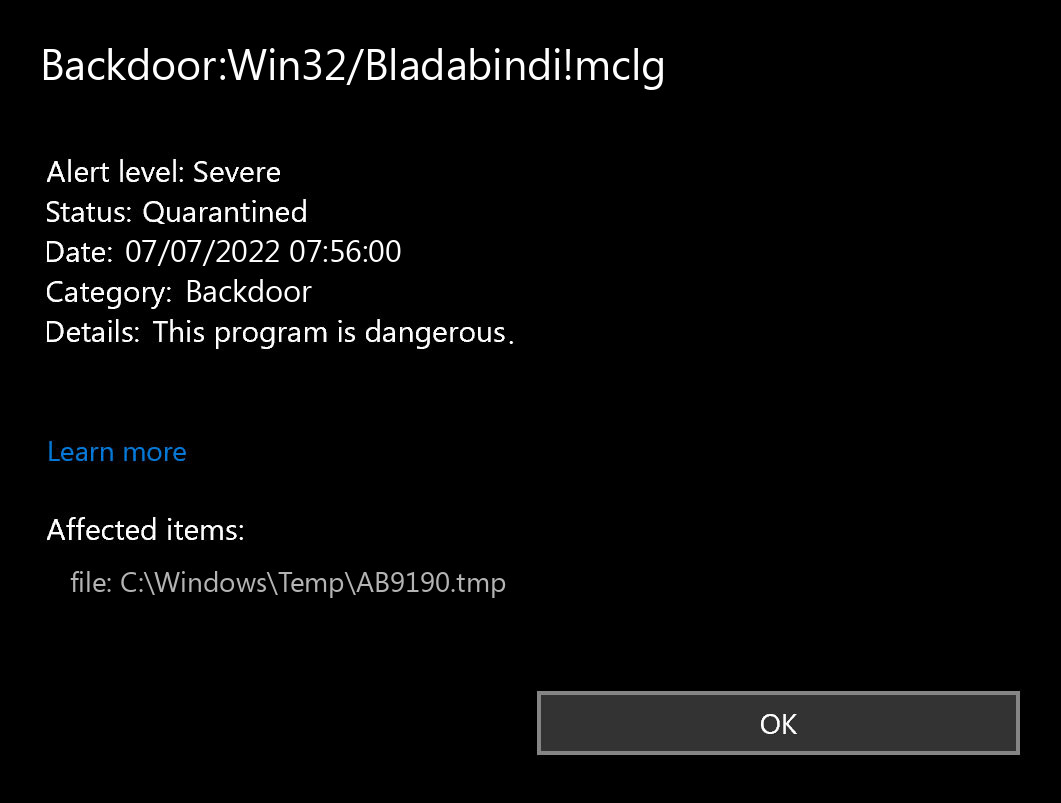
Microsoft Defender: “Backdoor:Win32/Bladabindi!mclg”
The exact Backdoor:Win32/Bladabindi!mclg virus is a really unpleasant thing. This malware is designed to be a sneaky burglar, which works as a remote-access tool. When you give someone remote access willingly, it is okay, however, Bladabindi will not ask you if you wish to provide it. After connecting to your system, criminals are able to do whatever they want – grabbing your files, checking out your messages, gathering personal data, and so on. Backdoors commonly carry an additional stealer – the virus that is created to pick up all possible data about you. Nonetheless, much more prevalent use of the backdoors is forming the botnet. Then, the network of infected computers may be put to use to conduct DDoS attacks or to inflate the poll results on different sites.
Backdoor Summary:
| Name | Bladabindi Backdoor |
| Detection | Backdoor:Win32/Bladabindi!mclg |
| Damage | Gain access to the operating system to perform various malicious actions. |
| Similar | Blackmoon, Manuscrypt, Virkel, Rmtsvc, Winnt Ircbot, Js Webshell, Trojan Ulthar, Sysjoker |
| Fix Tool | See If Your System Has Been Affected by Bladabindi backdoor |
Shortly about backdoors
Is Backdoor:Win32/Bladabindi!mclg dangerous?
As I have pointed out , non-harmful malware does not exist. And Backdoor:Win32/Bladabindi!mclg is not an exception. This backdoor does not deal a many damage just after it releases. Nonetheless, it will likely be a really unpleasant surprise when a random forum or website in the Internet will not let you in, because your IP-address is disallowed after the DDoS attack. But even if it is not crucial for you – is it pleasing in any way to know that someone else can easily access your PC, read your conversations, open your documents, as well as spectate what you do?
The spyware that is usually present as a supplement to the Backdoor:Win32/Bladabindi!mclg virus will likely be just an additional argument to remove it as fast as you can. Nowadays, when users’ data is valued incredibly high, it is too illogical to give the criminals such a possibility. Even worse if the spyware will somehow handle to steal your banking info. Seeing zeros on your financial account is the most awful headache, in my thoughts.
How did I get this virus?
It is difficult to line the sources of malware on your PC. Nowadays, things are mixed, and distribution tactics utilized by adware 5 years ago may be used by spyware nowadays. But if we abstract from the exact distribution way and will think about why it works, the answer will be really basic – low level of cybersecurity understanding. People click on promotions on strange websites, open the pop-ups they receive in their web browsers, call the “Microsoft tech support” believing that the weird banner that says about malware is true. It is very important to know what is legitimate – to prevent misconceptions when attempting to identify a virus.
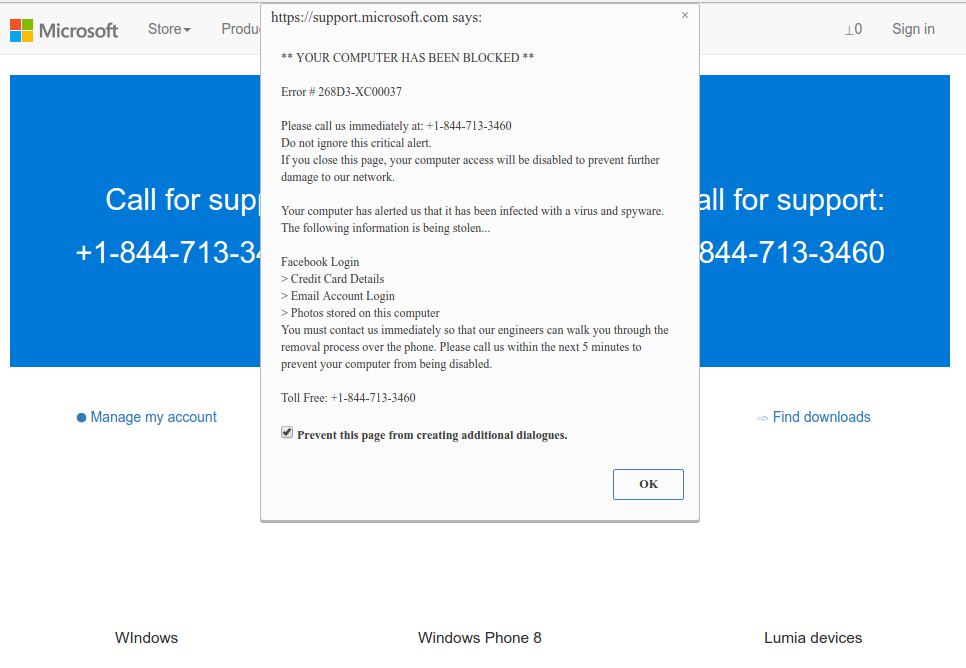
Microsoft Tech Support Scam
Nowadays, there are two of the most common tactics of malware spreading – bait e-mails and also injection into a hacked program. While the first one is not so easy to avoid – you need to know a lot to recognize a counterfeit – the second one is simple to solve: just do not use hacked programs. Torrent-trackers and other providers of “totally free” applications (which are, actually, paid, but with a disabled license checking) are just a giveaway point of malware. And Backdoor:Win32/Bladabindi!mclg is simply one of them.
How to remove the Backdoor:Win32/Bladabindi!mclg from my PC?
References
- Gossip about the backdoor in Intel processors on Reddit.


Leave a Comment