
The 8Base virus falls within the ransomware type of malicious agent. Such malware ciphers all the data on your PC (photos, text files, excel sheets, music, videos, etc) and appends its own extension to every file, leaving the info.txt files in each directory containing encrypted files. This ransomware belongs to Phobos family.
What is 8Base Ransomware?
8Base Ransomware belongs to the Phobos ransomware family, and has been identified by our malware researchers during their investigation of recently uploaded malware samples on the VirusTotal. This malicious software is designed with the primary intent of encrypting files on the infected system. Additionally, 8base deploys two ransom notes (“info.hta” and “info.txt”) and alters filenames to further its malevolent objectives.
To carry out its encryption process, 8base appends the victim’s unique ID, [email protected] email address, and the “.8base” extension to the original filenames. As an example, it transforms “1.jpg” into “1.jpg.id[0A4FDF4F-818E].[[email protected]].8base“, and “2.doc” into “2.doc.id[0A4FDF4F-818E].[[email protected]].8base“, and so on.
In each directory containing the encoded files, a info.txt file will appear. It is a ransom money memo. It contains information about the ways of contacting the racketeers and some other remarks. The ransom note most probably contains instructions on how to purchase the decryption tool from the tamperers. You can get this decryptor after contacting [email protected] through email. That is basically the scheme of the malefaction.
8Base Ransomware Overview
| Name | 8Base Ransomware |
| Extension | .8base |
| Family | Phobos |
| Ransomware note | info.txt |
| Contact | [email protected] |
| Detection | Win32.Virlock.Gen.4, NSIS/Injector.MK, Generic.Trojan.Malicious.DDS |
| Symptoms | Your files (photos, videos, documents) get a .8base extension and you can’t open them. |
| Fix Tool | See If Your System Has Been Affected by 8Base virus |
The info.txt document coming in package with the 8Base ransomware states the following:
!!!All of your files are encrypted!!!
To decrypt them send e-mail to this address: [email protected].
Write us to the Tox Messanger: 1167BDDAA32671D52932698FF508CF F194BF9E9B35E91BFBA7AD803C0A57EB41BB23880DD595
In the picture below, you can see what a folder with files encrypted by the 8Base looks like. Each filename has the “.8base” extension added to it.
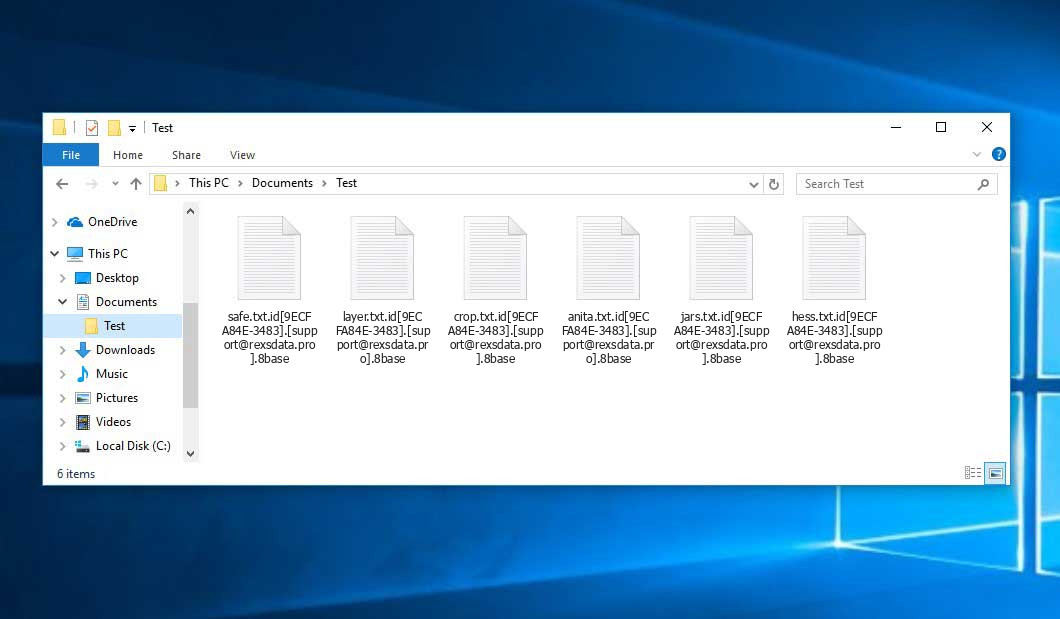
That is how encrypted “.8base” files look.
How did my computer get infected with 8Base ransomware?
There are many possible ways of ransomware infiltration.
There are currently three most exploited methods for hackers to have the 8Base virus settled in your digital environment. These are email spam, Trojan introduction and peer-to-peer networks.
If you access your inbox and see letters that look like familiar notifications from utility services providers, delivery agencies like FedEx, Internet providers, and whatnot, but whose “from” field is strange to you, be wary of opening those letters. They are most likely to have a viral item attached to them. Therefore, it is even riskier to open any attachments that come with letters like these.
Another option for ransom hunters is a Trojan horse scheme. A Trojan is an object that gets into your machine disguised as something different. For example, you download an installer for some program you want or an update for some service. But what is unpacked turns out to be a harmful program that compromises your data. As the update wizard can have any name and any icon, you’d better be sure that you can trust the source of the stuff you’re downloading. The best way is to use the software companies’ official websites.
As for the peer-to-peer networks like torrents or eMule, the danger is that they are even more trust-based than the rest of the Web. You can never guess what you download until you get it. Our suggestion is that you use trustworthy websites. Also, it is reasonable to scan the folder containing the downloaded files with the antivirus as soon as the downloading is finished.
How to remove the 8Base ransomware?
It is crucial to note that besides encrypting your data, the 8Base ransowmare will probably install Vidar Stealer on your machine to seize your credentials to different accounts (including cryptocurrency wallets). The mentioned program can extract your logins and passwords from your browser’s auto-filling data.
Often criminals would decode few of your files so you know that they indeed have the decryption tool. Since 8Base virus is a relatively new ransomware, anti-malware developers have not yet found a way to reverse its work. Nevertheless, the decoding tools are frequently updated, so the solution may soon arrive.
Of course, if the malefactors do the job of encrypting victim’s critical files, the desperate person will probably comply with their demands. Nevertheless, paying a ransom does not necessarily mean that you’re getting your data back. It is still risky. After getting the ransom, the racketeers may send a wrong decryption key to the injured party. There were reports about criminals just vanishing after getting the money without even writing back.
The optimal countermeasure to ransomware is to have a system restore point or the copies of your essential files in the cloud drive or at least on an external storage. Of course, that might be not enough. The most crucial thing could be that one you were working upon when it all started. But at least it is something. It is also reasonable to scan your drives with the antivirus program after the system is rolled back.
8Base is not the only ransomware of its kind, since there are other specimens of ransomware out there that act in the same manner. For instance, Miqe Virus, Mitu Virus, Miza Virus, and some others. The two main differences between them and the 8Baseare the ransom amount and the encoding method. The rest is the same: files become encoded, their extensions changed, ransom notes are created in each directory containing encrypted files.
Some lucky people were able to decrypt the arrested files with the help of the free tools provided by anti-ransomware specialists. Sometimes the racketeers mistakenly send the decoding key to the victims in the ransom note. Such an extraordinary fail allows the user to restore the files. But of course, one should never expect such a chance. Make no mistake, ransomware is a bandits’ instrument to lay their hands on the money of their victims.
FAQ
🤔 Are the “.8base” files accessible?
Negative. That is why ransomware is so frustrating. Until you decode the “.8base” files you will not be able to access them.
🤔 What should I do to make my files accessible as fast as possible?
If the “.8base” files contain some really important information, then you probably have them backed up. Otherwise, you might try to employ System Restore. The only question is whether you have saved any Restore Points that would be helpful now. The rest of the methods require patience.
🤔 What should I do if the 8base malware has blocked my computer and I can’t get the activation key.
🤔 What can I do right now?
Some of the encrypted files can be located elsewhere.
- If you exchanged your important files by email, you could still download them from your online mailbox.
- You might have shared images or videos with your friends or family members. Just ask them to give those pictures back to you.
- If you have initially got any of your files from the Internet, you can try downloading them again.
- Your messengers, social media pages, and cloud disks might have all those files as well.
- It might be that you still have the needed files on your old PC, a laptop, mobile, memory stick, etc.
HINT: You can employ data recovery utilities1 to get your lost data back since ransomware encrypts the copies of your files, deleting the authentic ones. In the tutorial below, you can learn how to use PhotoRec for such a restoration, but remember: you won’t be able to do it before you kill the virus with an antivirus program.
I need your help to share this article.
It is your turn to help other people. I have written this article to help users like you. You can use the buttons below to share this on your favorite social media Facebook, Twitter, or Reddit.
Brendan SmithReferences
- Here’s the list of Best Data Recovery Software Of 2023.


Leave a Comment