
Spectating the Win32:VunDrop [Drp] malware detection means that your PC is in big danger. This malware can correctly be identified as ransomware – type of malware which ciphers your files and asks you to pay for their decryption. Stopping it requires some unusual steps that must be done as soon as possible.
Win32:VunDrop [Drp] detection is a virus detection you can spectate in your computer. It frequently appears after the provoking activities on your computer – opening the suspicious email messages, clicking the advertisement in the Web or mounting the program from suspicious resources. From the second it shows up, you have a short time to take action until it begins its destructive action. And be sure – it is far better not to wait for these malicious effects.
What is Win32:VunDrop [Drp] virus?
Win32:VunDrop [Drp] Summary
In summary, Win32:VunDrop [Drp] virus activities in the infected system are next:
- Behavioural detection: Executable code extraction – unpacking;
- CAPE extracted potentially suspicious content;
- The binary likely contains encrypted or compressed data.;
- Authenticode signature is invalid;
- CAPE detected the shellcode patterns malware family;
- Anomalous binary characteristics;
- Yara detections observed in process dumps, payloads or dropped files;
- Encrypting the documents kept on the target’s disk drives — so the victim cannot open these files;
- Blocking the launching of .exe files of anti-virus programs
- Blocking the launching of installation files of anti-malware apps
Ransomware has actually been a headache for the last 4 years. It is challenging to picture a more hazardous malware for both individuals and corporations. The algorithms utilized in Win32:VunDrop [Drp] (typically, RHA-1028 or AES-256) are not hackable – with minor exclusions. To hack it with a brute force, you need to have more time than our galaxy currently exists, and possibly will exist. But that virus does not do all these terrible things instantly – it can require up to several hours to cipher all of your documents. Therefore, seeing the Win32:VunDrop [Drp] detection is a clear signal that you must start the elimination process.
Where did I get the Win32:VunDrop [Drp]?
Standard tactics of Win32:VunDrop [Drp] distribution are usual for all other ransomware examples. Those are one-day landing web pages where users are offered to download the free software, so-called bait e-mails and hacktools. Bait emails are a quite new tactic in malware distribution – you receive the email that simulates some standard notifications about deliveries or bank service conditions shifts. Within the email, there is a corrupted MS Office file, or a link which opens the exploit landing page.
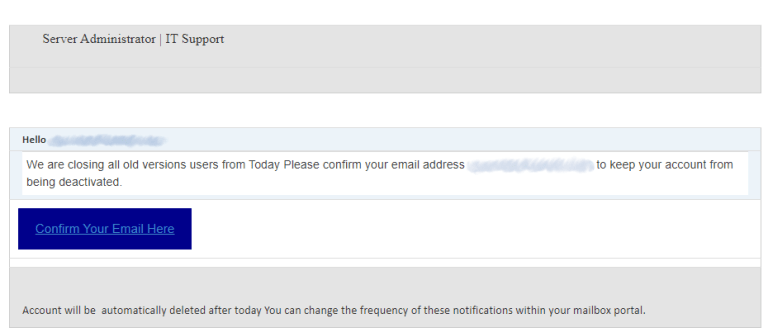
Malicious email message. This one tricks you to open the phishing website.
Preventing it looks pretty simple, but still demands a lot of recognition. Malware can hide in various spots, and it is better to prevent it even before it goes into your computer than to trust in an anti-malware program. Standard cybersecurity awareness is just an important thing in the modern world, even if your interaction with a computer remains on YouTube videos. That can keep you a great deal of money and time which you would spend while searching for a fix guide.
Win32:VunDrop [Drp] malware technical details
File Info:
name: 8769BFC55BB397097A34.mlwpath: /opt/CAPEv2/storage/binaries/cdbb73357edbf59d5b5a995a9cf9678ae4bfcedf859d02159cadd97d7a595d89crc32: 0CF706D5md5: 8769bfc55bb397097a3408f0336cc0a4sha1: cc606f1d3060638024daf4b2faf05fe5e2cd033asha256: cdbb73357edbf59d5b5a995a9cf9678ae4bfcedf859d02159cadd97d7a595d89sha512: e498ff48aca9c7a5158e44f9e54abc9cb51a101b41c0e24c189ba97cc6a66348704158eeb967f92f26cf0a1fe536184f167a323c599fa0c6dd74db565a5b4426ssdeep: 1536:NoiIRON/ZxX4XWoeD5l9IoCkMZrbBHhJuNrdV1:abC/vXV9tCkMZhHhJuddztype: PE32 executable (DLL) (GUI) Intel 80386, for MS Windowstlsh: T1DB439E2289FA115BC75611362F9428D6DF3B4F460C3741618FA52D6918F3CFFA287E98sha3_384: 51afc09c7632dadfefb75debaeb52dc6a7f3236460f3bbb264db4273e1c28861ace5968bf0ddc7713d96d192bcbf22c7ep_bytes: 516884e30ad683e10081c404000000e8timestamp: 2008-01-13 15:36:14Version Info:
0: [No Data]
Win32:VunDrop [Drp] also known as:
| Bkav | W32.AIDetectMalware |
| Lionic | Trojan.Win32.Generic.kYYZ |
| MicroWorld-eScan | Gen:Variant.Barys.395130 |
| FireEye | Generic.mg.8769bfc55bb39709 |
| Skyhigh | BehavesLike.Win32.Vundo.qc |
| McAfee | Vundo.gen.m |
| Cylance | unsafe |
| Sangfor | Suspicious.Win32.Save.a |
| K7AntiVirus | Trojan ( 00521e9b1 ) |
| Alibaba | Trojan:Win32/Monder.353bf62d |
| K7GW | Trojan ( 00521e9b1 ) |
| CrowdStrike | win/malicious_confidence_100% (D) |
| VirIT | Trojan.Win32.Virtumod.based.L |
| Symantec | ML.Attribute.HighConfidence |
| Elastic | malicious (high confidence) |
| ESET-NOD32 | Win32/Adware.Virtumonde |
| APEX | Malicious |
| ClamAV | Win.Trojan.Vundo-3790 |
| Kaspersky | Trojan.Win32.Monder.gen |
| BitDefender | Gen:Variant.Barys.395130 |
| NANO-Antivirus | Riskware.Win32.Virtumonde.xast |
| Avast | Win32:VunDrop [Drp] |
| Tencent | Win32.Trojan.Monder.Mcnw |
| TACHYON | Trojan-Clicker/W32.Virtumonde.58368.B |
| Emsisoft | Gen:Variant.Barys.395130 (B) |
| F-Secure | Adware.ADSPY/Virtumonde.trz |
| DrWeb | Trojan.Virtumod.based.11 |
| VIPRE | Gen:Variant.Barys.395130 |
| TrendMicro | ADW_VIRTUMONDE |
| Trapmine | malicious.moderate.ml.score |
| Sophos | Troj/Virtum-Gen |
| Ikarus | Trojan.Win32.Genome |
| GData | Gen:Variant.Barys.395130 |
| Jiangmin | Adware/Agent.bee |
| Detected | |
| Avira | ADSPY/Virtumonde.trz |
| Varist | W32/Virtumonde.X.gen!Eldorado |
| Antiy-AVL | Trojan/Win32.Monder |
| Kingsoft | Win32.Trojan.Monder.gen |
| Xcitium | Application.Win32.Adware.Virtumonde@dgt6 |
| Arcabit | Trojan.Barys.D6077A |
| ViRobot | Adware.Virtumonde.58368.E |
| ZoneAlarm | Trojan.Win32.Monder.gen |
| Microsoft | Trojan:Win32/Vundo.AX |
| Cynet | Malicious (score: 100) |
| AhnLab-V3 | Win-Trojan/Monder.Gen |
| BitDefenderTheta | AI:Packer.E7FE02591E |
| ALYac | Gen:Variant.Barys.395130 |
| MAX | malware (ai score=100) |
| VBA32 | BScope.Trojan.Monder |
| Panda | Trj/Genetic.gen |
| TrendMicro-HouseCall | ADW_VIRTUMONDE |
| Rising | Trojan.Win32.VUNDO.bgt (CLASSIC) |
| Yandex | Trojan.GenAsa!qCRMs1lNCOY |
| SentinelOne | Static AI – Malicious PE |
| MaxSecure | Trojan.Malware.737885.susgen |
| Fortinet | W32/Vundo.fam!tr |
| AVG | Win32:VunDrop [Drp] |
| DeepInstinct | MALICIOUS |


Leave a Comment