
Seeing the Win32:Crypt-RYR [Trj] malware detection means that your PC is in big danger. This computer virus can correctly be named as ransomware – sort of malware which encrypts your files and asks you to pay for their decryption. Removing it requires some unusual steps that must be done as soon as possible.
Win32:Crypt-RYR [Trj] detection is a virus detection you can spectate in your system. It generally appears after the preliminary actions on your PC – opening the suspicious e-mail, clicking the advertisement in the Web or mounting the program from suspicious sources. From the instance it shows up, you have a short time to do something about it before it starts its malicious activity. And be sure – it is better not to await these malicious things.
What is Win32:Crypt-RYR [Trj] virus?
Win32:Crypt-RYR [Trj] Summary
In total, Win32:Crypt-RYR [Trj] ransomware activities in the infected system are next:
- Behavioural detection: Executable code extraction – unpacking;
- Executed a command line with /C or /R argument to terminate command shell on completion which can be used to hide execution;
- Creates RWX memory;
- Dynamic (imported) function loading detected;
- Reads data out of its own binary image;
- A process created a hidden window;
- CAPE extracted potentially suspicious content;
- The binary likely contains encrypted or compressed data.;
- Authenticode signature is invalid;
- Uses Windows utilities for basic functionality;
- Created a process from a suspicious location;
- Installs itself for autorun at Windows startup;
- Installs itself for autorun at Windows startup;
- Created a service that was not started;
- Anomalous binary characteristics;
- Encrypting the documents located on the target’s drive — so the victim cannot use these documents;
- Blocking the launching of .exe files of anti-malware apps
- Blocking the launching of installation files of security tools
Ransomware has been a major problem for the last 4 years. It is difficult to realize a more damaging virus for both individuals and companies. The algorithms utilized in Win32:Crypt-RYR [Trj] (generally, RHA-1028 or AES-256) are not hackable – with minor exclusions. To hack it with a brute force, you need a lot more time than our galaxy already exists, and possibly will exist. But that malware does not do all these terrible things immediately – it can require up to a few hours to cipher all of your documents. Hence, seeing the Win32:Crypt-RYR [Trj] detection is a clear signal that you must begin the removal procedure.
Where did I get the Win32:Crypt-RYR [Trj]?
Ordinary tactics of Win32:Crypt-RYR [Trj] spreading are standard for all other ransomware variants. Those are one-day landing web pages where victims are offered to download the free software, so-called bait e-mails and hacktools. Bait emails are a relatively new strategy in malware distribution – you receive the e-mail that simulates some routine notifications about shipments or bank service conditions shifts. Within the e-mail, there is a malicious MS Office file, or a link which opens the exploit landing page.
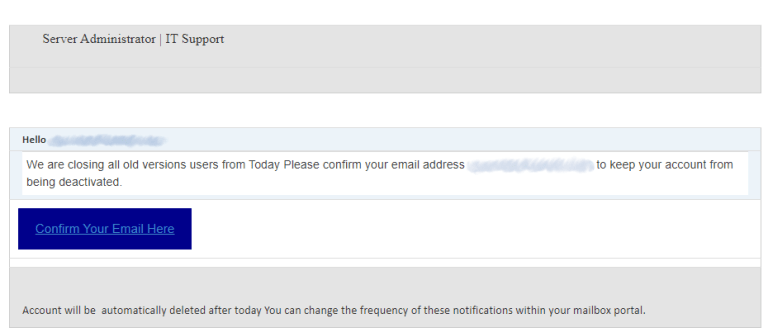
Malicious email message. This one tricks you to open the phishing website.
Preventing it looks pretty easy, however, still demands a lot of attention. Malware can hide in various places, and it is far better to stop it even before it goes into your PC than to trust in an anti-malware program. Essential cybersecurity awareness is just an essential item in the modern world, even if your interaction with a computer stays on YouTube videos. That may keep you a great deal of time and money which you would spend while looking for a solution.
Win32:Crypt-RYR [Trj] malware technical details
File Info:
name: 0967C024682DC9631C63.mlwpath: /opt/CAPEv2/storage/binaries/ae5f727db3b2942cc5fe339112d6193bd3c6f00f901f38c973ca0cb98caf849bcrc32: E23FF1B6md5: 0967c024682dc9631c63120659465cd7sha1: ffba8273d198c1d910e2bc3398867e6cf3d2884dsha256: ae5f727db3b2942cc5fe339112d6193bd3c6f00f901f38c973ca0cb98caf849bsha512: 19ce017caa9ba0a39a6cc05dad618d84a0b9b536161d3135ec1c65a4f01f1b39fb96f08434b67898f98dd04da3a2f94e36b7ed4cd98930e9a94f8999c960d377ssdeep: 6144:TzkhZBQBr+e8vAlKOO7cxLCiWbwi+Uhu6CZgnE9W3b:TzuZBmrQAlMcxLAU6rnEQrtype: PE32 executable (GUI) Intel 80386, for MS Windowstlsh: T13D34225BBB0A2F53E3BD033B681A79DC93D88A3715FED24E764A6981C397D474C28204sha3_384: 47658620a643a270c9ac75035d453037f6a4d982cd883e32be14151dc1958eed53c4735c4f307b4ef971dc8287e889b4ep_bytes: 53b820316300bb78563412b978563412timestamp: 2014-12-24 07:26:24Version Info:
0: [No Data]
Win32:Crypt-RYR [Trj] also known as:
| Bkav | W32.AIDetect.malware1 |
| Elastic | malicious (high confidence) |
| MicroWorld-eScan | Win32.Doboc.Gen.2.Dam |
| FireEye | Generic.mg.0967c024682dc963 |
| CAT-QuickHeal | W32.Tempedreve.A5 |
| ALYac | Win32.Doboc.Gen.2.Dam |
| Cylance | Unsafe |
| Zillya | Virus.PolyRansom.Win32.4 |
| K7AntiVirus | Virus ( 005223721 ) |
| K7GW | Trojan ( 004b936c1 ) |
| Cybereason | malicious.4682dc |
| Baidu | Win32.Trojan.Kryptik.ii |
| Cyren | W32/Ransom.BL.gen!Eldorado |
| Symantec | W32.Tempedreve |
| ESET-NOD32 | Win32/Spy.Tuscas.K |
| APEX | Malicious |
| ClamAV | Win.Trojan.Agent-1349155 |
| Kaspersky | Virus.Win32.PolyRansom.e |
| BitDefender | Win32.Doboc.Gen.2.Dam |
| NANO-Antivirus | Trojan.Win32.PolyRansom.dpzftw |
| SUPERAntiSpyware | Trojan.Agent/Gen-Tempedreve |
| Avast | Win32:Crypt-RYR [Trj] |
| Tencent | Trojan.Win32.BitCoinMiner.la |
| Ad-Aware | Win32.Doboc.Gen.2.Dam |
| TACHYON | Trojan/W32.Doboc.B |
| Sophos | ML/PE-A + Troj/EncPk-AQ |
| Comodo | TrojWare.Win32.Kryptik.CTYE@5ixzst |
| DrWeb | Trojan.Siggen13.52726 |
| VIPRE | Worm.Win32.Tempedreve.a (v) |
| TrendMicro | PE_URSNIF.B-O |
| McAfee-GW-Edition | BehavesLike.Win32.Generic.dc |
| Emsisoft | Win32.Doboc.Gen.2.Dam (B) |
| SentinelOne | Static AI – Malicious PE |
| GData | Win32.Doboc.Gen.2.Dam |
| Avira | TR/Dropper.Gen |
| Antiy-AVL | Trojan/Generic.ASBOL.272 |
| Microsoft | Trojan:Win32/MultiPlug.DA!MTB |
| Cynet | Malicious (score: 100) |
| AhnLab-V3 | Trojan/Win32.Invader.R130516 |
| Acronis | suspicious |
| McAfee | W32/PdfCrypt.b!0967C024682D |
| MAX | malware (ai score=82) |
| VBA32 | TrojanDropper.Daws |
| Malwarebytes | Trojan.Agent.ADA |
| TrendMicro-HouseCall | PE_URSNIF.B-O |
| Rising | Trojan.Spy.Win32.Tuscas.b (CLASSIC) |
| Yandex | Trojan.GenAsa!LyJXQNI6Zvo |
| Ikarus | Trojan.Win32.Crypt |
| eGambit | Unsafe.AI_Score_99% |
| Fortinet | W32/Kryptik.CTYE!tr |
| BitDefenderTheta | AI:FileInfector.52E8454215 |
| AVG | Win32:Crypt-RYR [Trj] |
| Panda | Generic Suspicious |
| CrowdStrike | win/malicious_confidence_80% (D) |
| MaxSecure | Virus.PolyRansom.e |


Leave a Comment