
Spectating the Win32/TrojanDownloader.Small.OCD detection usually means that your PC is in big danger. This virus can correctly be identified as ransomware – type of malware which encrypts your files and forces you to pay for their decryption. Deleteing it requires some unusual steps that must be taken as soon as possible.
Win32/TrojanDownloader.Small.OCD detection is a virus detection you can spectate in your computer. It frequently appears after the provoking actions on your PC – opening the suspicious email messages, clicking the banner in the Internet or installing the program from unreliable sources. From the instance it appears, you have a short time to act until it starts its malicious action. And be sure – it is much better not to await these malicious actions.
What is Win32/TrojanDownloader.Small.OCD virus?
Win32/TrojanDownloader.Small.OCD Summary
In summary, Win32/TrojanDownloader.Small.OCD malware activities in the infected PC are next:
- Sample contains Overlay data;
- Yara rule detections observed from a process memory dump/dropped files/CAPE;
- Checks adapter addresses which can be used to detect virtual network interfaces;
- Dynamic (imported) function loading detected;
- Performs HTTP requests potentially not found in PCAP.;
- HTTPS urls from behavior.;
- The binary contains an unknown PE section name indicative of packing;
- The binary likely contains encrypted or compressed data.;
- The executable is compressed using UPX;
- Authenticode signature is invalid;
- A process attempted to delay the analysis task by a long amount of time.;
- Installs itself for autorun at Windows startup;
- Attempts to modify proxy settings;
- Ciphering the documents kept on the target’s drive — so the victim cannot open these documents;
- Blocking the launching of .exe files of anti-malware programs
- Blocking the launching of installation files of anti-malware apps
Ransomware has actually been a major problem for the last 4 years. It is difficult to realize a more harmful malware for both individuals and organizations. The algorithms used in Win32/TrojanDownloader.Small.OCD (generally, RHA-1028 or AES-256) are not hackable – with minor exclusions. To hack it with a brute force, you need more time than our galaxy currently exists, and possibly will exist. But that malware does not do all these horrible things without delay – it can take up to several hours to cipher all of your documents. Therefore, seeing the Win32/TrojanDownloader.Small.OCD detection is a clear signal that you need to start the clearing process.
Where did I get the Win32/TrojanDownloader.Small.OCD?
Ordinary methods of Win32/TrojanDownloader.Small.OCD injection are usual for all other ransomware examples. Those are one-day landing sites where victims are offered to download and install the free app, so-called bait e-mails and hacktools. Bait emails are a pretty modern tactic in malware distribution – you get the e-mail that simulates some standard notifications about shipments or bank service conditions changes. Inside of the e-mail, there is a corrupted MS Office file, or a web link which opens the exploit landing page.
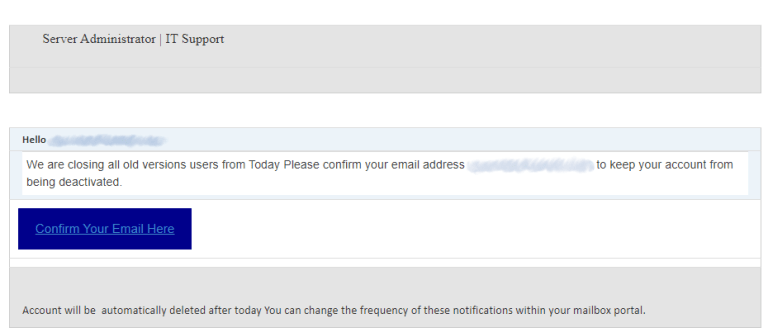
Malicious email message. This one tricks you to open the phishing website.
Preventing it looks fairly simple, but still needs a lot of attention. Malware can hide in different spots, and it is far better to stop it even before it invades your computer than to depend on an anti-malware program. Standard cybersecurity knowledge is just an important thing in the modern-day world, even if your relationship with a PC stays on YouTube videos. That can keep you a lot of time and money which you would certainly spend while looking for a fixing guide.
Win32/TrojanDownloader.Small.OCD malware technical details
File Info:
name: 984E84C30C7B5284CDB2.mlwpath: /opt/CAPEv2/storage/binaries/e57dfae60d6e7fb3efdd31d19743205bc92c457cd648364998a1c2e56f7f6976crc32: EF2EF2FCmd5: 984e84c30c7b5284cdb2f0db888394f6sha1: e6e37a31e5cea5e80e0e4cf30100f3887f5c5e88sha256: e57dfae60d6e7fb3efdd31d19743205bc92c457cd648364998a1c2e56f7f6976sha512: e73171347002f97b8b1e348eaf2058660c69f2e7de92a6b3f83f0d9744d703792ca771df5c78e0f543e4adb7f961ff4ca3151eea4a635bc558da4f756ea0dda4ssdeep: 12288:82SlGy8Q+AQ+by/yS5sy/y/yS5Z5syS5B+m+m+m+m+by/yC+m+m+m+m+AQ+m+byJ:82SlT8sqa2aaSoauUazktype: PE32 executable (GUI) Intel 80386, for MS Windowstlsh: T1392512B3738A5B4BE60A7C72E3AE9360085756A01E87D572F709B3E341B5C3241CEB59sha3_384: 7ab87f3bfa0e8c48138fedb0dae7cce6b1be16dbe1b021707668adc3b37e1ba04bdf200cf36ab574442ecd56e847720cep_bytes: 60be000041008dbe0010ffff5783cdfftimestamp: 2008-03-03 22:24:20Version Info:
0: [No Data]
Win32/TrojanDownloader.Small.OCD also known as:
| Elastic | malicious (moderate confidence) |
| MicroWorld-eScan | Trojan.Downloader.Small.AAKR |
| CAT-QuickHeal | Trojan.Toga.9282 |
| ALYac | Trojan.Downloader.Small.AAKR |
| Cylance | Unsafe |
| Zillya | Downloader.Small.Win32.11481 |
| Sangfor | Suspicious.Win32.Save.a |
| K7AntiVirus | EmailWorm ( 000415851 ) |
| K7GW | EmailWorm ( 000415851 ) |
| CrowdStrike | win/malicious_confidence_100% (W) |
| Baidu | Win32.Trojan-Downloader.Agent.au |
| VirIT | Trojan.Win32.Small.BVU |
| Cyren | W32/Socks.A.gen!Eldorado |
| Symantec | W32.SillyFDC |
| tehtris | Generic.Malware |
| ESET-NOD32 | Win32/TrojanDownloader.Small.OCD |
| APEX | Malicious |
| ClamAV | Win.Worm.Socks-7102088-0 |
| Kaspersky | Trojan-Ransom.Win32.Blocker.jckk |
| BitDefender | Trojan.Downloader.Small.AAKR |
| NANO-Antivirus | Trojan.Win32.Small.mqehs |
| SUPERAntiSpyware | Trojan.Agent/Gen-Malex |
| Avast | Win32:Injecter-AT [Trj] |
| Rising | Trojan.Agent!1.6618 (CLASSIC) |
| Ad-Aware | Trojan.Downloader.Small.AAKR |
| Emsisoft | Trojan.Downloader.Small.AAKR (B) |
| Comodo | TrojWare.Win32.TrojanDownloader.Small.OCD@dg9k |
| DrWeb | Trojan.PWS.Pace |
| VIPRE | Trojan.Downloader.Small.AAKR |
| TrendMicro | BKDR_SMALL.JAN |
| McAfee-GW-Edition | BehavesLike.Win32.Backdoor.fc |
| Trapmine | malicious.high.ml.score |
| FireEye | Generic.mg.984e84c30c7b5284 |
| Sophos | ML/PE-A + Mal/Koceg-A |
| SentinelOne | Static AI – Malicious PE |
| GData | Trojan.Downloader.Small.AAKR |
| Jiangmin | TrojanDownloader.Small.svx |
| Avira | TR/Drop.Agent.snv |
| MAX | malware (ai score=85) |
| Antiy-AVL | Trojan/Generic.ASMalwS.4A |
| Arcabit | Trojan.Downloader.Small.AAKR |
| ViRobot | Trojan.Win32.Downloader.6656.CU |
| ZoneAlarm | Trojan-Ransom.Win32.Blocker.jckk |
| Microsoft | Trojan:Win32/Sabsik.FL.B!ml |
| Cynet | Malicious (score: 100) |
| AhnLab-V3 | Trojan/Win32.Downloader.R40749 |
| McAfee | GenericRXAA-AA!984E84C30C7B |
| VBA32 | BScope.Trojan.Click |
| Malwarebytes | Generic.Trojan.Obfuscator.DDS |
| TrendMicro-HouseCall | BKDR_SMALL.JAN |
| Yandex | Worm.Koceg.Gen |
| Ikarus | Trojan-Downloader.Win32.Small |
| Fortinet | W32/Socks.NAL!tr |
| BitDefenderTheta | AI:Packer.D20FAB381B |
| AVG | Win32:Injecter-AT [Trj] |
| Cybereason | malicious.30c7b5 |
| Panda | Trj/Genetic.gen |


Leave a Comment