
Seeing the Win32/SpyVoltar.B detection usually means that your computer is in big danger. This computer virus can correctly be named as ransomware – sort of malware which encrypts your files and asks you to pay for their decryption. Deleteing it requires some peculiar steps that must be taken as soon as possible.
Win32/SpyVoltar.B detection is a virus detection you can spectate in your computer. It frequently shows up after the provoking procedures on your PC – opening the dubious e-mail messages, clicking the advertisement in the Internet or installing the program from dubious resources. From the second it shows up, you have a short time to do something about it before it starts its harmful activity. And be sure – it is better not to wait for these destructive effects.
What is Win32/SpyVoltar.B virus?
Win32/SpyVoltar.B Summary
In summary, Win32/SpyVoltar.B ransomware actions in the infected PC are next:
- SetUnhandledExceptionFilter detected (possible anti-debug);
- Yara rule detections observed from a process memory dump/dropped files/CAPE;
- Creates RWX memory;
- Possible date expiration check, exits too soon after checking local time;
- A process attempted to delay the analysis task.;
- Dynamic (imported) function loading detected;
- Performs HTTP requests potentially not found in PCAP.;
- HTTPS urls from behavior.;
- Reads data out of its own binary image;
- CAPE extracted potentially suspicious content;
- Unconventionial language used in binary resources: Russian;
- The binary likely contains encrypted or compressed data.;
- Authenticode signature is invalid;
- Behavioural detection: Injection (Process Hollowing);
- Executed a process and injected code into it, probably while unpacking;
- Behavioural detection: Injection (inter-process);
- Installs itself for autorun at Windows startup;
- Attempts to modify proxy settings;
- Harvests cookies for information gathering;
- Ciphering the files located on the target’s disk drives — so the victim cannot use these documents;
- Blocking the launching of .exe files of security tools
- Blocking the launching of installation files of anti-malware apps
Ransomware has actually been a major problem for the last 4 years. It is challenging to imagine a more damaging virus for both individuals and companies. The algorithms used in Win32/SpyVoltar.B (usually, RHA-1028 or AES-256) are not hackable – with minor exclusions. To hack it with a brute force, you need to have more time than our galaxy actually exists, and possibly will exist. But that virus does not do all these horrible things immediately – it can take up to several hours to cipher all of your documents. Therefore, seeing the Win32/SpyVoltar.B detection is a clear signal that you have to begin the elimination procedure.
Where did I get the Win32/SpyVoltar.B?
Standard ways of Win32/SpyVoltar.B spreading are typical for all other ransomware variants. Those are one-day landing websites where victims are offered to download the free program, so-called bait e-mails and hacktools. Bait e-mails are a quite modern strategy in malware distribution – you get the e-mail that mimics some normal notifications about deliveries or bank service conditions changes. Inside of the e-mail, there is a malicious MS Office file, or a link which opens the exploit landing site.
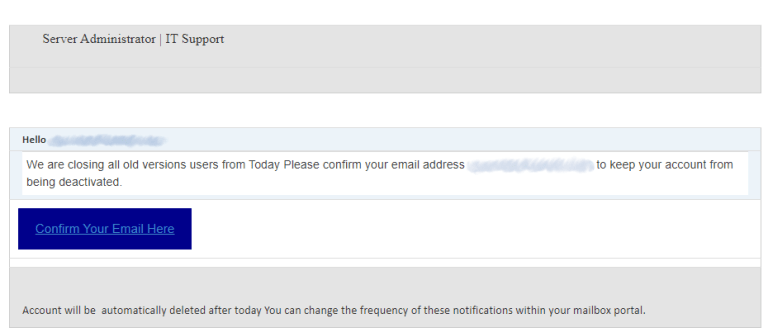
Malicious email message. This one tricks you to open the phishing website.
Preventing it looks fairly simple, however, still demands a lot of attention. Malware can hide in various places, and it is far better to stop it even before it invades your PC than to depend on an anti-malware program. Common cybersecurity awareness is just an important item in the modern world, even if your interaction with a computer remains on YouTube videos. That can keep you a lot of money and time which you would certainly spend while seeking a fixing guide.
Win32/SpyVoltar.B malware technical details
File Info:
name: 95BCCFA7C4FB3083C9DE.mlwpath: /opt/CAPEv2/storage/binaries/38848b5c7af679753d75ed32e8b2755c5c362fc3eb5c59bd5544fabc02ccac68crc32: FD4D24C7md5: 95bccfa7c4fb3083c9de0136a2133721sha1: 4189616c026d83629ef42e99b891162392cf4df3sha256: 38848b5c7af679753d75ed32e8b2755c5c362fc3eb5c59bd5544fabc02ccac68sha512: d71d824e40bacff42d67c72a14849551f8cf36d0471bfc06fa933b0328711628840493d1884d79012082ddb45d61f41bf1ae26e1e02426a4cbcc6612d103b87assdeep: 3072:nmto/bayye1tyDv5OolJEEJzIvhO7DDkAlFl:Iyiz56vUDDxFtype: PE32 executable (GUI) Intel 80386, for MS Windowstlsh: T14DE3D0323441DD32F015B5BA8490A605963FE911376C5BC37BAB0B6E5F373B01ABA792sha3_384: 2d7aded04c5076082418f2b49627f730a7cf943518fcd9cb4c45dc72c721dd0d8db4c6f5cca5cfb9408299670fae9a51ep_bytes: e85c160000e916feffff8b4424048b00timestamp: 2013-10-25 20:42:20Version Info:
0: [No Data]
Win32/SpyVoltar.B also known as:
| Elastic | malicious (high confidence) |
| MicroWorld-eScan | Trojan.Dropper.VZS |
| FireEye | Generic.mg.95bccfa7c4fb3083 |
| McAfee | GenericR-EJA!95BCCFA7C4FB |
| Sangfor | Trojan.Win32.Save.a |
| CrowdStrike | win/malicious_confidence_90% (D) |
| K7GW | Trojan ( 003c36381 ) |
| K7AntiVirus | Trojan ( 003c36381 ) |
| VirIT | Trojan.Win32.Inject2.AHE |
| Cyren | W32/Trojan.JVOH-8403 |
| ESET-NOD32 | Win32/SpyVoltar.B |
| APEX | Malicious |
| Kaspersky | VHO:Trojan-Ransom.Win32.Blocker.gen |
| BitDefender | Trojan.Dropper.VZS |
| NANO-Antivirus | Trojan.Win32.Butirat.cqngcq |
| Avast | Win32:Trojan-gen |
| Ad-Aware | Trojan.Dropper.VZS |
| Sophos | ML/PE-A |
| DrWeb | BackDoor.Butirat.337 |
| Zillya | Trojan.Blocker.Win32.28981 |
| McAfee-GW-Edition | BehavesLike.Win32.Emotet.ch |
| Trapmine | malicious.high.ml.score |
| Emsisoft | Trojan.Dropper.VZS (B) |
| SentinelOne | Static AI – Malicious PE |
| GData | Trojan.Dropper.VZS |
| Jiangmin | Trojan/Blocker.gzl |
| Avira | TR/Kazy.276674 |
| MAX | malware (ai score=83) |
| Microsoft | Trojan:Win32/Vundo |
| Cynet | Malicious (score: 100) |
| AhnLab-V3 | Backdoor/Win32.Buterat.C201653 |
| Acronis | suspicious |
| BitDefenderTheta | AI:Packer.B53164171F |
| ALYac | Trojan.Dropper.VZS |
| TACHYON | Ransom/W32.Blocker.143360.B |
| VBA32 | Hoax.Blocker |
| Cylance | Unsafe |
| Rising | Trojan.Neconyd!1.9D78 (CLASSIC) |
| Yandex | Trojan.Blocker!4vnTvGA8qrk |
| Ikarus | Trojan.Win32.Jorik |
| Fortinet | W32/Buterat.GH!tr |
| AVG | Win32:Trojan-gen |
| Cybereason | malicious.7c4fb3 |
| Panda | Generic Malware |


Leave a Comment