
Seeing the Win32/Small.NMO malware detection means that your system is in big danger. This malware can correctly be named as ransomware – type of malware which encrypts your files and forces you to pay for their decryption. Removing it requires some unusual steps that must be done as soon as possible.
Win32/Small.NMO detection is a virus detection you can spectate in your computer. It generally shows up after the preliminary procedures on your PC – opening the suspicious e-mail messages, clicking the banner in the Web or mounting the program from unreliable resources. From the second it appears, you have a short time to act before it begins its malicious activity. And be sure – it is far better not to await these destructive things.
What is Win32/Small.NMO virus?
Win32/Small.NMO Summary
In total, Win32/Small.NMO virus actions in the infected computer are next:
- Yara rule detections observed from a process memory dump/dropped files/CAPE;
- Unconventionial language used in binary resources: Chinese (Simplified);
- Authenticode signature is invalid;
- Attempts to modify proxy settings;
- Anomalous binary characteristics;
- Encrypting the documents located on the target’s disks — so the victim cannot open these documents;
- Blocking the launching of .exe files of security tools
- Blocking the launching of installation files of anti-malware apps
Ransomware has been a headache for the last 4 years. It is hard to realize a more hazardous virus for both individual users and organizations. The algorithms used in Win32/Small.NMO (usually, RHA-1028 or AES-256) are not hackable – with minor exclusions. To hack it with a brute force, you need a lot more time than our galaxy currently exists, and possibly will exist. However, that virus does not do all these horrible things without delay – it can take up to several hours to cipher all of your documents. Thus, seeing the Win32/Small.NMO detection is a clear signal that you must begin the elimination process.
Where did I get the Win32/Small.NMO?
Ordinary methods of Win32/Small.NMO distribution are typical for all other ransomware variants. Those are one-day landing sites where users are offered to download and install the free software, so-called bait e-mails and hacktools. Bait emails are a quite modern tactic in malware distribution – you get the email that imitates some routine notifications about shippings or bank service conditions shifts. Within the e-mail, there is a malicious MS Office file, or a web link which leads to the exploit landing page.
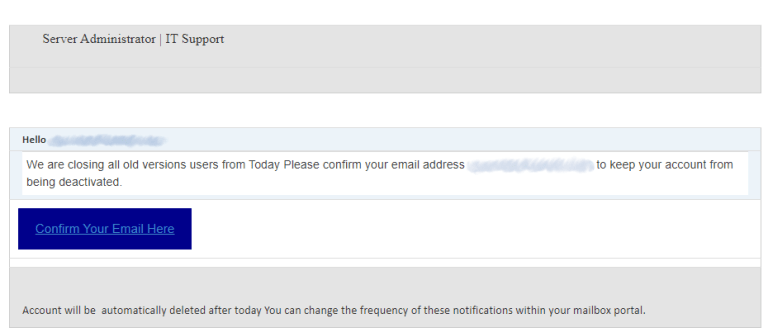
Malicious email message. This one tricks you to open the phishing website.
Preventing it looks pretty easy, but still needs a lot of awareness. Malware can hide in different places, and it is better to prevent it even before it invades your PC than to rely upon an anti-malware program. Simple cybersecurity knowledge is just an essential item in the modern world, even if your interaction with a PC remains on YouTube videos. That can save you a lot of time and money which you would certainly spend while seeking a fixing guide.
Win32/Small.NMO malware technical details
File Info:
name: 85A8E3404E8B727646CB.mlwpath: /opt/CAPEv2/storage/binaries/922aed79664efb62bd2b95d93ccdcf19f85ab49d18bab747037217deb950f0f0crc32: 3A094C42md5: 85a8e3404e8b727646cb77ff8a372a54sha1: a4b8d9d166c9aa94e139dbc124fce0c6cc6dbd9asha256: 922aed79664efb62bd2b95d93ccdcf19f85ab49d18bab747037217deb950f0f0sha512: a7c99130e45c7d6116564f6e75295392dd4f90bcaa3c796ec53157a1a2b9e63099fdf9af520d498a6f36c713901ec323a4e4e060b1ae75d0d857b6e99956f146ssdeep: 1536:TVlqdEIGbenpd14BOQ4OnY3kvIF/yuxUsyR6K:v6EIGbe4G6p2yKUbR6Ktype: PE32 executable (GUI) Intel 80386, for MS Windowstlsh: T171936B1070C1C436F45A00B68896CBB64D3EBD310B65A6C7BBE417AA9B352F2DF29357sha3_384: faf06ad278a2bd8cab49a5554f2cc7d264a259e61b8cc795a58e886c5c408deedb1b6ba9824ff1ad549b13e9f743bfaeep_bytes: e8ad4e0000e978feffff5064ff350000timestamp: 2015-05-12 07:15:18Version Info:
0: [No Data]
Win32/Small.NMO also known as:
| Bkav | W32.AIDetect.malware2 |
| Lionic | Trojan.Win32.Generic.les6 |
| Elastic | malicious (high confidence) |
| Cylance | Unsafe |
| Sangfor | Trojan.Win32.Save.a |
| K7AntiVirus | Riskware ( 0040eff71 ) |
| K7GW | Riskware ( 0040eff71 ) |
| Cybereason | malicious.166c9a |
| Symantec | ML.Attribute.HighConfidence |
| ESET-NOD32 | a variant of Win32/Small.NMO |
| APEX | Malicious |
| Paloalto | generic.ml |
| Kaspersky | Backdoor.Win32.Danti.j |
| NANO-Antivirus | Trojan.Win32.Danti.fbkavw |
| Avast | Win32:Malware-gen |
| Tencent | Win32.Backdoor.Danti.Ckjl |
| Comodo | Malware@#3cycy6wtk6151 |
| TrendMicro | TROJ_AGENT.YMNIG |
| McAfee-GW-Edition | BehavesLike.Win32.NetLoader.mh |
| FireEye | Generic.mg.85a8e3404e8b7276 |
| Sophos | Mal/PdfExDr-B |
| Ikarus | Trojan.Rogue |
| Detected | |
| Avira | HEUR/AGEN.1210035 |
| Antiy-AVL | Trojan/Generic.ASMalwS.3C54 |
| Kingsoft | Win32.Troj.Generic.v.(kcloud) |
| Microsoft | Ransom:Win32/StopCrypt!ml |
| Cynet | Malicious (score: 100) |
| AhnLab-V3 | Trojan/Win.Zbot.R474490 |
| McAfee | Artemis!85A8E3404E8B |
| VBA32 | BScope.Trojan.Dalgan |
| TrendMicro-HouseCall | TROJ_AGENT.YMNIG |
| Rising | Backdoor.Danti!8.2F46 (RDMK:cmRtazpUMrugeRjiD/MV9XGu1PCs) |
| Yandex | Trojan.Rogue!i5iO+9Ar3IA |
| SentinelOne | Static AI – Suspicious PE |
| Fortinet | W32/PdfExDr.B!tr |
| BitDefenderTheta | Gen:NN.ZexaF.34698.fqW@aSn44jgj |
| AVG | Win32:Malware-gen |
| Panda | Trj/Genetic.gen |
| CrowdStrike | win/malicious_confidence_90% (W) |


Leave a Comment