
Spectating the Win32/LockScreen.AQM malware detection means that your PC is in big danger. This virus can correctly be identified as ransomware – virus which ciphers your files and forces you to pay for their decryption. Removing it requires some peculiar steps that must be done as soon as possible.
Win32/LockScreen.AQM detection is a malware detection you can spectate in your computer. It frequently shows up after the preliminary actions on your PC – opening the suspicious email, clicking the advertisement in the Internet or installing the program from dubious sources. From the moment it appears, you have a short time to act before it begins its harmful action. And be sure – it is far better not to wait for these harmful effects.
What is Win32/LockScreen.AQM virus?
Win32/LockScreen.AQM Summary
In summary, Win32/LockScreen.AQM malware actions in the infected system are next:
- Behavioural detection: Executable code extraction – unpacking;
- The binary contains an unknown PE section name indicative of packing;
- Authenticode signature is invalid;
- Encrypting the files located on the victim’s disk drives — so the victim cannot check these files;
- Blocking the launching of .exe files of anti-virus programs
- Blocking the launching of installation files of anti-virus apps
Ransomware has actually been a nightmare for the last 4 years. It is difficult to picture a more harmful virus for both individual users and organizations. The algorithms utilized in Win32/LockScreen.AQM (typically, RHA-1028 or AES-256) are not hackable – with minor exclusions. To hack it with a brute force, you need to have a lot more time than our galaxy currently exists, and possibly will exist. But that malware does not do all these bad things without delay – it may take up to a few hours to cipher all of your files. Hence, seeing the Win32/LockScreen.AQM detection is a clear signal that you should begin the removal process.
Where did I get the Win32/LockScreen.AQM?
Standard methods of Win32/LockScreen.AQM injection are standard for all other ransomware variants. Those are one-day landing web pages where users are offered to download the free program, so-called bait e-mails and hacktools. Bait emails are a pretty new strategy in malware distribution – you get the email that mimics some standard notifications about shipments or bank service conditions updates. Inside of the email, there is an infected MS Office file, or a web link which leads to the exploit landing page.
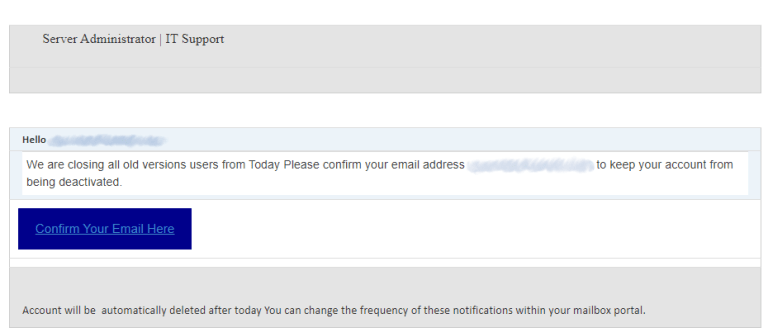
Malicious email message. This one tricks you to open the phishing website.
Avoiding it looks fairly simple, but still requires a lot of awareness. Malware can hide in various places, and it is better to stop it even before it goes into your system than to rely upon an anti-malware program. General cybersecurity awareness is just an essential thing in the modern-day world, even if your interaction with a PC stays on YouTube videos. That may save you a great deal of time and money which you would certainly spend while looking for a fixing guide.
Win32/LockScreen.AQM malware technical details
File Info:
name: 7B3DC6C5AE0B5ED678DB.mlwpath: /opt/CAPEv2/storage/binaries/56b1de0fec1d2bf832f31c7227c462018eb61c3094fdb31781432cfe7caa0665crc32: 6A372918md5: 7b3dc6c5ae0b5ed678db6a6339daf8e0sha1: efb8b65aa8b263b313d461d5cbf7c33fb31bfd78sha256: 56b1de0fec1d2bf832f31c7227c462018eb61c3094fdb31781432cfe7caa0665sha512: 702e33db012e30bbdb3a74c549000881145e0bd54095160854c58b15a5ca3d0655221da8cb0e8e36dc67abadd7296e2218e1fbe2b0f99bf085de67302786f22fssdeep: 1536:t9qQW1snK5LTBP4LVCzVvBGbwNOavN+AHvWEgoxiZFx00+hATe4CO+TL:NW1RBPNRcbMOa8NvHx00eATZCO+TLtype: PE32 executable (GUI) Intel 80386, for MS Windowstlsh: T1E7D39CE3A2614C39D0600BB87D1A4354EA33BFE13FBD8556B69C7A0E4F19EC58C29716sha3_384: 4a34ee4464ad674c7d81d01b03236237eb43340c8972f2d6edf933e4f1eb02765e83d3aff672a2cc8a0e1489952efb20ep_bytes: 558bec83c4a453565733c08945c48945timestamp: 1992-06-19 22:22:17Version Info:
Comments: This installation was built with Inno Setup.CompanyName: Sftware FileDescription: Software Group Inc FileVersion: LegalCopyright: Translation: 0x0409 0x04e4
Win32/LockScreen.AQM also known as:
| Bkav | W32.AIDetectMalware |
| Lionic | Trojan.Win32.Generic.4!c |
| Elastic | malicious (moderate confidence) |
| MicroWorld-eScan | Gen:Variant.Delf.165 |
| FireEye | Generic.mg.7b3dc6c5ae0b5ed6 |
| Skyhigh | BehavesLike.Win32.Ransomware.ch |
| McAfee | Ransom-FBOM!7B3DC6C5AE0B |
| Malwarebytes | Generic.Malware/Suspicious |
| Sangfor | Trojan.Win32.Delf.frix |
| K7AntiVirus | Trojan ( 0055e4091 ) |
| Alibaba | VirTool:Win32/Obfuscator.f3c12386 |
| K7GW | Trojan ( 0055e4091 ) |
| BitDefenderTheta | AI:Packer.C5F0424C14 |
| VirIT | Trojan.Win32.FakeGdF.RS |
| Symantec | Trojan.Ransomlock.Q!g3 |
| tehtris | Generic.Malware |
| ESET-NOD32 | Win32/LockScreen.AQM |
| Cynet | Malicious (score: 100) |
| APEX | Malicious |
| ClamAV | Win.Ransomware.Delf-9828911-0 |
| Kaspersky | HEUR:Trojan.Win32.Generic |
| BitDefender | Gen:Variant.Delf.165 |
| NANO-Antivirus | Trojan.Win32.Winlock.cqlocp |
| Avast | Win32:Crypt-PFS [Trj] |
| Tencent | Win32.Trojan.Lockscreen.Wwhl |
| Sophos | Mal/Generic-S |
| F-Secure | Dropper.DR/Delphi.Gen7 |
| DrWeb | Trojan.Inject.64560 |
| VIPRE | Gen:Variant.Delf.165 |
| Emsisoft | Gen:Variant.Delf.165 (B) |
| Jiangmin | Trojan.Generic.dvmvt |
| Webroot | Trojan.Dropper.Gen |
| Avira | DR/Delphi.Gen7 |
| Kingsoft | Win32.Trojan.Generic.a |
| Microsoft | Ransom:Win32/Urausy.C |
| Xcitium | Malware@#1yfqiy8h9cz16 |
| Arcabit | Trojan.Delf.165 |
| ZoneAlarm | HEUR:Trojan.Win32.Generic |
| GData | Gen:Variant.Delf.165 |
| Detected | |
| ALYac | Gen:Variant.Delf.165 |
| MAX | malware (ai score=100) |
| VBA32 | OScope.Malware-Cryptor.Hlux |
| Cylance | unsafe |
| Panda | Trj/Dtcontx.D |
| Rising | [email protected] (RDML:fink+S4jmG/rT0uqL0udtw) |
| Yandex | Trojan.Agentb!x3Bl5Uig220 |
| Ikarus | Trojan.Win32.Urausy |
| MaxSecure | Trojan.Malware.5725145.susgen |
| Fortinet | W32/LockScreen.AQM!tr |
| AVG | Win32:Crypt-PFS [Trj] |
| DeepInstinct | MALICIOUS |
| CrowdStrike | win/malicious_confidence_100% (W) |


Leave a Comment