
Spectating the Win32/Injector.EJNG detection usually means that your computer is in big danger. This malware can correctly be identified as ransomware – sort of malware which ciphers your files and forces you to pay for their decryption. Stopping it requires some specific steps that must be taken as soon as possible.
Win32/Injector.EJNG detection is a virus detection you can spectate in your computer. It generally appears after the provoking procedures on your computer – opening the suspicious email, clicking the banner in the Internet or installing the program from unreliable resources. From the moment it appears, you have a short time to act until it starts its malicious activity. And be sure – it is much better not to wait for these malicious effects.
What is Win32/Injector.EJNG virus?
Win32/Injector.EJNG Summary
In summary, Win32/Injector.EJNG virus actions in the infected system are next:
- Behavioural detection: Executable code extraction – unpacking;
- Presents an Authenticode digital signature;
- Dynamic (imported) function loading detected;
- Authenticode signature is invalid;
- The executable used a known stolen/malicious Authenticode signature;
- Anomalous binary characteristics;
- Ciphering the files kept on the victim’s disks — so the victim cannot open these files;
- Blocking the launching of .exe files of security tools
- Blocking the launching of installation files of anti-virus programs
Ransomware has actually been a headache for the last 4 years. It is challenging to realize a more harmful virus for both individual users and companies. The algorithms used in Win32/Injector.EJNG (typically, RHA-1028 or AES-256) are not hackable – with minor exclusions. To hack it with a brute force, you need to have a lot more time than our galaxy already exists, and possibly will exist. However, that virus does not do all these unpleasant things without delay – it may require up to a few hours to cipher all of your documents. Therefore, seeing the Win32/Injector.EJNG detection is a clear signal that you should start the clearing procedure.
Where did I get the Win32/Injector.EJNG?
Routine methods of Win32/Injector.EJNG distribution are standard for all other ransomware examples. Those are one-day landing web pages where victims are offered to download the free software, so-called bait e-mails and hacktools. Bait emails are a quite modern tactic in malware distribution – you receive the e-mail that imitates some standard notifications about shipments or bank service conditions updates. Inside of the email, there is a corrupted MS Office file, or a web link which leads to the exploit landing page.
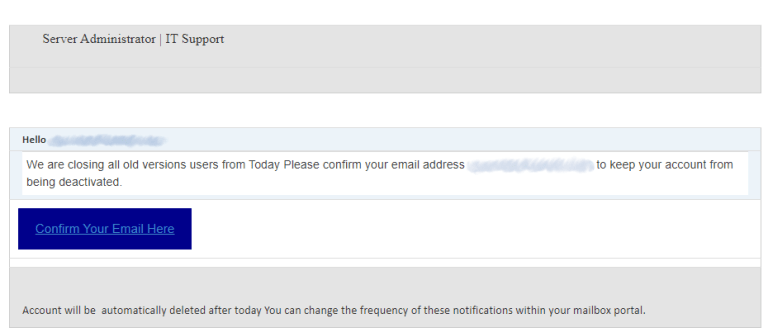
Malicious email message. This one tricks you to open the phishing website.
Preventing it looks pretty simple, but still requires a lot of attention. Malware can hide in various places, and it is much better to prevent it even before it invades your computer than to rely on an anti-malware program. Standard cybersecurity awareness is just an important thing in the modern-day world, even if your interaction with a computer remains on YouTube videos. That may keep you a lot of money and time which you would spend while looking for a fixing guide.
Win32/Injector.EJNG malware technical details
File Info:
name: 44B21AF75880AF21BAD9.mlwpath: /opt/CAPEv2/storage/binaries/ea19736c8e89e871974aabdc0d52ad0f0948159d4cf41d2889f49448cbe5e705crc32: E5487C5Bmd5: 44b21af75880af21bad9fda1dd953815sha1: c60d0ed7872f33fec07fcd42ccc4f21d512ab3ffsha256: ea19736c8e89e871974aabdc0d52ad0f0948159d4cf41d2889f49448cbe5e705sha512: 345641547c938929f7eac5108cbb9969b75eee5389d1acfd8a68faff0adce01e92158900869894617818c97055cf0c6512e07af2508ed4a196e825126cd440fdssdeep: 3072:Q2i8kiFiQ1t8ZjuSv7ItLrNEcqi8Fe7Di9Rl3jy7R3Lk984i1ECB/qjlE+EqCu+y:XfkcELsjqtype: PE32 executable (GUI) Intel 80386, for MS Windowstlsh: T12375613E29BD233BC9A8D2E9CFD68427F058E46B3951AC6294D787654783A4335C313Esha3_384: c25f6777e11af37434b6c3eaa2824d1125db93166049fcb4dfd8c497e85431ee812da7fa49c6ace4780990ed75b7117bep_bytes: 68641c4000e8f0ffffff000000000000timestamp: 2019-11-03 11:32:44Version Info:
Translation: 0x0409 0x04b0ProductName: Image ViewerFileVersion: 1.00ProductVersion: 1.00InternalName: Image ViewerOriginalFilename: Image Viewer.exe
Win32/Injector.EJNG also known as:
| Lionic | Trojan.Win32.Maze.j!c |
| MicroWorld-eScan | Gen:Variant.Bulz.416128 |
| CAT-QuickHeal | Ransom.Maze.VB3 |
| ALYac | Trojan.Skeeyah |
| Zillya | Trojan.GenKryptik.Win32.38659 |
| K7AntiVirus | Trojan ( 0055aeca1 ) |
| Alibaba | Ransom:Win32/Injector.2b97f9de |
| K7GW | Trojan ( 0055aeca1 ) |
| CrowdStrike | win/malicious_confidence_100% (W) |
| Arcabit | Trojan.Bulz.D65980 |
| Cyren | W32/Zbot.AAN.gen!Eldorado |
| Symantec | Downloader |
| ESET-NOD32 | a variant of Win32/Injector.EJNG |
| APEX | Malicious |
| Paloalto | generic.ml |
| ClamAV | Win.Malware.Agent-7761820-0 |
| Kaspersky | Trojan-Ransom.Win32.Maze.fc |
| BitDefender | Gen:Variant.Bulz.416128 |
| NANO-Antivirus | Trojan.Win32.Zbot.ghnaez |
| Avast | Win32:Malware-gen |
| Ad-Aware | Gen:Variant.Bulz.416128 |
| TACHYON | Ransom/W32.VB-Maze.1554960 |
| Emsisoft | Gen:Variant.Bulz.416128 (B) |
| Comodo | Malware@#1j4nlsoms30sj |
| F-Secure | Trojan.TR/Kryptik.pxjtu |
| DrWeb | Trojan.Encoder.30073 |
| VIPRE | Trojan.Win32.Generic!BT |
| TrendMicro | Ransom.Win32.MAZE.AC |
| McAfee-GW-Edition | Generic VB.fl |
| FireEye | Generic.mg.44b21af75880af21 |
| Sophos | Mal/Generic-R + Mal/VBCheMan-C |
| Ikarus | Trojan-Ransom.Maze |
| Jiangmin | TrojanSpy.MSIL.ajeu |
| Webroot | W32.Malware.Gen |
| Avira | TR/Kryptik.pxjtu |
| Antiy-AVL | Trojan/Generic.ASMalwS.2CDC43F |
| Microsoft | PWS:Win32/Zbot!MTB |
| ViRobot | Trojan.Win32.S.MazeRansom.1554960 |
| GData | Gen:Variant.Bulz.416128 |
| Cynet | Malicious (score: 100) |
| AhnLab-V3 | Trojan/Win32.Skeeyah.C3549368 |
| McAfee | Generic VB.fl |
| MAX | malware (ai score=100) |
| VBA32 | BScope.Trojan.Occamy |
| TrendMicro-HouseCall | Ransom.Win32.MAZE.AC |
| Tencent | Msil.Trojan-spy.Zbot.Pdmg |
| Yandex | Trojan.VBInject.Gen.8 |
| SentinelOne | Static AI – Suspicious PE |
| MaxSecure | Trojan.Malware.1728101.susgen |
| Fortinet | W32/Bifrose.NKY!tr |
| AVG | Win32:Malware-gen |
| Cybereason | malicious.75880a |
| Panda | Trj/GdSda.A |


Leave a Comment