
Spectating the Win32/GenKryptik.GPQQ detection name means that your PC is in big danger. This malware can correctly be identified as ransomware – sort of malware which encrypts your files and asks you to pay for their decryption. Deleteing it requires some specific steps that must be taken as soon as possible.
Win32/GenKryptik.GPQQ detection is a virus detection you can spectate in your computer. It generally appears after the provoking actions on your PC – opening the untrustworthy email messages, clicking the banner in the Internet or mounting the program from suspicious sources. From the instance it shows up, you have a short time to take action before it begins its harmful action. And be sure – it is much better not to await these harmful things.
What is Win32/GenKryptik.GPQQ virus?
Win32/GenKryptik.GPQQ Summary
Summarizingly, Win32/GenKryptik.GPQQ malware actions in the infected system are next:
- Behavioural detection: Executable code extraction – unpacking;
- CAPE extracted potentially suspicious content;
- The binary likely contains encrypted or compressed data.;
- Authenticode signature is invalid;
- CAPE detected the shellcode get eip malware family;
- Yara detections observed in process dumps, payloads or dropped files;
- Ciphering the files kept on the victim’s disk — so the victim cannot open these files;
- Blocking the launching of .exe files of security tools
- Blocking the launching of installation files of anti-virus programs
Ransomware has actually been a major problem for the last 4 years. It is hard to imagine a more dangerous virus for both individuals and businesses. The algorithms used in Win32/GenKryptik.GPQQ (typically, RHA-1028 or AES-256) are not hackable – with minor exclusions. To hack it with a brute force, you need a lot more time than our galaxy currently exists, and possibly will exist. However, that virus does not do all these horrible things without delay – it can take up to a few hours to cipher all of your files. Thus, seeing the Win32/GenKryptik.GPQQ detection is a clear signal that you have to begin the removal procedure.
Where did I get the Win32/GenKryptik.GPQQ?
Common ways of Win32/GenKryptik.GPQQ distribution are standard for all other ransomware variants. Those are one-day landing web pages where users are offered to download the free app, so-called bait emails and hacktools. Bait emails are a pretty modern method in malware spreading – you receive the email that mimics some regular notifications about shippings or bank service conditions changes. Inside of the e-mail, there is an infected MS Office file, or a web link which opens the exploit landing page.
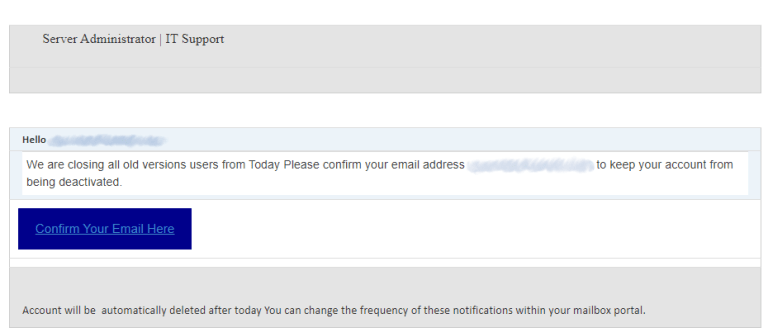
Malicious email message. This one tricks you to open the phishing website.
Preventing it looks pretty simple, but still requires a lot of focus. Malware can hide in various places, and it is far better to stop it even before it invades your computer than to rely on an anti-malware program. Essential cybersecurity knowledge is just an important item in the modern world, even if your interaction with a computer stays on YouTube videos. That can keep you a great deal of money and time which you would certainly spend while searching for a fix guide.
Win32/GenKryptik.GPQQ malware technical details
File Info:
name: BDB4488BD6E00CA9C664.mlwpath: /opt/CAPEv2/storage/binaries/9a1a304953552b6cbaeecb94481e55f6c2f023d7b0d488504bd4c0da1722cbe5crc32: 84FD6FCAmd5: bdb4488bd6e00ca9c6647f49fc4f89basha1: 1617a40e2e880fad5d44a5fda4e4def042b05933sha256: 9a1a304953552b6cbaeecb94481e55f6c2f023d7b0d488504bd4c0da1722cbe5sha512: f760a32f64e4b8e800b5b2b50f5d485dd742349800d44a878ae7ea77588c4775bf0199348399f0a0f351717654516aa3f378591ffb1363c0d737efad3ac0d299ssdeep: 98304:OJe1JlVl8BRVgLA3qvwgTFByYVK+Q6NKXH:OJe1wXgLTgIKXHtype: PE32 executable (console) Intel 80386, for MS Windowstlsh: T1FB16C0DBA5663355C680193C491AB2EFD336F03F07C05487BAEB7D92BC2A1258D98E1Dsha3_384: 6dc148cc989f961d6097c0ca3845dfd866034bfbc9d3805e3064d8dc900511d78c78bbb5b899eaf2235581098d60ade1ep_bytes: c70508db7f0000000000e9a1fcffff90timestamp: 2023-12-04 10:45:32Version Info:
0: [No Data]
Win32/GenKryptik.GPQQ also known as:
| Lionic | Trojan.Win32.Qilin.j!c |
| MicroWorld-eScan | Gen:Variant.Zusy.515850 |
| FireEye | Gen:Variant.Zusy.515850 |
| Skyhigh | BehavesLike.Win32.Ctsinf.wc |
| ALYac | Trojan.Ransom.Filecoder |
| Malwarebytes | Trojan.Crypt |
| VIPRE | Gen:Variant.Zusy.515850 |
| Sangfor | Ransom.Win32.Kryptik.V4i1 |
| Alibaba | Ransom:Win32/Qilin.e2a2cb68 |
| CrowdStrike | win/malicious_confidence_90% (D) |
| Arcabit | Trojan.Zusy.D7DF0A |
| Symantec | Ransom.Qilin |
| Elastic | malicious (high confidence) |
| ESET-NOD32 | a variant of Win32/GenKryptik.GPQQ |
| APEX | Malicious |
| Kaspersky | Trojan-Ransom.Win32.Qilin.u |
| BitDefender | Gen:Variant.Zusy.515850 |
| NANO-Antivirus | Trojan.Win32.Qilin.khpzck |
| Avast | Win32:Evo-gen [Trj] |
| Sophos | Mal/Generic-S |
| F-Secure | Trojan.TR/Crypt.ZPACK.Gen2 |
| TrendMicro | Ransom_Agent.R002C0XL723 |
| Emsisoft | Gen:Variant.Zusy.515850 (B) |
| Ikarus | Trojan.Crypt |
| Detected | |
| Avira | TR/Crypt.ZPACK.Gen2 |
| Varist | W32/ABRisk.MBNP-2384 |
| Antiy-AVL | Trojan/Win32.GenKryptik |
| Microsoft | Trojan:Win32/Wacatac.B!ml |
| ZoneAlarm | Trojan-Ransom.Win32.Qilin.u |
| GData | Gen:Variant.Zusy.515850 |
| Cynet | Malicious (score: 100) |
| AhnLab-V3 | Trojan/Win.Generic.C5503103 |
| McAfee | GenericRXAA-AA!BDB4488BD6E0 |
| MAX | malware (ai score=85) |
| Cylance | unsafe |
| Panda | Trj/RansomGen.A |
| TrendMicro-HouseCall | Ransom_Agent.R002C0XL723 |
| Rising | Ransom.Agent!8.6B7 (TFE:5:2xZkjUV4mdE) |
| MaxSecure | Trojan.Malware.221268311.susgen |
| Fortinet | W32/GenKryptik.GPQQ!tr |
| AVG | Win32:Evo-gen [Trj] |
| DeepInstinct | MALICIOUS |


Leave a Comment