
Seeing the Win32/GenKryptik.FUIP detection name means that your PC is in big danger. This malware can correctly be named as ransomware – type of malware which encrypts your files and forces you to pay for their decryption. Removing it requires some specific steps that must be taken as soon as possible.
Win32/GenKryptik.FUIP detection is a virus detection you can spectate in your system. It frequently shows up after the provoking actions on your computer – opening the untrustworthy e-mail, clicking the banner in the Web or installing the program from unreliable sources. From the second it shows up, you have a short time to do something about it before it begins its destructive action. And be sure – it is much better not to await these destructive effects.
What is Win32/GenKryptik.FUIP virus?
Win32/GenKryptik.FUIP Summary
Summarizingly, Win32/GenKryptik.FUIP virus actions in the infected system are next:
- SetUnhandledExceptionFilter detected (possible anti-debug);
- Behavioural detection: Executable code extraction – unpacking;
- Executed a command line with /C or /R argument to terminate command shell on completion which can be used to hide execution;
- Yara rule detections observed from a process memory dump/dropped files/CAPE;
- Creates RWX memory;
- Dynamic (imported) function loading detected;
- Reads data out of its own binary image;
- A process created a hidden window;
- CAPE extracted potentially suspicious content;
- Drops a binary and executes it;
- Unconventionial language used in binary resources: Uzbek (Latin);
- Authenticode signature is invalid;
- Uses Windows utilities for basic functionality;
- Enumerates services, possibly for anti-virtualization;
- Behavioural detection: Injection (Process Hollowing);
- Executed a process and injected code into it, probably while unpacking;
- Behavioural detection: Injection (inter-process);
- Installs itself for autorun at Windows startup;
- Installs itself for autorun at Windows startup;
- CAPE detected the Tofsee malware family;
- Anomalous binary characteristics;
- Uses suspicious command line tools or Windows utilities;
- Ciphering the documents located on the target’s drives — so the victim cannot use these files;
- Blocking the launching of .exe files of anti-malware programs
- Blocking the launching of installation files of anti-virus programs
Ransomware has been a major problem for the last 4 years. It is difficult to realize a more dangerous virus for both individuals and organizations. The algorithms utilized in Win32/GenKryptik.FUIP (generally, RHA-1028 or AES-256) are not hackable – with minor exclusions. To hack it with a brute force, you need to have more time than our galaxy actually exists, and possibly will exist. But that malware does not do all these horrible things instantly – it can take up to a few hours to cipher all of your documents. Therefore, seeing the Win32/GenKryptik.FUIP detection is a clear signal that you need to begin the removal process.
Where did I get the Win32/GenKryptik.FUIP?
General ways of Win32/GenKryptik.FUIP distribution are typical for all other ransomware variants. Those are one-day landing web pages where victims are offered to download and install the free program, so-called bait emails and hacktools. Bait emails are a pretty new tactic in malware distribution – you receive the e-mail that imitates some standard notifications about deliveries or bank service conditions modifications. Inside of the email, there is a malicious MS Office file, or a link which leads to the exploit landing page.
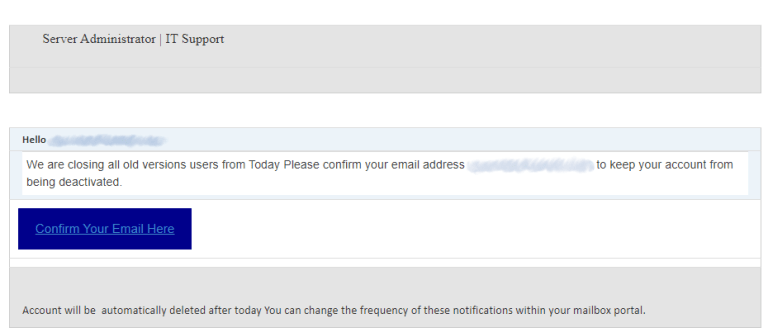
Malicious email message. This one tricks you to open the phishing website.
Preventing it looks quite easy, but still needs a lot of awareness. Malware can hide in various spots, and it is much better to stop it even before it gets into your PC than to depend on an anti-malware program. Simple cybersecurity awareness is just an important thing in the modern-day world, even if your interaction with a PC stays on YouTube videos. That may keep you a great deal of time and money which you would certainly spend while looking for a fix guide.
Win32/GenKryptik.FUIP malware technical details
File Info:
name: 2E9541D956695722168C.mlwpath: /opt/CAPEv2/storage/binaries/1d469dd2bc5c1abcec57484d8afb4c39cf7018950d62f0e63bab1530114a1b02crc32: 256EF089md5: 2e9541d956695722168c6898779825b1sha1: 901555f9bcc97083f7f50676626e1e96abbdb9ecsha256: 1d469dd2bc5c1abcec57484d8afb4c39cf7018950d62f0e63bab1530114a1b02sha512: 86d9dc2d08004d2374ebd29e8d81cfe097d2754e8a38b2bb638917e22eaaeab167dc3167ca542f28d9328f815aed888121f5e65ee4e4aee0ab5a0cfecef414c6ssdeep: 49152:qXtkkkkkkkkkkkkkkkkkkkkkkkkkkkkkkkkkkkkkkkkkkkkkkkkkkkkkkkkkkkkM:qtype: PE32 executable (GUI) Intel 80386, for MS Windowstlsh: T1C0C68D407794E955D2582EB6493B8AE25A3AFCDBD91442CB32197F0FFC326406D86F23sha3_384: 17acdcbecc8d4f9f230c81295de83b72dd8154734b2081c57a444c4d49cacd761d6f2159708622b9ff364cae9d96f23eep_bytes: 8bff558bece8c6a70000e8110000005dtimestamp: 2021-09-10 03:27:58Version Info:
Translations: 0x0203 0x02bd
Win32/GenKryptik.FUIP also known as:
| Bkav | W32.AIDetect.malware1 |
| tehtris | Generic.Malware |
| DrWeb | Trojan.Siggen17.49432 |
| FireEye | Generic.mg.2e9541d956695722 |
| CAT-QuickHeal | Ransom.Stop.P5 |
| McAfee | Packed-GEE!2E9541D95669 |
| Malwarebytes | Trojan.MalPack.GS |
| Sangfor | Trojan.Win32.Save.a |
| CrowdStrike | win/malicious_confidence_60% (D) |
| Cyren | W32/Kryptik.EYC.gen!Eldorado |
| Symantec | ML.Attribute.HighConfidence |
| Elastic | malicious (high confidence) |
| ESET-NOD32 | a variant of Win32/GenKryptik.FUIP |
| Avast | Win32:PWSX-gen [Trj] |
| Rising | [email protected] (RDMK:cmRtazp57sPLqgVRpRyK97kT+RBe) |
| McAfee-GW-Edition | BehavesLike.Win32.Worm.wm |
| Sophos | ML/PE-A |
| Ikarus | Trojan-Ransom.StopCrypt |
| Microsoft | Trojan:Win32/Wacatac.B!ml |
| Cynet | Malicious (score: 100) |
| Acronis | suspicious |
| APEX | Malicious |
| SentinelOne | Static AI – Malicious PE |
| AVG | Win32:PWSX-gen [Trj] |
| Cybereason | malicious.9bcc97 |


Leave a Comment