
Seeing the Win32/Filecoder.OMD detection means that your system is in big danger. This virus can correctly be identified as ransomware – virus which ciphers your files and asks you to pay for their decryption. Deleteing it requires some unusual steps that must be taken as soon as possible.
Win32/Filecoder.OMD detection is a virus detection you can spectate in your system. It frequently appears after the preliminary procedures on your computer – opening the untrustworthy e-mail messages, clicking the banner in the Internet or installing the program from suspicious resources. From the moment it appears, you have a short time to take action before it begins its malicious action. And be sure – it is much better not to await these destructive actions.
What is Win32/Filecoder.OMD virus?
Win32/Filecoder.OMD Summary
In total, Win32/Filecoder.OMD virus actions in the infected PC are next:
- Authenticode signature is invalid;
- Ciphering the files kept on the victim’s drive — so the victim cannot open these documents;
- Blocking the launching of .exe files of anti-virus apps
- Blocking the launching of installation files of anti-virus apps
Ransomware has actually been a major problem for the last 4 years. It is hard to imagine a more hazardous virus for both individual users and corporations. The algorithms used in Win32/Filecoder.OMD (typically, RHA-1028 or AES-256) are not hackable – with minor exclusions. To hack it with a brute force, you need more time than our galaxy actually exists, and possibly will exist. But that virus does not do all these terrible things immediately – it can take up to several hours to cipher all of your files. Therefore, seeing the Win32/Filecoder.OMD detection is a clear signal that you need to begin the removal process.
Where did I get the Win32/Filecoder.OMD?
Usual methods of Win32/Filecoder.OMD distribution are common for all other ransomware variants. Those are one-day landing websites where victims are offered to download the free app, so-called bait emails and hacktools. Bait e-mails are a quite new tactic in malware spreading – you receive the email that imitates some normal notifications about deliveries or bank service conditions changes. Within the e-mail, there is a corrupted MS Office file, or a link which opens the exploit landing page.
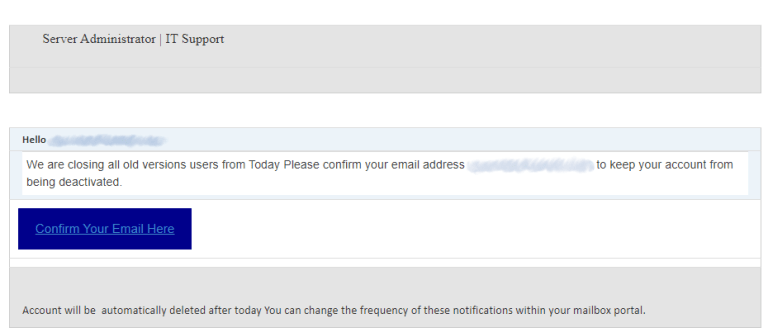
Malicious email message. This one tricks you to open the phishing website.
Avoiding it looks quite easy, but still demands a lot of attention. Malware can hide in different spots, and it is much better to stop it even before it goes into your system than to rely upon an anti-malware program. Simple cybersecurity knowledge is just an important thing in the modern world, even if your relationship with a PC stays on YouTube videos. That can keep you a lot of money and time which you would spend while looking for a solution.
Win32/Filecoder.OMD malware technical details
File Info:
name: 8199E6CAE628CF576475.mlwpath: /opt/CAPEv2/storage/binaries/af2125e2dc4b1c85c9e93f1a2b1ec492eb80b99c608126aeb0284761f6f68994crc32: 74AB2939md5: 8199e6cae628cf576475894f2962a0a6sha1: b292607e5557b859e222d014e6222592bd80a00dsha256: af2125e2dc4b1c85c9e93f1a2b1ec492eb80b99c608126aeb0284761f6f68994sha512: 0d39a001f56232530a64b063484a3dff34c3116a6b7141d93494db4367e73a6a177c95067faacb83d2f99ea5f2470a122d9f40a2b4515f96d73816b9847f31bessdeep: 24576:751Atr8BM45Dm6iy8ME8Qo+J8Q5kTe7KP/e30CxBMpZV:Frr/Pgo2V5kTe7KP/eLxBMpZVtype: PE32 executable (console) Intel 80386, for MS Windowstlsh: T1CB35BF42FB8269B2E4C6453A11B3AB3F4937AD205315C9D787A12C69CC316E16B3F3D9sha3_384: 5fd9b9a37d853abfd801b808c2ce663580f120ce78b09550113fa0a0ca289a4e857c8e64dcfd1a6bb4ae2141437f053eep_bytes: e89d070000e974feffffcccccccccccctimestamp: 2022-08-28 20:08:31Version Info:
0: [No Data]
Win32/Filecoder.OMD also known as:
| Lionic | Trojan.Win32.Fragtor.4!c |
| MicroWorld-eScan | Gen:Variant.Fragtor.130320 |
| FireEye | Gen:Variant.Fragtor.130320 |
| CAT-QuickHeal | Trojanransom.Encoder |
| ALYac | Gen:Variant.Fragtor.130320 |
| Malwarebytes | Ransom.FileCryptor |
| Sangfor | Trojan.Win32.Filecoder.V41y |
| K7AntiVirus | Trojan ( 005970cc1 ) |
| Alibaba | Ransom:Win32/Encoder.0d5ddf57 |
| K7GW | Trojan ( 005970cc1 ) |
| CrowdStrike | win/malicious_confidence_70% (W) |
| Cyren | W32/ABRisk.XHQP-1250 |
| Symantec | ML.Attribute.HighConfidence |
| Elastic | malicious (high confidence) |
| ESET-NOD32 | a variant of Win32/Filecoder.OMD |
| APEX | Malicious |
| Paloalto | generic.ml |
| Cynet | Malicious (score: 100) |
| Kaspersky | HEUR:Trojan-Ransom.Win32.Encoder.gen |
| BitDefender | Gen:Variant.Fragtor.130320 |
| Avast | Win32:Trojan-gen |
| Tencent | Win32.Trojan.Filecoder.Wimw |
| Ad-Aware | Gen:Variant.Fragtor.130320 |
| Emsisoft | Gen:Variant.Fragtor.130320 (B) |
| DrWeb | Trojan.Encoder.35770 |
| VIPRE | Gen:Variant.Fragtor.130320 |
| McAfee-GW-Edition | BehavesLike.Win32.Tool.th |
| Sophos | Mal/Generic-S |
| Avira | TR/FileCoder.ipygy |
| GData | Gen:Variant.Fragtor.130320 |
| Detected | |
| AhnLab-V3 | Malware/Win.Generic.R512873 |
| McAfee | Artemis!8199E6CAE628 |
| Rising | Ransom.Protected!1.DF8B (CLASSIC) |
| Ikarus | Trojan-Ransom.FileCrypter |
| MaxSecure | Trojan.Malware.300983.susgen |
| BitDefenderTheta | Gen:NN.ZexaF.34606.cvW@a8fiHuoi |
| AVG | Win32:Trojan-gen |


Leave a Comment