
Spectating the Win32/Filecoder.Conti.N malware detection usually means that your system is in big danger. This virus can correctly be named as ransomware – type of malware which encrypts your files and forces you to pay for their decryption. Stopping it requires some unusual steps that must be done as soon as possible.
Win32/Filecoder.Conti.N detection is a malware detection you can spectate in your system. It usually shows up after the preliminary activities on your PC – opening the untrustworthy e-mail, clicking the advertisement in the Internet or setting up the program from untrustworthy resources. From the instance it appears, you have a short time to act before it begins its destructive activity. And be sure – it is much better not to await these destructive effects.
What is Win32/Filecoder.Conti.N virus?
Win32/Filecoder.Conti.N Summary
Summarizingly, Win32/Filecoder.Conti.N malware activities in the infected system are next:
- SetUnhandledExceptionFilter detected (possible anti-debug);
- Yara rule detections observed from a process memory dump/dropped files/CAPE;
- Creates RWX memory;
- Guard pages use detected – possible anti-debugging.;
- Attempts to connect to a dead IP:Port (255 unique times);
- Dynamic (imported) function loading detected;
- Performs HTTP requests potentially not found in PCAP.;
- A named pipe was used for inter-process communication;
- Enumerates running processes;
- Manipulates data from or to the Recycle Bin;
- CAPE extracted potentially suspicious content;
- The binary contains an unknown PE section name indicative of packing;
- The binary likely contains encrypted or compressed data.;
- The executable is compressed using UPX;
- Creates an autorun.inf file;
- Authenticode signature is invalid;
- Steals private information from local Internet browsers;
- Collects and encrypts information about the computer likely to send to C2 server;
- Performs a large number of encryption calls using the same key possibly indicative of ransomware file encryption behavior;
- Exhibits possible ransomware file modification behavior;
- Creates a hidden or system file;
- CAPE detected the Conti malware family;
- Harvests cookies for information gathering;
- Encrypting the documents kept on the victim’s drives — so the victim cannot check these documents;
- Blocking the launching of .exe files of security tools
- Blocking the launching of installation files of anti-malware programs
Ransomware has actually been a major problem for the last 4 years. It is challenging to picture a more damaging virus for both individuals and businesses. The algorithms utilized in Win32/Filecoder.Conti.N (usually, RHA-1028 or AES-256) are not hackable – with minor exclusions. To hack it with a brute force, you need more time than our galaxy already exists, and possibly will exist. However, that malware does not do all these horrible things immediately – it can require up to several hours to cipher all of your documents. Hence, seeing the Win32/Filecoder.Conti.N detection is a clear signal that you have to start the elimination process.
Where did I get the Win32/Filecoder.Conti.N?
Ordinary methods of Win32/Filecoder.Conti.N distribution are basic for all other ransomware variants. Those are one-day landing sites where users are offered to download and install the free program, so-called bait e-mails and hacktools. Bait emails are a relatively new tactic in malware distribution – you get the email that simulates some regular notifications about deliveries or bank service conditions updates. Within the e-mail, there is a corrupted MS Office file, or a link which leads to the exploit landing site.
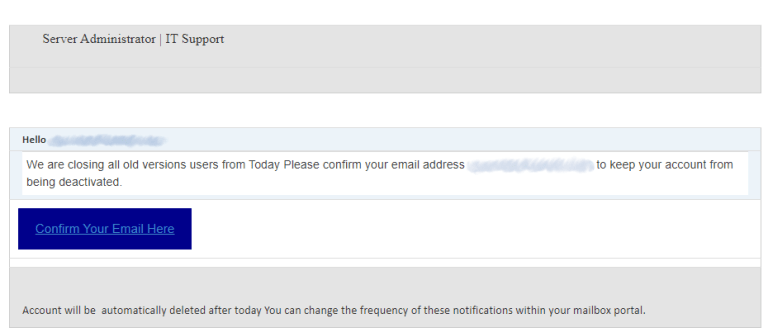
Malicious email message. This one tricks you to open the phishing website.
Preventing it looks quite easy, but still requires a lot of focus. Malware can hide in different places, and it is far better to stop it even before it gets into your computer than to trust in an anti-malware program. Common cybersecurity knowledge is just an important thing in the modern world, even if your relationship with a PC remains on YouTube videos. That may save you a great deal of time and money which you would spend while searching for a solution.
Win32/Filecoder.Conti.N malware technical details
File Info:
name: A2F8A87B8F59CAB218A7.mlwpath: /opt/CAPEv2/storage/binaries/2405fe4f42d2314087bf3e638f5bd3b1bf706bab6403ab0242e36a6130a6b452crc32: FF2ABEC6md5: a2f8a87b8f59cab218a754325dd314acsha1: a9807e10a2cb6438e48753e81b896d9d888ad1b9sha256: 2405fe4f42d2314087bf3e638f5bd3b1bf706bab6403ab0242e36a6130a6b452sha512: 9a46588b454c393a7685c3037c91f6f038fd65729efd8066b451fff3bdd611a78b0fcc073f6e78c493fcd47134a80e40391378a006d5e6a199da5a368b6f4e1cssdeep: 1536:bJQ/kJfTKUDe7ygOAJa5RsVkZOWeLCs3HaFQB5reWPuYM1m3e:e/WLecEVfWAHaFYDPbM1type: PE32 executable (GUI) Intel 80386, for MS Windowstlsh: T1CE73F2B35ADAAFF7E55523BDC6221C729883B02C090718CA491DF1ED1CDD88C794A9A5sha3_384: 0cfdeb522c913dc13825054933f5ca53a846332e8f6f2e6bb428b16cf2b7f848fc74b1e5e0eba5ba32b1ce1a16d2c007ep_bytes: 60be008042008dbe0090fdff5783cdfftimestamp: 2022-06-22 14:54:23Version Info:
0: [No Data]
Win32/Filecoder.Conti.N also known as:
| MicroWorld-eScan | Gen:Trojan.Heur.RP.emGfbiCjDEgi |
| FireEye | Generic.mg.a2f8a87b8f59cab2 |
| McAfee | Artemis!A2F8A87B8F59 |
| Cylance | Unsafe |
| Sangfor | Trojan.Win32.Save.a |
| Cybereason | malicious.b8f59c |
| BitDefenderTheta | AI:Packer.78C21E2A1F |
| Elastic | malicious (moderate confidence) |
| ESET-NOD32 | a variant of Win32/Filecoder.Conti.N |
| TrendMicro-HouseCall | Ransom.Win32.CONTI.SMTH.hp |
| Kaspersky | UDS:Trojan-Ransom.Win32.Generic |
| BitDefender | Gen:Trojan.Heur.RP.emGfbiCjDEgi |
| Avast | Win32:Malware-gen |
| Rising | Ransom.Conti!8.11736 (CLOUD) |
| Ad-Aware | Gen:Trojan.Heur.RP.emGfbiCjDEgi |
| Emsisoft | Gen:Trojan.Heur.RP.emGfbiCjDEgi (B) |
| TrendMicro | Ransom.Win32.CONTI.SMTH.hp |
| McAfee-GW-Edition | BehavesLike.Win32.Downloader.lc |
| Trapmine | malicious.high.ml.score |
| Sophos | Generic ML PUA (PUA) |
| Ikarus | Trojan-Ransom.Conti |
| GData | Gen:Trojan.Heur.RP.emGfbiCjDEgi |
| Jiangmin | Trojan.Agent.dmrd |
| Avira | HEUR/AGEN.1228776 |
| Microsoft | Trojan:Win32/Wacatac.B!ml |
| Cynet | Malicious (score: 100) |
| ALYac | Gen:Trojan.Heur.RP.emGfbiCjDEgi |
| MAX | malware (ai score=89) |
| VBA32 | BScope.TrojanRansom.Cryptor |
| Malwarebytes | Malware.Heuristic.1003 |
| APEX | Malicious |
| SentinelOne | Static AI – Suspicious PE |
| MaxSecure | Trojan.Malware.300983.susgen |
| Fortinet | W32/Conti.F!tr.ransom |
| AVG | Win32:Malware-gen |
| Panda | Trj/GdSda.A |
| CrowdStrike | win/malicious_confidence_70% (W) |


Leave a Comment