
Seeing the Win32/Filecoder.Buran.K detection name means that your PC is in big danger. This malware can correctly be identified as ransomware – type of malware which encrypts your files and asks you to pay for their decryption. Removing it requires some peculiar steps that must be done as soon as possible.
Win32/Filecoder.Buran.K detection is a virus detection you can spectate in your computer. It generally shows up after the provoking procedures on your PC – opening the dubious e-mail messages, clicking the advertisement in the Internet or installing the program from unreliable sources. From the moment it shows up, you have a short time to take action until it begins its malicious activity. And be sure – it is much better not to await these destructive effects.
What is Win32/Filecoder.Buran.K virus?
Win32/Filecoder.Buran.K Summary
Summarizingly, Win32/Filecoder.Buran.K ransomware activities in the infected system are next:
- Executed a command line with /C or /R argument to terminate command shell on completion which can be used to hide execution;
- Checks adapter addresses which can be used to detect virtual network interfaces;
- Dynamic (imported) function loading detected;
- Performs HTTP requests potentially not found in PCAP.;
- Enumerates running processes;
- Expresses interest in specific running processes;
- Manipulates data from or to the Recycle Bin;
- Drops a binary and executes it;
- The binary contains an unknown PE section name indicative of packing;
- Authenticode signature is invalid;
- A scripting utility was executed;
- Uses Windows utilities for basic functionality;
- Attempts to modify proxy settings;
- Creates a copy of itself;
- Encrypting the documents located on the target’s disk drives — so the victim cannot use these documents;
- Blocking the launching of .exe files of anti-virus apps
- Blocking the launching of installation files of anti-virus programs
Ransomware has been a major problem for the last 4 years. It is hard to imagine a more damaging malware for both individual users and businesses. The algorithms utilized in Win32/Filecoder.Buran.K (typically, RHA-1028 or AES-256) are not hackable – with minor exclusions. To hack it with a brute force, you need more time than our galaxy currently exists, and possibly will exist. However, that malware does not do all these terrible things immediately – it may take up to a few hours to cipher all of your documents. Hence, seeing the Win32/Filecoder.Buran.K detection is a clear signal that you must start the elimination process.
Where did I get the Win32/Filecoder.Buran.K?
Standard methods of Win32/Filecoder.Buran.K distribution are standard for all other ransomware examples. Those are one-day landing sites where users are offered to download the free program, so-called bait emails and hacktools. Bait emails are a relatively new method in malware distribution – you get the email that mimics some normal notifications about shipments or bank service conditions shifts. Inside of the e-mail, there is a malicious MS Office file, or a web link which opens the exploit landing site.
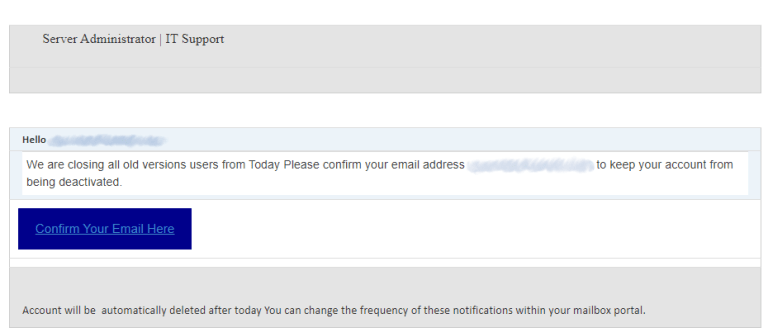
Malicious email message. This one tricks you to open the phishing website.
Avoiding it looks quite simple, but still demands a lot of focus. Malware can hide in different spots, and it is much better to stop it even before it gets into your system than to trust in an anti-malware program. Standard cybersecurity knowledge is just an essential thing in the modern world, even if your relationship with a PC remains on YouTube videos. That may save you a lot of money and time which you would spend while seeking a solution.
Win32/Filecoder.Buran.K malware technical details
File Info:
name: 0B1B688881B4D690AD15.mlwpath: /opt/CAPEv2/storage/binaries/0737ddbd894f37316eee04c6739ac32f0c888535783a1af8c873023bcebbb8e8crc32: 3032F4E7md5: 0b1b688881b4d690ad1574a0a34ced6esha1: 49e69c5cf546d9312b768a15fa7c1dac432e2d75sha256: 0737ddbd894f37316eee04c6739ac32f0c888535783a1af8c873023bcebbb8e8sha512: 40b5bc54a0d51e65bc5956ca5172c26519bcbd406d42aa9f16a2cf0913c9315c90f873d1afc60fc20bd6be89170644b0f2fa42468bd0936bb80d41e1080b8006ssdeep: 3072:t3blGV9hulKmhbfvjv69vF6nHynNPFW7Lifa81HhJmrGSFtNi48xDkGCW/E2L:t3bq9UlKgPuEyNFWSb1Hfmqi/8xDx/ZLtype: PE32 executable (GUI) Intel 80386, for MS Windowstlsh: T17E146B66F6818D32F1555F3CCE5BD2A9B17A78302E1C5046BDE94D8E9A3F6D2242C2C3sha3_384: 0f30e38d889eb4b9a1318a386b9904f97e034aa44a5125dfa6dcfd08ed238c54ad7356942de2beca51b779e182bd4394ep_bytes: 558becb9210000006a006a004975f953timestamp: 2022-07-20 09:47:14Version Info:
0: [No Data]
Win32/Filecoder.Buran.K also known as:
| Bkav | W32.AIDetect.malware1 |
| Cynet | Malicious (score: 100) |
| McAfee | Ransom-Monster!0B1B688881B4 |
| Cybereason | malicious.881b4d |
| VirIT | Ransom.Win32.Phobos.DGY |
| Symantec | ML.Attribute.HighConfidence |
| Elastic | malicious (high confidence) |
| ESET-NOD32 | a variant of Win32/Filecoder.Buran.K |
| APEX | Malicious |
| Kaspersky | HEUR:Trojan-Ransom.Win32.Agent.gen |
| BitDefender | Gen:Variant.Ransom.Pipaki.6 |
| MicroWorld-eScan | Gen:Variant.Ransom.Pipaki.6 |
| Avast | Win32:Evo-gen [Susp] |
| Rising | Trojan.Injector!1.DF63 (CLASSIC) |
| Ad-Aware | Gen:Variant.Ransom.Pipaki.6 |
| Emsisoft | Gen:Variant.Ransom.Pipaki.6 (B) |
| VIPRE | Gen:Variant.Ransom.Pipaki.6 |
| McAfee-GW-Edition | BehavesLike.Win32.Dropper.ch |
| Trapmine | malicious.high.ml.score |
| FireEye | Generic.mg.0b1b688881b4d690 |
| Sophos | Generic ML PUA (PUA) |
| Ikarus | Trojan-Ransom.FileCrypter |
| Avira | HEUR/AGEN.1238400 |
| Microsoft | Program:Win32/Wacapew.C!ml |
| Arcabit | Trojan.Ransom.Pipaki.6 |
| ZoneAlarm | HEUR:Trojan-Ransom.Win32.Agent.gen |
| GData | Gen:Variant.Ransom.Pipaki.6 |
| AhnLab-V3 | Ransomware/Win.FILECODER.C5025693 |
| Acronis | suspicious |
| VBA32 | BScope.Trojan.Sabsik.TE |
| ALYac | Gen:Variant.Ransom.Pipaki.6 |
| MAX | malware (ai score=86) |
| Malwarebytes | Ransom.FileCryptor |
| Tencent | Win32.Trojan.Filecoder.Eop |
| SentinelOne | Static AI – Malicious PE |
| MaxSecure | Trojan.Malware.300983.susgen |
| Fortinet | W32/Filecoder.OKG!tr.ransom |
| BitDefenderTheta | AI:Packer.F18F446D21 |
| AVG | Win32:Evo-gen [Susp] |
| Panda | Trj/GdSda.A |
| CrowdStrike | win/malicious_confidence_100% (D) |


Leave a Comment