
Seeing the Win32/Agent.WUO detection means that your PC is in big danger. This computer virus can correctly be identified as ransomware – sort of malware which ciphers your files and asks you to pay for their decryption. Stopping it requires some specific steps that must be taken as soon as possible.
Win32/Agent.WUO detection is a malware detection you can spectate in your system. It frequently shows up after the provoking activities on your PC – opening the suspicious e-mail messages, clicking the banner in the Internet or setting up the program from untrustworthy sources. From the instance it shows up, you have a short time to do something about it before it starts its harmful action. And be sure – it is better not to wait for these harmful effects.
What is Win32/Agent.WUO virus?
Win32/Agent.WUO Summary
Summarizingly, Win32/Agent.WUO virus activities in the infected computer are next:
- CAPE extracted potentially suspicious content;
- Authenticode signature is invalid;
- CAPE detected the shellcode get eip malware family;
- Yara detections observed in process dumps, payloads or dropped files;
- Encrypting the files kept on the victim’s disk drive — so the victim cannot open these files;
- Blocking the launching of .exe files of security tools
- Blocking the launching of installation files of anti-virus apps
Ransomware has been a major problem for the last 4 years. It is challenging to imagine a more dangerous virus for both individual users and companies. The algorithms used in Win32/Agent.WUO (usually, RHA-1028 or AES-256) are not hackable – with minor exclusions. To hack it with a brute force, you need more time than our galaxy currently exists, and possibly will exist. But that virus does not do all these horrible things immediately – it may take up to several hours to cipher all of your documents. Hence, seeing the Win32/Agent.WUO detection is a clear signal that you have to begin the clearing process.
Where did I get the Win32/Agent.WUO?
Routine ways of Win32/Agent.WUO distribution are typical for all other ransomware variants. Those are one-day landing websites where users are offered to download and install the free program, so-called bait e-mails and hacktools. Bait e-mails are a pretty modern tactic in malware spreading – you receive the email that simulates some normal notifications about shippings or bank service conditions changes. Inside of the email, there is a corrupted MS Office file, or a link which opens the exploit landing site.
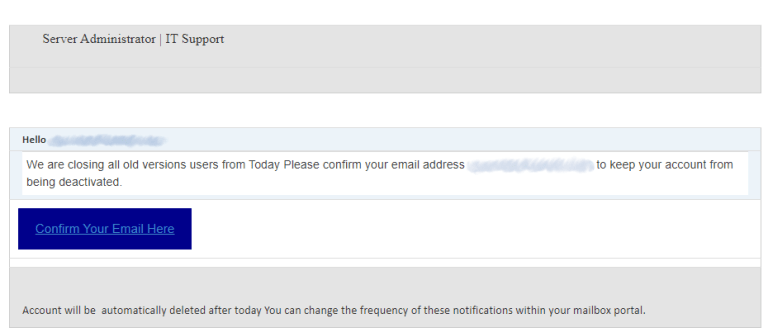
Malicious email message. This one tricks you to open the phishing website.
Preventing it looks pretty uncomplicated, but still requires a lot of awareness. Malware can hide in different places, and it is much better to stop it even before it goes into your system than to rely on an anti-malware program. Standard cybersecurity awareness is just an important thing in the modern world, even if your relationship with a computer stays on YouTube videos. That may keep you a lot of time and money which you would certainly spend while looking for a fix guide.
Win32/Agent.WUO malware technical details
File Info:
name: CB54F4AAF182C266E561.mlwpath: /opt/CAPEv2/storage/binaries/b670faa0d89b9e93d32ab9a98847937aeaccf884d9c8d1975c4ac15c496f49aacrc32: 5C6D3CF6md5: cb54f4aaf182c266e561a024f73ca4f0sha1: 5520dabebe51bcb3079607ce11274530c9e62a82sha256: b670faa0d89b9e93d32ab9a98847937aeaccf884d9c8d1975c4ac15c496f49aasha512: 7769afa29a75e825520b7e126ca0d8f87c6fc8aaafa7301fb7767169fdac0a18b8b80ebe21e18d304a9ce0f4b0fe517315b0c4ad62afa1556d6cecb92ca6660dssdeep: 6144:rt0uxdocuOTHdWc/ITIOU2xnPTghOAFeHPFgvF9N5g1I40HdqIMwou4MK:rtHHdXWxnPTgIAisx5o0kIMwoFMtype: PE32 executable (GUI) Intel 80386, for MS Windowstlsh: T122B4BF21B6C2C0FFC1A700F58906FB9DB7FBB9614A2656577BC2FB4E1D30183A625252sha3_384: c78a629caa8ecf35ce366544d4fbdd4f763660f0fde492e9886c5cfe7a5997746ee4e0432b052e38a62f85dcfffa1c93ep_bytes: e8e2b40000e916feffff8b44240485c0timestamp: 2015-01-19 07:26:19Version Info:
CompanyName: Crawler.comLegalCopyright: Crawler.com (C) 2007-2015 LegalTrademarks: Crawler.com (C) 2007-2015 FileDescription: Shortcomings RecruitingOriginalFilename: FetusesClientsidexml.exeProductName: FetusesClientsidexmlProductVersion: 2.8.86.140Translation: 0x0409 0x04b0
Win32/Agent.WUO also known as:
| Bkav | W32.Common.CF0D9E67 |
| Lionic | Trojan.Win32.Generic.4!c |
| AVG | Win32:Malware-gen |
| Elastic | malicious (high confidence) |
| MicroWorld-eScan | Gen:Variant.Jaik.60820 |
| FireEye | Generic.mg.cb54f4aaf182c266 |
| Skyhigh | BehavesLike.Win32.Infected.gh |
| ALYac | Gen:Variant.Jaik.60820 |
| Cylance | unsafe |
| VIPRE | Gen:Variant.Jaik.60820 |
| Sangfor | Trojan.Win32.Agent.Vy9f |
| K7AntiVirus | Trojan ( 0052706c1 ) |
| Alibaba | Trojan:Win32/Generic.c75b9e60 |
| K7GW | Trojan ( 0052706c1 ) |
| Cybereason | malicious.ebe51b |
| BitDefenderTheta | Gen:NN.ZexaF.36744.Eu0@aiE9XEei |
| Symantec | Trojan Horse |
| ESET-NOD32 | Win32/Agent.WUO |
| Cynet | Malicious (score: 99) |
| APEX | Malicious |
| BitDefender | Gen:Variant.Jaik.60820 |
| Avast | Win32:Malware-gen |
| Tencent | Win32.Trojan.Agen.Eplw |
| Emsisoft | Gen:Variant.Jaik.60820 (B) |
| F-Secure | Trojan.TR/AD.MalwareCrypter.jleif |
| TrendMicro | TROJ_GEN.R002C0OA924 |
| Sophos | Mal/Generic-S |
| Ikarus | Trojan.Win32.Agent |
| Avira | TR/AD.MalwareCrypter.jleif |
| Kingsoft | Win32.Troj.Undef.a |
| Xcitium | Malware@#3olobch9n2wz0 |
| Arcabit | Trojan.Jaik.DED94 |
| GData | Gen:Variant.Jaik.60820 |
| McAfee | RDN/generic.dx |
| MAX | malware (ai score=82) |
| VBA32 | BScope.TrojanRansom.Foreign |
| Malwarebytes | MachineLearning/Anomalous.100% |
| Panda | Trj/CI.A |
| TrendMicro-HouseCall | TROJ_GEN.R002C0OA924 |
| Rising | [email protected] (RDML:/UjyqUok9aQC06fP7GIleA) |
| Yandex | Trojan.Agent!FC+sf6w4lKU |
| Fortinet | W32/Agent.WUO!tr |
| DeepInstinct | MALICIOUS |
| CrowdStrike | win/malicious_confidence_70% (W) |


Leave a Comment