
Spectating the Win32/Agent.NQS malware detection means that your computer is in big danger. This malware can correctly be identified as ransomware – sort of malware which ciphers your files and asks you to pay for their decryption. Deleteing it requires some unusual steps that must be taken as soon as possible.
Win32/Agent.NQS detection is a malware detection you can spectate in your system. It generally appears after the provoking procedures on your computer – opening the dubious e-mail, clicking the advertisement in the Web or mounting the program from unreliable resources. From the moment it appears, you have a short time to take action before it begins its malicious activity. And be sure – it is better not to await these harmful actions.
What is Win32/Agent.NQS virus?
Win32/Agent.NQS Summary
In total, Win32/Agent.NQS malware activities in the infected PC are next:
- SetUnhandledExceptionFilter detected (possible anti-debug);
- Behavioural detection: Executable code extraction – unpacking;
- Yara rule detections observed from a process memory dump/dropped files/CAPE;
- Creates RWX memory;
- Possible date expiration check, exits too soon after checking local time;
- Dynamic (imported) function loading detected;
- Enumerates running processes;
- CAPE extracted potentially suspicious content;
- Unconventionial binary language: Arabic (Algeria);
- Unconventionial language used in binary resources: Rhaeto (Romance);
- The binary likely contains encrypted or compressed data.;
- Authenticode signature is invalid;
- Behavioural detection: Injection (Process Hollowing);
- Executed a process and injected code into it, probably while unpacking;
- Detects the presence of Wine emulator via function name;
- Detects Sandboxie through the presence of a library;
- Detects SunBelt Sandbox through the presence of a library;
- Queries information on disks, possibly for anti-virtualization;
- Behavioural detection: Injection (inter-process);
- Checks the version of Bios, possibly for anti-virtualization;
- Checks the presence of disk drives in the registry, possibly for anti-virtualization;
- Detects VirtualBox through the presence of a registry key;
- Detects VMware through the presence of a registry key;
- Encrypting the files kept on the victim’s drive — so the victim cannot check these files;
- Blocking the launching of .exe files of security tools
- Blocking the launching of installation files of anti-virus programs
Ransomware has been a headache for the last 4 years. It is challenging to realize a more dangerous virus for both individuals and companies. The algorithms used in Win32/Agent.NQS (generally, RHA-1028 or AES-256) are not hackable – with minor exclusions. To hack it with a brute force, you need more time than our galaxy currently exists, and possibly will exist. However, that virus does not do all these bad things immediately – it may take up to a few hours to cipher all of your documents. Thus, seeing the Win32/Agent.NQS detection is a clear signal that you should begin the removal process.
Where did I get the Win32/Agent.NQS?
Usual ways of Win32/Agent.NQS spreading are usual for all other ransomware variants. Those are one-day landing websites where victims are offered to download and install the free app, so-called bait e-mails and hacktools. Bait emails are a quite new method in malware spreading – you receive the email that simulates some regular notifications about deliveries or bank service conditions updates. Within the email, there is a corrupted MS Office file, or a link which opens the exploit landing site.
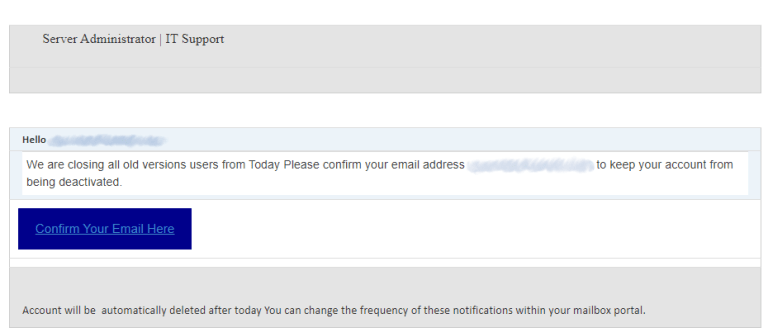
Malicious email message. This one tricks you to open the phishing website.
Avoiding it looks quite easy, however, still demands a lot of recognition. Malware can hide in various places, and it is better to prevent it even before it gets into your computer than to rely upon an anti-malware program. Simple cybersecurity awareness is just an essential thing in the modern-day world, even if your interaction with a PC stays on YouTube videos. That can keep you a lot of time and money which you would certainly spend while trying to find a solution.
Win32/Agent.NQS malware technical details
File Info:
name: B56D1BA6D92E65807B80.mlwpath: /opt/CAPEv2/storage/binaries/e293c09de8540a2865769f5b06902f95d6c5bf082f49a7843b15c1b82d321107crc32: FCB6C67Dmd5: b56d1ba6d92e65807b809dcd6e4e1d13sha1: bcd192d0bfd5443af25dd92a81f25dab8508c03dsha256: e293c09de8540a2865769f5b06902f95d6c5bf082f49a7843b15c1b82d321107sha512: a2b4c8502c4f83e06a52438852e0fe8204c290be6b0bb0b8c89148f52f0a19f7f3e40a128122cb085044f2bb2271219be5a1a3a7c354575906ad4a8d6635a4b3ssdeep: 3072:cPSvAvG2gwnMgHdyykaGd6sIv77qjmWTmR/gUlVu+ezCx:caAdnMprdv077q36R/RVu6type: PE32 executable (GUI) Intel 80386, for MS Windowstlsh: T100E39D1AB8B190B2D0D7D23148F9DAE6C5AEB431136D3C477F9C16EE5B103E01A76E85sha3_384: bb25c89f0841b65b99780a9f4f68d10d9b44cc344898b5aa1915e1298a0764f145d115c83439628c52b1b9076eb4b68bep_bytes: e81f440000e978feffff558bec83ec04timestamp: 2014-11-17 11:49:00Version Info:
CompanyName: Raw hollow percent - www.Badly.comFileDescription: Eddy evidence fed offer route topic anybodyFileVersion: 6.0.0.4Internal Name: Screen.exeLegal Trademarks: BadlyOriginal Filename: Screen.exeProductName: BadlyProductVersion: 6.0LegalCopyright: Copyright (C) Badly 2008-2013Translation: 0x0401 0x04b0
Win32/Agent.NQS also known as:
| Bkav | W32.BanfesiA.Trojan |
| Lionic | Trojan.Win32.Generic.4!c |
| Elastic | malicious (high confidence) |
| MicroWorld-eScan | Trojan.Lethic.Gen.1 |
| CAT-QuickHeal | TrojanRansom.Crowti.A4 |
| McAfee | PWSZbot-FAGF!B56D1BA6D92E |
| Cylance | Unsafe |
| Sangfor | Worm.Win32.Agent.NQS |
| K7AntiVirus | Trojan ( 0055e3dd1 ) |
| Alibaba | VirTool:Win32/Injector.828eb8b1 |
| K7GW | Trojan ( 0055e3dd1 ) |
| Cybereason | malicious.6d92e6 |
| Cyren | W32/Rovnix.A.gen!Eldorado |
| Symantec | W32.IRCBot.NG |
| tehtris | Generic.Malware |
| ESET-NOD32 | Win32/Agent.NQS |
| APEX | Malicious |
| Paloalto | generic.ml |
| Kaspersky | HEUR:Trojan.Win32.Generic |
| BitDefender | Trojan.Lethic.Gen.1 |
| NANO-Antivirus | Trojan.Win32.Yakes.dizcke |
| Avast | Win32:Androp [Drp] |
| Rising | Worm.Agent!8.25 (CLOUD) |
| Ad-Aware | Trojan.Lethic.Gen.1 |
| Sophos | ML/PE-A + Mal/Wonton-AN |
| Comodo | Malware@#2bsbmtkyppdf4 |
| F-Secure | Heuristic.HEUR/AGEN.1238248 |
| DrWeb | Trojan.Matsnu.79 |
| Zillya | Trojan.Yakes.Win32.26999 |
| TrendMicro | TROJ_YAKES.DUKML |
| McAfee-GW-Edition | BehavesLike.Win32.Locky.cc |
| FireEye | Generic.mg.b56d1ba6d92e6580 |
| Emsisoft | Trojan.Lethic.Gen.1 (B) |
| SentinelOne | Static AI – Suspicious PE |
| Jiangmin | Trojan/Yakes.pgw |
| Webroot | Trojan.Dropper.Gen |
| Avira | HEUR/AGEN.1238248 |
| MAX | malware (ai score=100) |
| Antiy-AVL | Trojan/Generic.ASMalwS.CC9C6E |
| Kingsoft | Win32.Troj.Yakes.hg.(kcloud) |
| Microsoft | VirTool:Win32/Injector.EY |
| SUPERAntiSpyware | Trojan.Agent/Gen-Yakes |
| GData | Trojan.Lethic.Gen.1 |
| Cynet | Malicious (score: 100) |
| AhnLab-V3 | Trojan/Win32.Necurs.R125275 |
| Acronis | suspicious |
| BitDefenderTheta | Gen:NN.ZexaF.34606.jq0@a4!q1tkG |
| ALYac | Trojan.Lethic.Gen.1 |
| VBA32 | Heur.Malware-Cryptor.Ngrbot |
| Malwarebytes | Trojan.Agent.DED |
| TrendMicro-HouseCall | TROJ_YAKES.DUKML |
| Tencent | Win32.Trojan.Generic.Pepp |
| Yandex | Worm.Agent!GNSZGdZsJeE |
| Ikarus | Trojan-Downloader.Win32.Waski |
| MaxSecure | Trojan.Malware.300983.susgen |
| Fortinet | W32/Injector.BPYL!tr |
| AVG | Win32:Androp [Drp] |
| Panda | Trj/Genetic.gen |
| CrowdStrike | win/malicious_confidence_100% (D) |


Leave a Comment