
The Water virus belongs under the Phobos ransomware family. Malware of this type encrypts all the data on your PC (photos, documents, excel tables, audio files, videos, etc) and adds its own extension to every file, leaving the info.txt text files in every directory containing encrypted files.
What is known about the Water virus?
☝️ Water is a Phobos family ransomware-type virus.
The pattern of renaming is this: id[xxxxxx].[contact-email].water. During the encryption, a file named, for example, “report.docx” will be changed to “report.docx.id[9ECFA84E-3499].[[email protected]].water”.
In each directory that contains the encoded files, a info.txt file will be found. It is a ransom money note. Therein you can find information about the ways of contacting the racketeers and some other information. The ransom note usually contains a description of how to buy the decryption tool from the tamperers. You can get this tool after contacting [email protected] by email. That is how they do it.
Water Summary:
| Name | Water Virus |
| Ransomware family1 | Phobos ransomware |
| Extension | .water |
| Ransomware note | info.txt |
| Contact | [email protected] |
| Detection | Rogue:Win32/Winwebsec!pz Virus Removal, BScope.TrojanRansom.Exxroute Virus Removal, Win32/PSW.Papras.DU Virus Removal |
| Symptoms | Your files (photos, videos, documents) have a .water extension and you can’t open them. |
| Fix Tool | See If Your System Has Been Affected by Water virus |
The info.txt document accompanying the Water ransomware states the following:
YOUR DATA IS ENCRYPTED!
Unlocking your data is possible only with our software.
Important! An attempt to decrypt it yourself or decrypt it with third-party software will result in the loss of your data forever.
Contacting intermediary companies, recovery companies will create the risk of losing your data forever or being deceived by these companies. Being deceived is your responsibility! Learn the experience on the forums.
CONTACT US
Write us to the e-mail: [email protected]
Write this ID in the title of your message -
If you have not contacted within 2 days from the moment of the incident, we will consider the transaction not completed. Your data will be sent to all interested parties. This is your responsibility.
SCAMMER ALERT
People who you will find on the internet saying they can help you will try to scam you. Videos to youtube and other sites are fake so you shouldn\'t believe it. Do not pay anyone who cannot provide an example proof files. Do not forward a payment to anyone with btc apart from us. You can get your exemplary proof file for free by contacting us with your company email.
Not a single file will be sent to any other email except the company one (This is a precaution in order to for you to not get scammed) Contacting any other third party or data rescue companies will create the risk of losing your data forever or you getting scammed by these firms. Getting scammed or not is up to you. Learn about the experiences of other people on the forums.
ATTENTION!
Do not rename encrypted files.
Do not try to decrypt your data using third party software, it may cause permanent data loss.
Decryption of your files with the help of third parties may cause increased price (they add their fee to our) or you can become a victim of a scam.
If you have not contacted within 2 days from the moment of the incident, we will consider the transaction not completed. Your data will be sent to all interested parties. This is your responsibility.
Don\'t be afraid to contact us. Remember, this is the only way to recover your data.
In the image below, you can see what a directory with files encrypted by the Water looks like. Each filename has the “.water” extension appended to it.
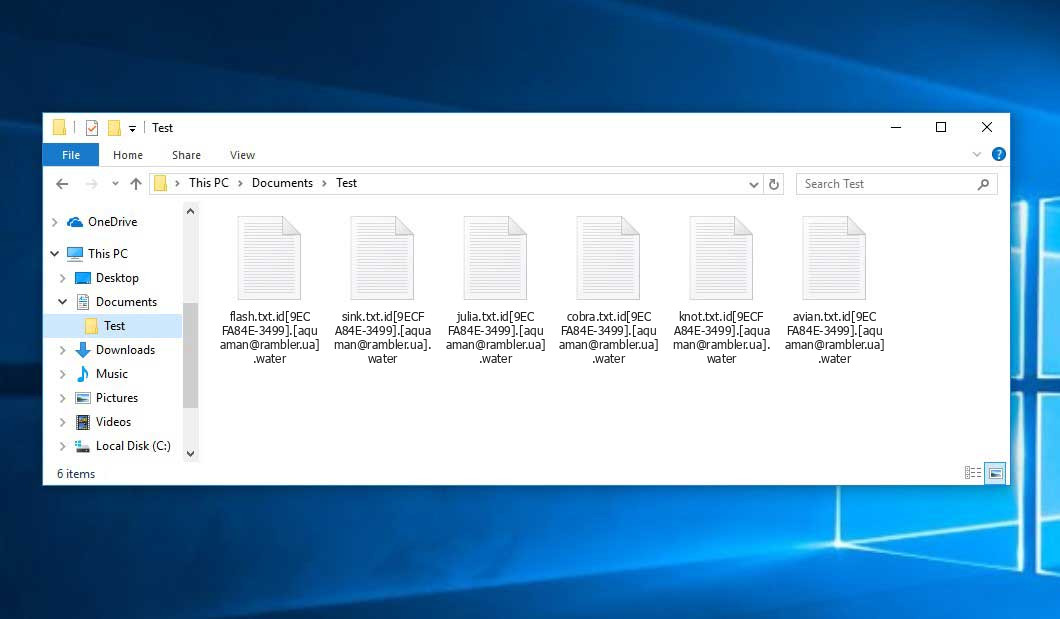
That is how encrypted “.water” files look.
How did my machine catch Water ransomware?
There is a huge number of possible ways of ransomware infiltration.
There are currently three most popular ways for evil-doers to have ransomware planted in your system. These are email spam, Trojan injection and peer-to-peer file transfer.
- Another option for ransom hunters is a Trojan file model. A Trojan is a program that gets into your machine disguised as something different. Imagine, you download an installer for some program you need or an update for some service. However, what is unpacked turns out to be a harmful program that compromises your data. Since the update package can have any title and any icon, you have to make sure that you can trust the source of the files you’re downloading. The best way is to use the software developers’ official websites.
- As for the peer file transfer protocols like BitTorrent or eMule, the danger is that they are even more trust-based than the rest of the Web. You can never know what you download until you get it. Our suggestion is that you use trustworthy websites. Also, it is a good idea to scan the directory containing the downloaded files with the anti-malware utility as soon as the downloading is finished.
How do I get rid of ransomware?
It is important to note that besides encrypting your files, the Water virus will probably deploy Vidar Stealer on your computer to seize your credentials to various accounts (including cryptocurrency wallets). That spyware can derive your logins and passwords from your browser’s auto-filling cardfile.
How сan I avoid ransomware attack?
Water ransomware doesn’t have a superpower, so as any similar malware.
You can protect your system from its attack within several easy steps:
- Never open any letters from unknown mailboxes with strange addresses, or with content that has nothing to do with something you are waiting for (how can you win in a money prize draw without participating in it?). If the email subject is likely something you are expecting, scrutinize all elements of the dubious email carefully. A fake email will surely have a mistake.
- Do not use cracked or unknown programs. Trojans are often shared as an element of cracked software, most likely under the guise of “patch” to prevent the license check. But untrusted programs are very hard to distinguish from trustworthy ones, because trojans may also have the functionality you need. Try searching for information on this software product on the anti-malware forums, but the best solution is not to use such programs at all.
Frequently Asked Questions
🤔 Are the “.water” files accessible?
Negative. That is why ransomware is so frustrating. Until you decode the “.water” files you will not be able to access them.
🤔 What should I do to make my files accessible as fast as possible?
Hopefully, you have made a copy of those important files. If not, there is still a function of System Restore but it needs a Restore Point to be previously saved. There are other ways to beat ransomware, but they take time.
🤔 What actions should I take if the Water virus has blocked my PC and I can’t get the activation code.
🤔 What can I do right now?
Many of the blocked files might still be at your disposal
- If you sent or received your critical files via email, you could still download them from your online mail server.
- You might have shared photographs or videos with your friends or relatives. Just ask them to send those images back to you.
- If you have initially downloaded any of your files from the Internet, you can try doing it again.
- Your messengers, social networks pages, and cloud disks might have all those files too.
- It might be that you still have the needed files on your old computer, a laptop, cellphone, external storage, etc.
USEFUL TIP: You can use file recovery programs2 to retrieve your lost information since ransomware blocks the copies of your files, removing the original ones. In the tutorial below, you can learn how to use PhotoRec for such a restoration, but remember: you can do it only after you eradicate the ransomware itself with an anti-malware program.


Leave a Comment