
Seeing the VirTool:Win32/Obfuscator.XI detection name usually means that your system is in big danger. This malware can correctly be named as ransomware – sort of malware which encrypts your files and asks you to pay for their decryption. Removing it requires some specific steps that must be done as soon as possible.
VirTool:Win32/Obfuscator.XI detection is a virus detection you can spectate in your system. It generally appears after the preliminary actions on your PC – opening the suspicious e-mail messages, clicking the banner in the Web or installing the program from dubious resources. From the instance it shows up, you have a short time to do something about it before it starts its harmful activity. And be sure – it is better not to await these destructive things.
What is VirTool:Win32/Obfuscator.XI virus?
VirTool:Win32/Obfuscator.XI Summary
In summary, VirTool:Win32/Obfuscator.XI malware actions in the infected system are next:
- The binary contains an unknown PE section name indicative of packing;
- Authenticode signature is invalid;
- Anomalous binary characteristics;
- Ciphering the documents located on the victim’s disk drives — so the victim cannot use these files;
- Blocking the launching of .exe files of anti-malware programs
- Blocking the launching of installation files of anti-virus apps
Ransomware has actually been a headache for the last 4 years. It is challenging to realize a more dangerous malware for both individuals and companies. The algorithms used in VirTool:Win32/Obfuscator.XI (generally, RHA-1028 or AES-256) are not hackable – with minor exclusions. To hack it with a brute force, you need more time than our galaxy actually exists, and possibly will exist. But that virus does not do all these unpleasant things immediately – it may require up to a few hours to cipher all of your documents. Thus, seeing the VirTool:Win32/Obfuscator.XI detection is a clear signal that you should start the elimination procedure.
Where did I get the VirTool:Win32/Obfuscator.XI?
General methods of VirTool:Win32/Obfuscator.XI spreading are typical for all other ransomware examples. Those are one-day landing websites where victims are offered to download the free software, so-called bait e-mails and hacktools. Bait e-mails are a quite new method in malware distribution – you receive the e-mail that mimics some routine notifications about shipments or bank service conditions changes. Inside of the e-mail, there is a malicious MS Office file, or a web link which leads to the exploit landing site.
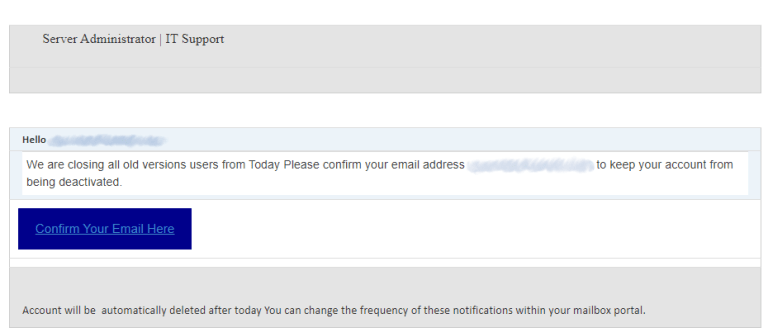
Malicious email message. This one tricks you to open the phishing website.
Avoiding it looks fairly uncomplicated, however, still requires a lot of focus. Malware can hide in various places, and it is much better to stop it even before it invades your system than to rely on an anti-malware program. Common cybersecurity knowledge is just an important item in the modern-day world, even if your interaction with a PC remains on YouTube videos. That can keep you a lot of money and time which you would spend while looking for a fix guide.
VirTool:Win32/Obfuscator.XI malware technical details
File Info:
name: 72044F3C59D5516D1A77.mlwpath: /opt/CAPEv2/storage/binaries/c6a60dedc5f25ad1d380d8a5098c58b2163320000cd1461e2cccb22c72a8fa8ecrc32: 48BA536Bmd5: 72044f3c59d5516d1a77c245cbed9bddsha1: 0ace9a40aad400310bda767156fe4a7d5fdf308bsha256: c6a60dedc5f25ad1d380d8a5098c58b2163320000cd1461e2cccb22c72a8fa8esha512: afacb6e6fc7bb326dc2504c76174f66472ae759776d1e3af3f1984c324cac205cf849bb7d8a269985ab159acb720202e79623c586974318980e288566f8fa6fdssdeep: 6144:ovCbyyLQVToUxbxiPKkuILavhsK2RQMcgnjNN/k:pbNEVv9TPKtvH/type: PE32 executable (GUI) Intel 80386, for MS Windowstlsh: T1359401F21F60FD47D538EA7F2E796612BBF1A6701C24C53A32494809FA362C1BDE5252sha3_384: 3ee9e9d68cdec6b9f6938ff95eebce6b32f0a0084faf4b5e620df75c606b4598e5fef7050b402f6f3904550ba3925f42ep_bytes: fc8b368b763c8d54da788b14328955fctimestamp: 2012-01-26 06:05:54Version Info:
0: [No Data]
VirTool:Win32/Obfuscator.XI also known as:
| Bkav | W32.AIDetect.malware1 |
| MicroWorld-eScan | Gen:Variant.Graftor.19495 |
| FireEye | Generic.mg.72044f3c59d5516d |
| CAT-QuickHeal | Trojan.Zbot.100335 |
| ALYac | Gen:Variant.Graftor.19495 |
| Cybereason | malicious.c59d55 |
| BitDefenderTheta | Gen:NN.ZexaF.34084.zKZ@a000Zhh |
| Symantec | ML.Attribute.HighConfidence |
| APEX | Malicious |
| Kaspersky | Trojan-Ransom.Win32.PornoAsset.fdr |
| BitDefender | Gen:Variant.Graftor.19495 |
| Avast | Win32:Carberp-ABK [Trj] |
| Ad-Aware | Gen:Variant.Graftor.19495 |
| Sophos | ML/PE-A |
| VIPRE | Lookslike.Win32.Sirefef.d (v) |
| McAfee-GW-Edition | Artemis!Trojan |
| Emsisoft | Gen:Variant.Graftor.19495 (B) |
| SentinelOne | Static AI – Malicious PE |
| GData | Gen:Variant.Graftor.19495 |
| eGambit | Unsafe.AI_Score_100% |
| Avira | TR/Patched.Ren.Gen |
| Arcabit | Trojan.Graftor.D4C27 |
| Microsoft | VirTool:Win32/Obfuscator.XI |
| Cynet | Malicious (score: 100) |
| AhnLab-V3 | Dropper/Win32.Injector.R23158 |
| McAfee | Artemis!72044F3C59D5 |
| MAX | malware (ai score=83) |
| Malwarebytes | Trojan.Agent |
| Rising | Malware.Heuristic!ET#96% (RDMK:cmRtazrKe5uTP9cWqAFRcnH4oAQ8) |
| Ikarus | Trojan.Crypt |
| Fortinet | W32/ZeroAccess.B!tr |
| AVG | Win32:Carberp-ABK [Trj] |
| CrowdStrike | win/malicious_confidence_90% (W) |


Leave a Comment