
Spectating the VirTool:Win32/CeeInject!KC detection usually means that your system is in big danger. This virus can correctly be named as ransomware – virus which ciphers your files and asks you to pay for their decryption. Deleteing it requires some specific steps that must be taken as soon as possible.
VirTool:Win32/CeeInject!KC detection is a malware detection you can spectate in your computer. It generally shows up after the preliminary activities on your computer – opening the dubious email, clicking the advertisement in the Internet or installing the program from dubious resources. From the second it appears, you have a short time to take action before it starts its harmful activity. And be sure – it is far better not to wait for these malicious actions.
What is VirTool:Win32/CeeInject!KC virus?
VirTool:Win32/CeeInject!KC Summary
Summarizingly, VirTool:Win32/CeeInject!KC malware activities in the infected PC are next:
- Behavioural detection: Executable code extraction – unpacking;
- CAPE extracted potentially suspicious content;
- The binary contains an unknown PE section name indicative of packing;
- Authenticode signature is invalid;
- Behavioural detection: Injection (Process Hollowing);
- Behavioural detection: Injection (inter-process);
- CAPE detected the Andromeda malware family;
- Checks the presence of disk drives in the registry, possibly for anti-virtualization;
- Creates a copy of itself;
- Deletes executed files from disk;
- Yara rule detections observed from a process memory dump/dropped files/CAPE;
- Ciphering the files located on the victim’s drives — so the victim cannot use these documents;
- Blocking the launching of .exe files of anti-virus programs
- Blocking the launching of installation files of security tools
Ransomware has been a headache for the last 4 years. It is difficult to picture a more damaging malware for both individual users and companies. The algorithms utilized in VirTool:Win32/CeeInject!KC (typically, RHA-1028 or AES-256) are not hackable – with minor exclusions. To hack it with a brute force, you need to have a lot more time than our galaxy already exists, and possibly will exist. But that malware does not do all these unpleasant things without delay – it may require up to a few hours to cipher all of your files. Therefore, seeing the VirTool:Win32/CeeInject!KC detection is a clear signal that you should start the removal process.
Where did I get the VirTool:Win32/CeeInject!KC?
Standard methods of VirTool:Win32/CeeInject!KC injection are basic for all other ransomware variants. Those are one-day landing web pages where users are offered to download and install the free software, so-called bait emails and hacktools. Bait e-mails are a pretty new method in malware spreading – you receive the e-mail that mimics some regular notifications about shippings or bank service conditions updates. Within the e-mail, there is an infected MS Office file, or a web link which leads to the exploit landing page.
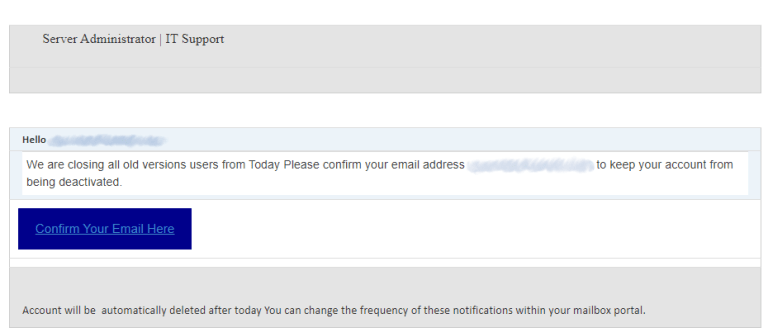
Malicious email message. This one tricks you to open the phishing website.
Preventing it looks pretty uncomplicated, however, still requires a lot of awareness. Malware can hide in different spots, and it is much better to stop it even before it gets into your system than to trust in an anti-malware program. Simple cybersecurity awareness is just an important item in the modern-day world, even if your interaction with a PC stays on YouTube videos. That can keep you a great deal of time and money which you would certainly spend while trying to find a fixing guide.
VirTool:Win32/CeeInject!KC malware technical details
File Info:
name: A3C6DFFA308E33FCFED2.mlwpath: /opt/CAPEv2/storage/binaries/96866a3509a0dd882472c4608c756ac9e61f6e3244f314b076b78ac2c8952a2ecrc32: 223FB1B1md5: a3c6dffa308e33fcfed2d66ace85f350sha1: 67539a66a25c90abc0cd00a36da2abcc94e7871bsha256: 96866a3509a0dd882472c4608c756ac9e61f6e3244f314b076b78ac2c8952a2esha512: e8b59dd44d010a831501e817da966cc62a3a9e48cf9dc4a0d7d56d3a1c9a3d321c18e9401f2a02be2853e66d2dcf16aa4b884ce5dd291f0cd33db94d921151edssdeep: 12288:wMU4/sQGHV8P92x48sW4Z6SpZuLZ/0tlSY3kGerakafPReRUvR:wc/uV8l2x4HW4d7g5ml3kGerakasRUptype: PE32 executable (GUI) Intel 80386, for MS Windowstlsh: T192E47E23E2A14837D1732A359C1B4B78AE36FE103938A9852BF5ED0CDF356907D25297sha3_384: ba397fe2165bbdeed193d038c951a8bc75950e3a06a43444b7fc4f18be12c95c7c5a36873d081eed1505589ac74cc64aep_bytes: 558bec83c4f0b868544800e80811f8fftimestamp: 1992-06-19 22:22:17Version Info:
0: [No Data]
VirTool:Win32/CeeInject!KC also known as:
| Bkav | W32.AIDetectMalware |
| Lionic | Trojan.Win32.Androm.4!c |
| DrWeb | BackDoor.Blackshades.17 |
| MicroWorld-eScan | Gen:Variant.Ransom.42 |
| FireEye | Generic.mg.a3c6dffa308e33fc |
| ALYac | Gen:Variant.Ransom.42 |
| Malwarebytes | Malware.AI.3358212124 |
| Zillya | Backdoor.Androm.Win32.34976 |
| Sangfor | Trojan.Win32.Save.a |
| K7AntiVirus | Trojan ( 0055e3991 ) |
| Alibaba | VirTool:Win32/CeeInject.a027fe64 |
| K7GW | Trojan ( 0055e3991 ) |
| Cybereason | malicious.a308e3 |
| Arcabit | Trojan.Ransom.42 |
| BitDefenderTheta | AI:Packer.313E292C21 |
| Symantec | Packed.Dromedan!gen13 |
| Elastic | malicious (high confidence) |
| ESET-NOD32 | a variant of Win32/Injector.ALMH |
| APEX | Malicious |
| Kaspersky | HEUR:Backdoor.Win32.Androm.gen |
| BitDefender | Gen:Variant.Ransom.42 |
| NANO-Antivirus | Trojan.Win32.Inject.cvbspd |
| Avast | Win32:Malware-gen |
| Tencent | Malware.Win32.Gencirc.13b18cdf |
| Sophos | Mal/Generic-S |
| F-Secure | Heuristic.HEUR/AGEN.1356531 |
| VIPRE | Gen:Variant.Ransom.42 |
| TrendMicro | TROJ_GEN.R002C0DEF23 |
| McAfee-GW-Edition | RDN/Generic BackDoor |
| Trapmine | malicious.high.ml.score |
| Emsisoft | Gen:Variant.Ransom.42 (B) |
| SentinelOne | Static AI – Suspicious PE |
| Jiangmin | Backdoor/Androm.aiu |
| Detected | |
| Avira | HEUR/AGEN.1356531 |
| Antiy-AVL | Trojan[FakeAV]/Win32.Windef |
| Xcitium | Malware@#ett20up3tbpd |
| Microsoft | VirTool:Win32/CeeInject.gen!KC |
| ZoneAlarm | HEUR:Backdoor.Win32.Androm.gen |
| GData | Gen:Variant.Ransom.42 |
| Cynet | Malicious (score: 100) |
| AhnLab-V3 | Backdoor/Win32.Androm.C4176997 |
| McAfee | RDN/Generic BackDoor |
| MAX | malware (ai score=100) |
| VBA32 | BScope.TrojanDropper.Injector |
| Cylance | unsafe |
| Panda | Trj/CI.A |
| TrendMicro-HouseCall | TROJ_GEN.R002C0DEF23 |
| Rising | HackTool.CeeInject!8.B22 (TFE:5:Pr5lRHb2udE) |
| Yandex | Trojan.Injector!K7rBV8CigJo |
| Ikarus | Backdoor.Win32.Androm |
| MaxSecure | Trojan.Malware.73688777.susgen |
| Fortinet | W32/Injector.EHDJ!tr |
| AVG | Win32:Malware-gen |
| DeepInstinct | MALICIOUS |
| CrowdStrike | win/malicious_confidence_100% (W) |


Leave a Comment