
Seeing the UDS:Trojan-Spy.Win32.Windigo detection name usually means that your system is in big danger. This virus can correctly be identified as ransomware – sort of malware which ciphers your files and asks you to pay for their decryption. Removing it requires some unusual steps that must be done as soon as possible.
UDS:Trojan-Spy.Win32.Windigo detection is a malware detection you can spectate in your computer. It frequently shows up after the preliminary activities on your computer – opening the untrustworthy e-mail, clicking the advertisement in the Internet or setting up the program from suspicious resources. From the moment it appears, you have a short time to take action until it begins its destructive activity. And be sure – it is far better not to wait for these harmful things.
What is UDS:Trojan-Spy.Win32.Windigo virus?
UDS:Trojan-Spy.Win32.Windigo Summary
In summary, UDS:Trojan-Spy.Win32.Windigo ransomware actions in the infected computer are next:
- SetUnhandledExceptionFilter detected (possible anti-debug);
- Behavioural detection: Executable code extraction – unpacking;
- At least one process apparently crashed during execution;
- Yara rule detections observed from a process memory dump/dropped files/CAPE;
- Presents an Authenticode digital signature;
- Creates RWX memory;
- Guard pages use detected – possible anti-debugging.;
- A process attempted to delay the analysis task.;
- Dynamic (imported) function loading detected;
- Performs HTTP requests potentially not found in PCAP.;
- A named pipe was used for inter-process communication;
- Enumerates running processes;
- Expresses interest in specific running processes;
- CAPE extracted potentially suspicious content;
- Unconventionial language used in binary resources: Spanish (Paraguay);
- The binary likely contains encrypted or compressed data.;
- Authenticode signature is invalid;
- Collects and encrypts information about the computer likely to send to C2 server;
- Creates a hidden or system file;
- Checks the CPU name from registry, possibly for anti-virtualization;
- Accessed credential storage registry keys;
- Collects information to fingerprint the system;
- Anomalous binary characteristics;
- Ciphering the files located on the target’s disk drive — so the victim cannot check these files;
- Blocking the launching of .exe files of security tools
- Blocking the launching of installation files of anti-virus programs
Related domains:
| wpad.local-net | Ransom:Win32/StopCrypt!ml |
Ransomware has been a major problem for the last 4 years. It is difficult to picture a more harmful malware for both individual users and organizations. The algorithms utilized in UDS:Trojan-Spy.Win32.Windigo (usually, RHA-1028 or AES-256) are not hackable – with minor exclusions. To hack it with a brute force, you need a lot more time than our galaxy actually exists, and possibly will exist. However, that malware does not do all these terrible things immediately – it may require up to several hours to cipher all of your documents. Therefore, seeing the UDS:Trojan-Spy.Win32.Windigo detection is a clear signal that you should start the clearing procedure.
Where did I get the UDS:Trojan-Spy.Win32.Windigo?
Usual ways of UDS:Trojan-Spy.Win32.Windigo distribution are standard for all other ransomware examples. Those are one-day landing sites where users are offered to download the free program, so-called bait emails and hacktools. Bait emails are a pretty modern tactic in malware spreading – you get the e-mail that mimics some regular notifications about deliveries or bank service conditions changes. Within the email, there is a malicious MS Office file, or a link which leads to the exploit landing page.
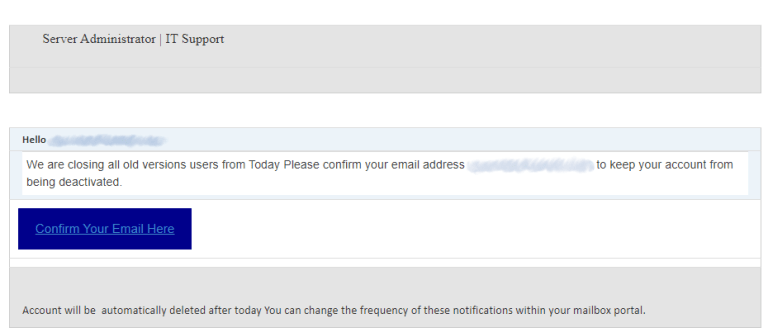
Malicious email message. This one tricks you to open the phishing website.
Avoiding it looks pretty uncomplicated, however, still requires a lot of awareness. Malware can hide in different places, and it is far better to stop it even before it invades your system than to depend on an anti-malware program. Common cybersecurity awareness is just an important thing in the modern world, even if your relationship with a PC stays on YouTube videos. That may save you a great deal of money and time which you would certainly spend while searching for a fixing guide.
UDS:Trojan-Spy.Win32.Windigo malware technical details
File Info:
name: 0B6EEC8E38F4A3DF069D.mlwpath: /opt/CAPEv2/storage/binaries/9b39c124538cf8b232d6c17d4052ccec11d6a03ffc7c7cb7461315946009a396crc32: 0D7EDF4Emd5: 0b6eec8e38f4a3df069de944632d88b7sha1: 596cf16a7ad4b7fb2fb5f74f16f3198c302dde6bsha256: 9b39c124538cf8b232d6c17d4052ccec11d6a03ffc7c7cb7461315946009a396sha512: db80920bc2b99c0f64923c2b5e117e59002b87dd547e3637be3c705151c6e533f2b8c8acee9bb5b269e9a8d3c8741f520a548b38de925a4dcfc5c0110468e0f6ssdeep: 98304:bt/GzUmicbbv4hsfDtUSsac+Wo50yN4tNHOp/j6my9:b2URciCUtaHWo5rN4qq9type: PE32 executable (GUI) Intel 80386, for MS Windowstlsh: T1A4263309B361C03DE126AB749D7683AB9D2B3EA0A731D4CFA2D455DA4B728D0DC3135Bsha3_384: 593ad48d73190032b4d40ee8d7fcf0d9c4cc27309b23897bfe8510e15bb8e9ba50bb46834628c2e8dee2f9400da24866ep_bytes: 8bff558bece806030000e8110000005dtimestamp: 2021-01-27 06:22:17Version Info:
0: [No Data]
UDS:Trojan-Spy.Win32.Windigo also known as:
| Elastic | malicious (high confidence) |
| MicroWorld-eScan | Gen:Variant.Jaik.49513 |
| ALYac | Gen:Variant.Jaik.49513 |
| Cylance | Unsafe |
| K7GW | Riskware ( 00584baa1 ) |
| Cybereason | malicious.a7ad4b |
| Arcabit | Trojan.Jaik.DC169 |
| Cyren | W32/Kryptik.FSC.gen!Eldorado |
| Symantec | ML.Attribute.HighConfidence |
| ESET-NOD32 | WinGo/RanumBot.U |
| Kaspersky | UDS:Trojan-Spy.Win32.Windigo.gen |
| BitDefender | Gen:Variant.Jaik.49513 |
| Avast | Win32:Malware-gen |
| Ad-Aware | Gen:Variant.Jaik.49513 |
| Sophos | Troj/Krypt-DY |
| SentinelOne | Static AI – Malicious PE |
| FireEye | Generic.mg.0b6eec8e38f4a3df |
| Ikarus | Trojan.Agent |
| Microsoft | Ransom:Win32/StopCrypt!ml |
| GData | Win32.Trojan.BSE.WS9D4D |
| Cynet | Malicious (score: 100) |
| AhnLab-V3 | CoinMiner/Win.Glupteba.R452572 |
| Acronis | suspicious |
| VBA32 | BScope.Trojan.Krypter |
| Malwarebytes | Trojan.MalPack.GS |
| MAX | malware (ai score=89) |
| eGambit | Unsafe.AI_Score_99% |
| AVG | Win32:Malware-gen |
| CrowdStrike | win/malicious_confidence_60% (W) |
| MaxSecure | Trojan.Malware.300983.susgen |


Leave a Comment