
Spectating the Trojan:Win32/Stealc.CA!MTB detection usually means that your system is in big danger. This computer virus can correctly be identified as ransomware – virus which ciphers your files and asks you to pay for their decryption. Removing it requires some specific steps that must be taken as soon as possible.
Trojan:Win32/Stealc.CA!MTB detection is a virus detection you can spectate in your computer. It often appears after the provoking activities on your computer – opening the suspicious email messages, clicking the banner in the Internet or installing the program from suspicious resources. From the second it shows up, you have a short time to take action before it begins its malicious activity. And be sure – it is better not to await these harmful things.
What is Trojan:Win32/Stealc.CA!MTB virus?
Trojan:Win32/Stealc.CA!MTB Summary
Summarizingly, Trojan:Win32/Stealc.CA!MTB virus activities in the infected PC are next:
- Behavioural detection: Executable code extraction – unpacking;
- Sample contains Overlay data;
- Presents an Authenticode digital signature;
- Reads data out of its own binary image;
- CAPE extracted potentially suspicious content;
- Unconventionial language used in binary resources: Punjabi;
- The binary likely contains encrypted or compressed data.;
- Authenticode signature is invalid;
- Detects Bochs through the presence of a registry key;
- Checks the version of Bios, possibly for anti-virtualization;
- Checks the CPU name from registry, possibly for anti-virtualization;
- Attempted to write directly to a physical drive;
- Accessed credential storage registry keys;
- Collects information to fingerprint the system;
- Anomalous binary characteristics;
- Yara rule detections observed from a process memory dump/dropped files/CAPE;
- Encrypting the files located on the victim’s disk drive — so the victim cannot use these documents;
- Blocking the launching of .exe files of security tools
- Blocking the launching of installation files of anti-malware apps
Ransomware has actually been a headache for the last 4 years. It is challenging to realize a more hazardous malware for both individual users and companies. The algorithms utilized in Trojan:Win32/Stealc.CA!MTB (generally, RHA-1028 or AES-256) are not hackable – with minor exclusions. To hack it with a brute force, you need to have a lot more time than our galaxy actually exists, and possibly will exist. However, that virus does not do all these terrible things immediately – it may require up to a few hours to cipher all of your documents. Hence, seeing the Trojan:Win32/Stealc.CA!MTB detection is a clear signal that you have to start the elimination process.
Where did I get the Trojan:Win32/Stealc.CA!MTB?
Usual tactics of Trojan:Win32/Stealc.CA!MTB injection are common for all other ransomware variants. Those are one-day landing websites where users are offered to download the free program, so-called bait e-mails and hacktools. Bait e-mails are a pretty new method in malware distribution – you receive the email that imitates some routine notifications about shippings or bank service conditions updates. Inside of the email, there is a corrupted MS Office file, or a web link which opens the exploit landing site.
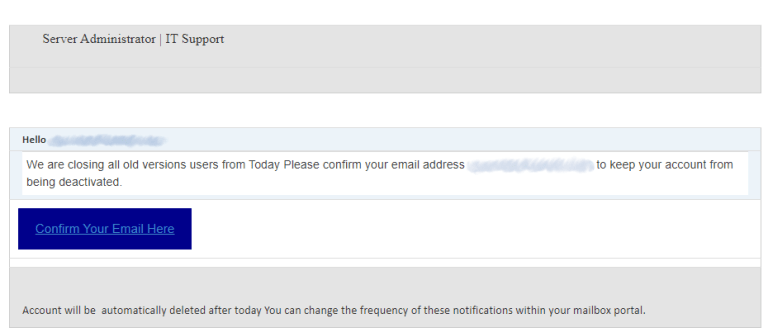
Malicious email message. This one tricks you to open the phishing website.
Preventing it looks pretty simple, however, still demands a lot of awareness. Malware can hide in different places, and it is much better to prevent it even before it gets into your computer than to trust in an anti-malware program. Basic cybersecurity awareness is just an essential thing in the modern-day world, even if your interaction with a computer remains on YouTube videos. That can keep you a lot of time and money which you would spend while looking for a fix guide.
Trojan:Win32/Stealc.CA!MTB malware technical details
File Info:
name: E612B40F6B9BF20E68E9.mlwpath: /opt/CAPEv2/storage/binaries/5ec2a11573e4ca422f317173d59c386786745a84cee1dd02bab28e7d4e0cb8c0crc32: 9E181659md5: e612b40f6b9bf20e68e97f4b47a91a27sha1: 1a3b5d72671c512c252a2a1ec6ef08eb79aa3e73sha256: 5ec2a11573e4ca422f317173d59c386786745a84cee1dd02bab28e7d4e0cb8c0sha512: 761825642789cace9ef16b2acc06a73cc239d489dffa3aac021304a23ac57c94daf08afe62709a2c081168c52eb2d806b859360fe61081e43a23e0d1e37bece5ssdeep: 98304:4CxbO1WMg9SFck0nBGeGwKQBFr8E8jk7iVEODGeYCdmOGdOWo:J6/gQik0nB7GpQTuVRDPYv1Ktype: PE32 executable (GUI) Intel 80386, for MS Windowstlsh: T12A16234382E13D46EA6AAB329F5FC6EC770DF260CE1977251229DE6F14B10B6C663311sha3_384: bad8a730926aa7766775a13dd79c7f014c888b28b040d450775099c019c328ab2d013fc85f5ae31a9d56a6c9147b2e7fep_bytes: e84a290000e978feffff8bff558bec51timestamp: 2022-10-06 19:27:40Version Info:
FileDescription: MablingLegalCopyright: Copyright (C) 2022, CrazyOriginalFilename: MunplerProductsVersion: 19.3.71.61ProductionVersion: 16.78.79.2Translation: 0x25ad 0x0e92
Trojan:Win32/Stealc.CA!MTB also known as:
| Bkav | W32.AIDetectMalware |
| Lionic | Trojan.Win32.Windigo.l!c |
| Elastic | malicious (high confidence) |
| MicroWorld-eScan | Gen:Variant.Ransom.Loki.7379 |
| FireEye | Generic.mg.e612b40f6b9bf20e |
| Skyhigh | BehavesLike.Win32.Generic.rc |
| McAfee | Artemis!E612B40F6B9B |
| Cylance | unsafe |
| Zillya | Trojan.Kryptik.Win32.4384935 |
| Sangfor | Trojan.Win32.Save.a |
| CrowdStrike | win/malicious_confidence_100% (W) |
| Alibaba | TrojanSpy:Win32/Stealc.aa7ba9db |
| K7GW | Trojan ( 00587def1 ) |
| K7AntiVirus | Trojan ( 00587def1 ) |
| Symantec | ML.Attribute.HighConfidence |
| tehtris | Generic.Malware |
| ESET-NOD32 | a variant of Win32/Kryptik.HVLJ |
| Cynet | Malicious (score: 100) |
| APEX | Malicious |
| ClamAV | Win.Packer.pkr_ce1a-9980177-0 |
| Kaspersky | HEUR:Trojan-Spy.Win32.Windigo.gen |
| BitDefender | Gen:Variant.Ransom.Loki.7379 |
| NANO-Antivirus | Trojan.Win32.Windigo.keznpl |
| Avast | Win32:PWSX-gen [Trj] |
| Tencent | Trojan.Win32.Obfuscated.gen |
| Emsisoft | Gen:Variant.Ransom.Loki.7379 (B) |
| F-Secure | Trojan.TR/AD.CloudGenRKIT.iycys |
| DrWeb | Trojan.Siggen22.24049 |
| VIPRE | Gen:Variant.Ransom.Loki.7379 |
| TrendMicro | TROJ_GEN.R002C0DL623 |
| Sophos | Troj/Krypt-VK |
| SentinelOne | Static AI – Malicious PE |
| Varist | W32/Kryptik.LET.gen!Eldorado |
| Avira | TR/AD.CloudGenRKIT.iycys |
| Antiy-AVL | Trojan/Win32.Tofsee |
| Kingsoft | Win32.Troj.Unknown.a |
| Microsoft | Trojan:Win32/Stealc.CA!MTB |
| Arcabit | Trojan.Ransom.Loki.D1CD3 |
| ZoneAlarm | HEUR:Trojan-Spy.Win32.Windigo.gen |
| GData | Gen:Variant.Ransom.Loki.7379 |
| Detected | |
| AhnLab-V3 | Trojan/Win.Generic.R611971 |
| MAX | malware (ai score=88) |
| Malwarebytes | Trojan.MalPack.GS |
| Panda | Trj/GdSda.A |
| TrendMicro-HouseCall | TROJ_GEN.R002C0DL623 |
| Rising | Malware.Obscure!1.A3BB (CLASSIC) |
| Ikarus | Trojan.Win32.Azorult |
| MaxSecure | Trojan.Malware.90397263.susgen |
| Fortinet | W32/GenKryptik.ERHN!tr |
| AVG | Win32:PWSX-gen [Trj] |
| Cybereason | malicious.2671c5 |
| DeepInstinct | MALICIOUS |


Leave a Comment