
Seeing the Trojan:Win32/Morphisil.PM!MTB malware detection usually means that your computer is in big danger. This computer virus can correctly be identified as ransomware – sort of malware which ciphers your files and asks you to pay for their decryption. Removing it requires some peculiar steps that must be taken as soon as possible.
Trojan:Win32/Morphisil.PM!MTB detection is a virus detection you can spectate in your system. It often appears after the preliminary actions on your PC – opening the dubious email, clicking the advertisement in the Web or setting up the program from dubious resources. From the second it appears, you have a short time to do something about it before it starts its destructive activity. And be sure – it is far better not to wait for these harmful things.
What is Trojan:Win32/Morphisil.PM!MTB virus?
Trojan:Win32/Morphisil.PM!MTB Summary
Summarizingly, Trojan:Win32/Morphisil.PM!MTB virus actions in the infected system are next:
- Behavioural detection: Executable code extraction – unpacking;
- SetUnhandledExceptionFilter detected (possible anti-debug);
- Yara rule detections observed from a process memory dump/dropped files/CAPE;
- Presents an Authenticode digital signature;
- Creates RWX memory;
- Guard pages use detected – possible anti-debugging.;
- Dynamic (imported) function loading detected;
- Enumerates running processes;
- CAPE extracted potentially suspicious content;
- The binary likely contains encrypted or compressed data.;
- Authenticode signature is invalid;
- Installs itself for autorun at Windows startup;
- Installs itself for autorun at Windows startup;
- Created a service that was not started;
- Anomalous binary characteristics;
- Encrypting the documents kept on the target’s disk — so the victim cannot check these files;
- Blocking the launching of .exe files of security tools
- Blocking the launching of installation files of security tools
Ransomware has been a headache for the last 4 years. It is hard to imagine a more damaging virus for both individual users and organizations. The algorithms utilized in Trojan:Win32/Morphisil.PM!MTB (usually, RHA-1028 or AES-256) are not hackable – with minor exclusions. To hack it with a brute force, you need to have a lot more time than our galaxy currently exists, and possibly will exist. But that malware does not do all these horrible things instantly – it may require up to several hours to cipher all of your documents. Therefore, seeing the Trojan:Win32/Morphisil.PM!MTB detection is a clear signal that you should start the elimination procedure.
Where did I get the Trojan:Win32/Morphisil.PM!MTB?
Typical methods of Trojan:Win32/Morphisil.PM!MTB distribution are usual for all other ransomware variants. Those are one-day landing websites where users are offered to download and install the free app, so-called bait emails and hacktools. Bait e-mails are a pretty modern strategy in malware spreading – you get the e-mail that imitates some regular notifications about deliveries or bank service conditions shifts. Inside of the e-mail, there is a malicious MS Office file, or a web link which opens the exploit landing page.
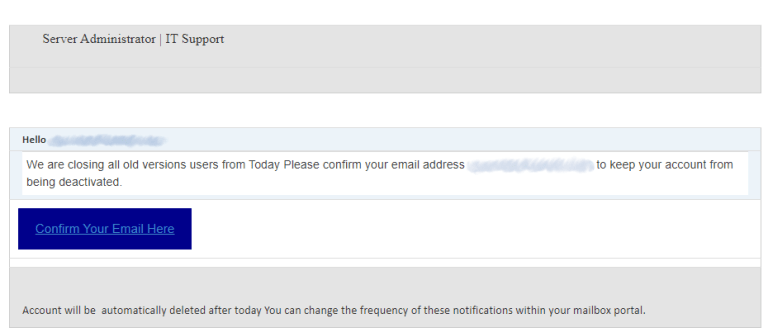
Malicious email message. This one tricks you to open the phishing website.
Avoiding it looks fairly easy, however, still demands a lot of recognition. Malware can hide in different spots, and it is better to prevent it even before it goes into your system than to trust in an anti-malware program. Basic cybersecurity knowledge is just an essential item in the modern-day world, even if your interaction with a computer remains on YouTube videos. That may save you a lot of money and time which you would spend while looking for a solution.
Trojan:Win32/Morphisil.PM!MTB malware technical details
File Info:
name: 50FB4C27E33E43F85BB3.mlwpath: /opt/CAPEv2/storage/binaries/ece5543855c4d2ee5434e28de98cc339277f969166180439232787cc9ffeb12acrc32: D7AE716Fmd5: 50fb4c27e33e43f85bb3fc143199e469sha1: 6afcc05ea2936405ce39d96b325f3c091d806e6csha256: ece5543855c4d2ee5434e28de98cc339277f969166180439232787cc9ffeb12asha512: 061f7e579540e40fefd60836a890aae1f8fa7c65da4f4d324cd257b4eee6968db71f2bdbcb74dfd4cc1a12b9f0f9045c0dd8a345b0465f81d40adbb3835371fdssdeep: 49152:GZu/obYv298ab7By56Z5mMSvwFLOVQYxtHQ/TBZDbz:GqoNjPcv8LOoTbtype: PE32 executable (GUI) Intel 80386, for MS Windowstlsh: T12195F14F24D8E336D6731AB8D9DCC8E950072AEABC418DB1B7B88176B45B872339175Csha3_384: 5d9e68edae39741a220ce515473cb18f4f8aeecd031e15bebcba4cd8133f7f7e25e07550073e8e57e669dc70d087c347ep_bytes: 558bec83ec14c745f401000000c745f0timestamp: 1984-01-30 13:18:53Version Info:
CompanyName: Oracle CorporationFileDescription: Java(TM) Platform SE binaryFileVersion: 8.0.1210.13Full Version: 8.0.121-fcs-b13InternalName: javapackagerLegalCopyright: Copyright © 2016OriginalFilename: javapackager.exeProductName: Java(TM) Platform SE 8ProductVersion: 8.0.1210.13Translation: 0x0000 0x04b0
Trojan:Win32/Morphisil.PM!MTB also known as:
| Bkav | W32.AIDetect.malware1 |
| Lionic | Trojan.Win32.Qshell.4!c |
| Elastic | malicious (high confidence) |
| MicroWorld-eScan | Gen:Variant.Razy.911528 |
| FireEye | Generic.mg.50fb4c27e33e43f8 |
| ALYac | Gen:Variant.Razy.911528 |
| Cylance | Unsafe |
| Zillya | Trojan.Morphisil.Win32.52 |
| K7AntiVirus | Trojan ( 004dbcb71 ) |
| Alibaba | Trojan:Win32/Morphisil.fb12ea76 |
| K7GW | Trojan ( 004dbcb71 ) |
| ESET-NOD32 | Win32/SpamTool.Agent.NGI |
| APEX | Malicious |
| Paloalto | generic.ml |
| Kaspersky | Trojan.Win32.Morphisil.tu |
| BitDefender | Gen:Variant.Razy.911528 |
| Avast | Win32:CrypterX-gen [Trj] |
| Ad-Aware | Gen:Variant.Razy.911528 |
| Emsisoft | Gen:Variant.Razy.911528 (B) |
| DrWeb | Trojan.Ssebot.2 |
| TrendMicro | Trojan.Win32.HANCITOR.YXBK1Z |
| McAfee-GW-Edition | GenericRXPX-WC!50FB4C27E33E |
| Sophos | Mal/Generic-S |
| Ikarus | Trojan.Win32.Generic |
| Avira | TR/SpamTool.bwbgv |
| Antiy-AVL | Trojan/Generic.ASCommon.1BE |
| Microsoft | Trojan:Win32/Morphisil.PM!MTB |
| Arcabit | Trojan.Razy.DDE8A8 |
| GData | Gen:Variant.Razy.911528 |
| Cynet | Malicious (score: 100) |
| AhnLab-V3 | Trojan/Win.Generic.R442504 |
| Acronis | suspicious |
| McAfee | GenericRXPX-WC!50FB4C27E33E |
| MAX | malware (ai score=81) |
| VBA32 | BScope.TrojanRansom.Shade |
| Malwarebytes | Malware.AI.3582823706 |
| TrendMicro-HouseCall | Trojan.Win32.HANCITOR.YXBK1Z |
| Rising | Trojan.Kryptik!1.C73F (CLASSIC) |
| Yandex | Trojan.Morphisil!mmCkU0oDvLE |
| SentinelOne | Static AI – Malicious PE |
| eGambit | PE.Heur.InvalidSig |
| Fortinet | W32/Ursnif.CZ!tr.spy |
| BitDefenderTheta | Gen:NN.ZexaF.34294.7r1@aKaHvCc |
| AVG | Win32:CrypterX-gen [Trj] |
| Panda | Trj/GdSda.A |
| CrowdStrike | win/malicious_confidence_100% (W) |


Leave a Comment