
Spectating the Trojan:MSIL/Disabler.EM!MTB malware detection usually means that your system is in big danger. This malware can correctly be identified as ransomware – virus which ciphers your files and forces you to pay for their decryption. Deleteing it requires some unusual steps that must be done as soon as possible.
Trojan:MSIL/Disabler.EM!MTB detection is a malware detection you can spectate in your system. It often shows up after the provoking procedures on your computer – opening the untrustworthy email, clicking the banner in the Internet or installing the program from unreliable resources. From the second it shows up, you have a short time to take action before it begins its harmful activity. And be sure – it is better not to wait for these harmful actions.
What is Trojan:MSIL/Disabler.EM!MTB virus?
Trojan:MSIL/Disabler.EM!MTB Summary
In total, Trojan:MSIL/Disabler.EM!MTB virus activities in the infected system are next:
- Sample contains Overlay data;
- CAPE extracted potentially suspicious content;
- The binary likely contains encrypted or compressed data.;
- Authenticode signature is invalid;
- CAPE detected the RedLine malware family;
- Anomalous binary characteristics;
- Yara rule detections observed from a process memory dump/dropped files/CAPE;
- Encrypting the documents kept on the victim’s disk drive — so the victim cannot open these documents;
- Blocking the launching of .exe files of anti-malware programs
- Blocking the launching of installation files of anti-malware apps
Ransomware has been a horror story for the last 4 years. It is challenging to imagine a more harmful malware for both individual users and businesses. The algorithms utilized in Trojan:MSIL/Disabler.EM!MTB (typically, RHA-1028 or AES-256) are not hackable – with minor exclusions. To hack it with a brute force, you need more time than our galaxy currently exists, and possibly will exist. But that malware does not do all these unpleasant things immediately – it may require up to a few hours to cipher all of your documents. Therefore, seeing the Trojan:MSIL/Disabler.EM!MTB detection is a clear signal that you need to begin the clearing process.
Where did I get the Trojan:MSIL/Disabler.EM!MTB?
General methods of Trojan:MSIL/Disabler.EM!MTB distribution are typical for all other ransomware examples. Those are one-day landing web pages where users are offered to download and install the free software, so-called bait e-mails and hacktools. Bait emails are a pretty new strategy in malware distribution – you receive the email that simulates some routine notifications about shipments or bank service conditions shifts. Within the e-mail, there is a malicious MS Office file, or a web link which leads to the exploit landing site.
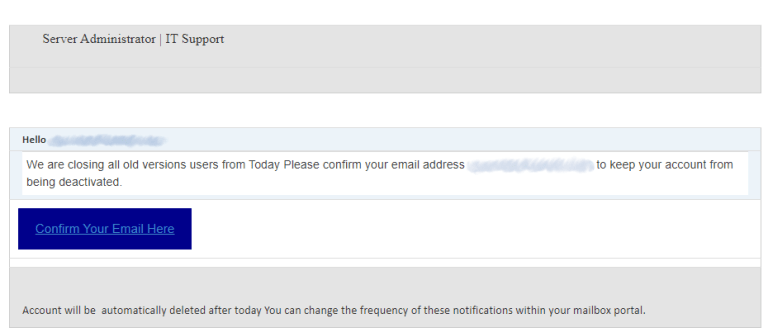
Malicious email message. This one tricks you to open the phishing website.
Preventing it looks fairly easy, however, still demands a lot of awareness. Malware can hide in various spots, and it is far better to prevent it even before it gets into your system than to rely on an anti-malware program. Simple cybersecurity awareness is just an essential thing in the modern-day world, even if your relationship with a PC remains on YouTube videos. That can keep you a great deal of time and money which you would certainly spend while searching for a fix guide.
Trojan:MSIL/Disabler.EM!MTB malware technical details
File Info:
name: FBA6E0C029303B8C8B01.mlwpath: /opt/CAPEv2/storage/binaries/2201cd9411b35fe02f15a111dbb5ff41e8e8e2c8a99a095fff9c4c53c9516da3crc32: 08B0000Emd5: fba6e0c029303b8c8b01e7d0335ac932sha1: 458d1187a07cb8ac08038a1052f76145a171c195sha256: 2201cd9411b35fe02f15a111dbb5ff41e8e8e2c8a99a095fff9c4c53c9516da3sha512: 9fb10d077786fb7568da9a772fcf964c77a851d08763c44b48b4a2a56688bafac907fa0fcf4961b677b4fc84764d4332cdaf2bb598053532089e21eb0149117dssdeep: 3072:1DKW1LgppLRHMY0TBfJvjcTp5XmvTJT00K9ItKcHxaAixOi:1DKW1Lgbdl0TBBvjc/mvTJKmjxutype: PE32 executable (GUI) Intel 80386, for MS Windowstlsh: T1A804AE2171C1C1B3C4B7113044E6CB799E7930724B6A96D7B79D2BBA6E213E1A3352CEsha3_384: f422db1b2308b55ff3c356e125efd6f271f33da43a5fa616df432a8fae6ab46175a3187ecaf4a246d4ed250570ed303bep_bytes: e8e15c0000e9a4feffff8bff558bec83timestamp: 2012-07-13 22:47:16Version Info:
Translation: 0x0000 0x04b0Comments: CompanyName: FileDescription: HealerFileVersion: 1.0.0.0InternalName: Healer.exeLegalCopyright: Copyright © 2023LegalTrademarks: OriginalFilename: Healer.exeProductName: HealerProductVersion: 1.0.0.0Assembly Version: 1.0.0.0
Trojan:MSIL/Disabler.EM!MTB also known as:
| Bkav | W32.AIDetectMalware |
| Lionic | Trojan.Win32.Generic.4!c |
| Elastic | malicious (high confidence) |
| MicroWorld-eScan | Gen:Variant.Zusy.456486 |
| FireEye | Generic.mg.fba6e0c029303b8c |
| McAfee | Artemis!FBA6E0C02930 |
| Malwarebytes | Disabler.Trojan.MSIL.DDS |
| Zillya | Trojan.Generic.Win32.1715080 |
| Sangfor | Trojan.Win32.Save.a |
| K7AntiVirus | Riskware ( 00584baa1 ) |
| Alibaba | Trojan:MSIL/Disabler.40f471bd |
| K7GW | Riskware ( 00584baa1 ) |
| Cybereason | malicious.7a07cb |
| VirIT | Trojan.Win32.Genus.QHN |
| Cyren | W32/Stealer.DF.gen!Eldorado |
| Symantec | ML.Attribute.HighConfidence |
| tehtris | Generic.Malware |
| ESET-NOD32 | a variant of MSIL/Disabler.DR |
| APEX | Malicious |
| Cynet | Malicious (score: 100) |
| Kaspersky | HEUR:Trojan-Spy.Win32.Stealer.pef |
| BitDefender | Gen:Variant.Zusy.456486 |
| SUPERAntiSpyware | Trojan.Agent/Gen-MSIL |
| Avast | Win32:TrojanX-gen [Trj] |
| Tencent | Trojan.MSIL.Disabler.kb |
| Sophos | Troj/Ransom-EWQ |
| F-Secure | Heuristic.HEUR/AGEN.1323756 |
| DrWeb | Trojan.Siggen20.47790 |
| VIPRE | Gen:Variant.Zusy.456486 |
| TrendMicro | TROJ_GEN.R002C0DEN23 |
| McAfee-GW-Edition | BehavesLike.Win32.Generic.cc |
| Trapmine | malicious.high.ml.score |
| Emsisoft | Gen:Variant.Zusy.456486 (B) |
| Ikarus | Trojan.MSIL.Disabler |
| GData | Gen:Variant.Zusy.456486 |
| Avira | HEUR/AGEN.1323756 |
| Antiy-AVL | Trojan[Backdoor]/Win32.Bladabindi |
| Arcabit | Trojan.Zusy.D6F726 |
| ZoneAlarm | HEUR:Trojan-Spy.Win32.Stealer.pef |
| Microsoft | Trojan:MSIL/Disabler.EM!MTB |
| Detected | |
| AhnLab-V3 | Trojan/Win.Generic.R577297 |
| BitDefenderTheta | Gen:NN.ZexaF.36250.lq1@aCzs@Tf |
| ALYac | Gen:Variant.Zusy.456486 |
| MAX | malware (ai score=80) |
| VBA32 | Backdoor.Bladabindi |
| Cylance | unsafe |
| Panda | Trj/Genetic.gen |
| TrendMicro-HouseCall | TROJ_GEN.R002C0DEN23 |
| Rising | [email protected] (RDML:P2bzYsEhkkQsfKEQKbaoSw) |
| Yandex | Trojan.Agent!XRl4Ng+lFe0 |
| SentinelOne | Static AI – Suspicious PE |
| MaxSecure | Trojan.Malware.300983.susgen |
| Fortinet | W32/PossibleThreat |
| AVG | Win32:TrojanX-gen [Trj] |
| DeepInstinct | MALICIOUS |
| CrowdStrike | win/malicious_confidence_100% (W) |


Leave a Comment